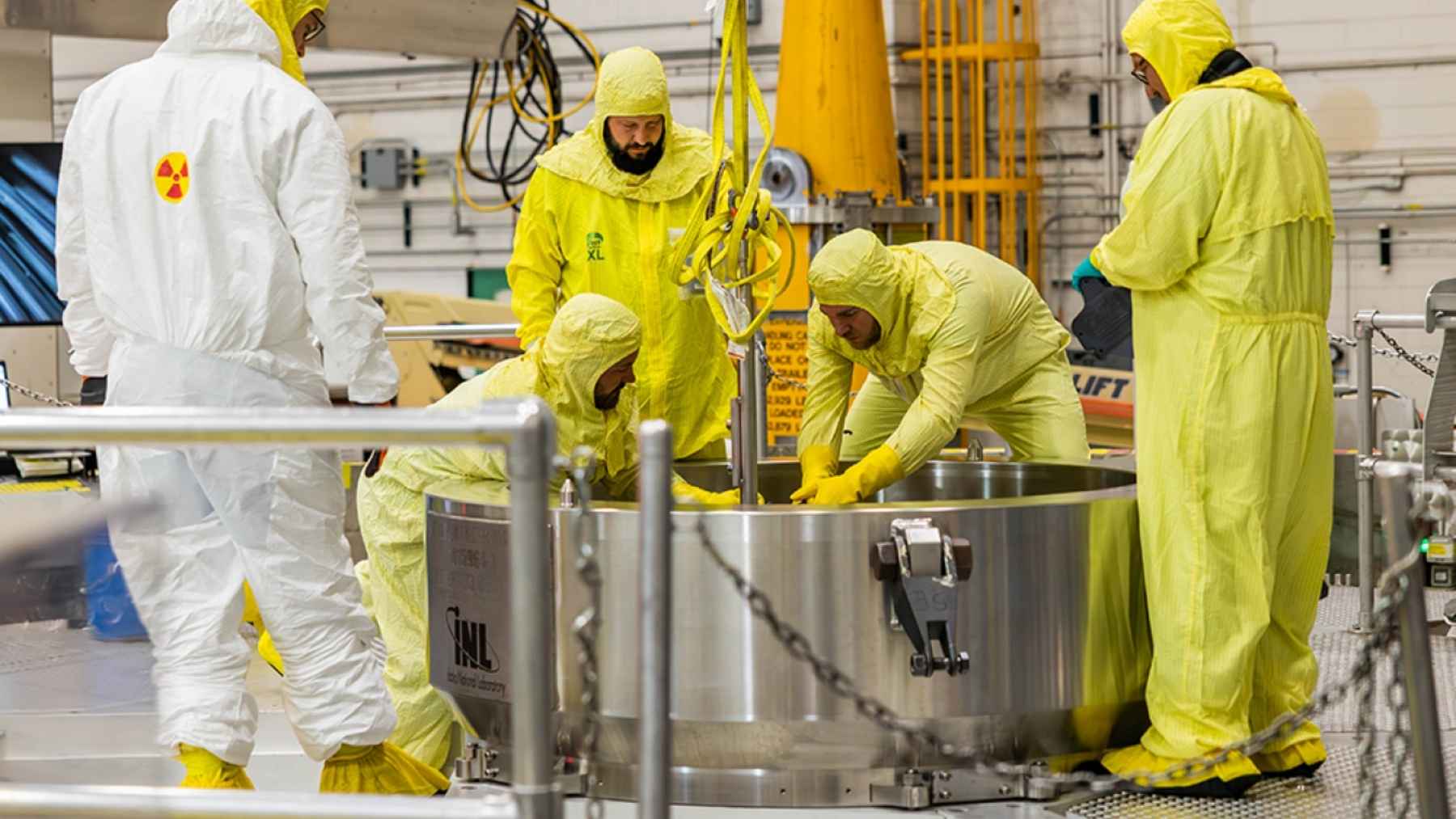

If you’ve ever shopped for a halfway decent kitchen knife, you’ve probably seen a Rockwell hardness number printed somewhere on the box. The test behind that number is pretty simple. A machine pushes a hard tip into the steel and measures how far it sinks.
Oak Ridge National Laboratory has been doing a version of that with nuclear fuel. Only its target is about the size of a poppy seed, and it’s already spent time inside a reactor.
On September 3, the Tennessee lab said it had finished mechanical measurements on irradiated TRISO fuel particles. The silicon carbide shell inside those particles came out with a lower hardness and a lower modulus, which is the engineer’s word for stiffness.
ORNL’s team ran the tests on an indentation setup the lab uses for fuel and materials that have been irradiated, and it went layer by layer. That meant the inner and outer layers of pyrolytic carbon (a dense carbon coating deposited from a gas) and the silicon carbide sandwiched between them. Both carbon layers changed as well. ORNL’s announcement doesn’t say in which direction.
So what’s a TRISO particle?
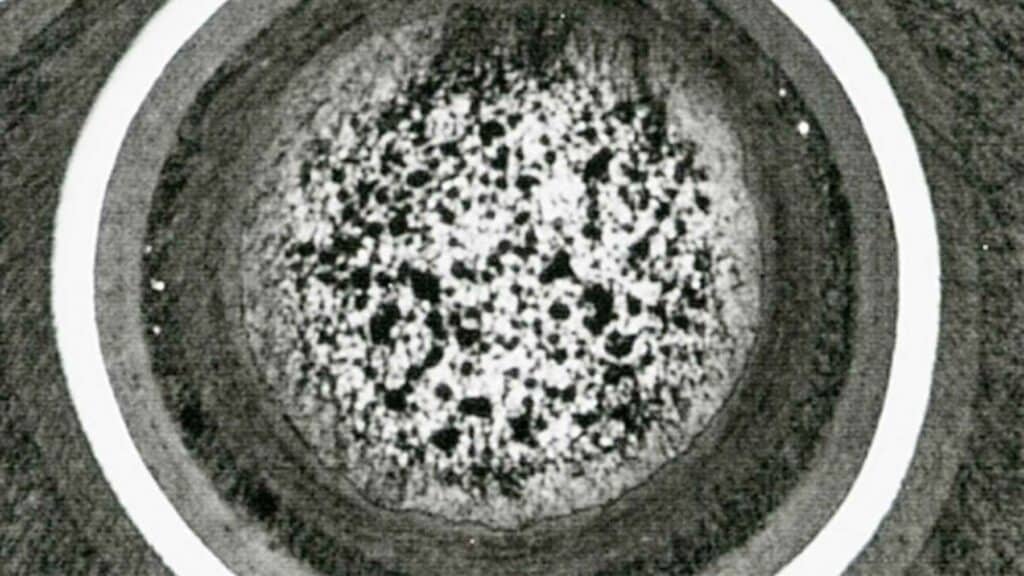
TRISO is short for tristructural isotropic, which is a mouthful, so you’ll rarely hear anyone say the full name. At the center of each particle there’s a kernel of uranium fuel. Around it go four coatings: a porous carbon buffer, the inner pyrolytic carbon, the silicon carbide and the outer pyrolytic carbon.
Fuel in a regular American power plant sits inside long metal tubes, and those tubes do a lot of the work of keeping radioactive material where it belongs. A TRISO particle basically carries its own miniature version of that containment. ORNL describes the silicon carbide as the barrier that stops fission products (the radioactive leftovers of splitting uranium) from getting out, both in normal operation and in an accident.
The Department of Energy is confident enough in the design to call it “the most robust nuclear fuel on Earth” in its own TRISO explainer. That’s a pretty bold line for a government website, but I get why they went with it.
These particles don’t go into a reactor loose. They get pressed by the thousand into fuel forms, and the particle ORNL photographed for its announcement came from a test program called AGR-2. Here’s how that fuel stacks up, going from the shell outward.
Source: Idaho National Laboratory, AGR-2 Irradiation Test Final As-Run Report.
According to Idaho National Laboratory’s as-run report on AGR-2, that test kept its capsules inside the lab’s Advanced Test Reactor for about three and a half calendar years. Which means the particle in that photo has done some serious time.
So why go to all this trouble with fuel that’s already been through a reactor?
Because a reactor changes the material. Neutrons spend years knocking atoms out of place, the fuel runs hot the whole time, and what comes out isn’t quite what the factory shipped. A fresh particle on a lab bench only tells you what got made. Engineers predicting how fuel will behave in a real core need property numbers from the far end of that process. Frankly, those are the only numbers I’d want in my model.
ORNL’s Katherine Montoya, an R&D associate staff member in the lab’s Particle Fuel Forms group, said the point is to line up what a particle looked like fresh from manufacturing against what it turns into after running at different temperatures and burnups. “These data improve nuclear fuel performance models,” she said.
Burnup, if you haven’t run into the term, is basically how much of the fuel’s uranium has already been split. INL measures it as fissions per initial heavy-metal atom, and the uranium oxycarbide compacts in AGR-2 finished somewhere between 7.26% and 13.15%.
So is the fuel in trouble?
Probably not, at least going by anything ORNL has said. A layer measuring lower hardness isn’t the same thing as a particle that cracks or leaks, and ORNL’s announcement doesn’t claim any particle failed. For what it’s worth, INL’s report says it found nothing that definitely pointed to a failed particle while AGR-2 was in the reactor. The report also notes that gas-flow problems partway through the test meant it couldn’t rule a failure out completely.
What I’d really like to see is the size of the change. ORNL hasn’t said how much softer the silicon carbide got, which compacts the tested particles came from, or what temperature and burnup those particles reached. Presumably that shows up once the full data gets published, but I can’t find it anywhere yet.
The fuel is also HALEU, which ORNL made a point of flagging. That’s high-assay low-enriched uranium, enriched to between 5% and just under 20% uranium-235, according to the DOE. The reactors already running in the US use fuel at 5% or less, and the DOE says most US advanced reactor designs need HALEU instead.
TRISO keeps turning up in new places
If the name sounds familiar, you’ve probably seen it here before. It’s the fuel behind a Tennessee plant being built to press it into uranium spheres the size of billiard balls, and it’s what’s packed into the compacts for the Pentagon’s transportable microreactor.
Every one of those projects leans on the coatings behaving the way the models say they will. I’d argue measurements like this one matter a lot more to those reactors than any ribbon-cutting does. They’re just much harder to photograph.
ORNL’s neutron scattering work in February went after the chemistry inside HALEU TRISO particles. This time the lab went after how hard and stiff their coatings are, and it posted those results on September 3.