
Cars come off assembly lines. So do tractors, dishwashers, and jet engines. Nuclear reactors never have. Every commercial reactor on the American grid was built where it runs, as a one-off construction project licensed as a unique piece of infrastructure.
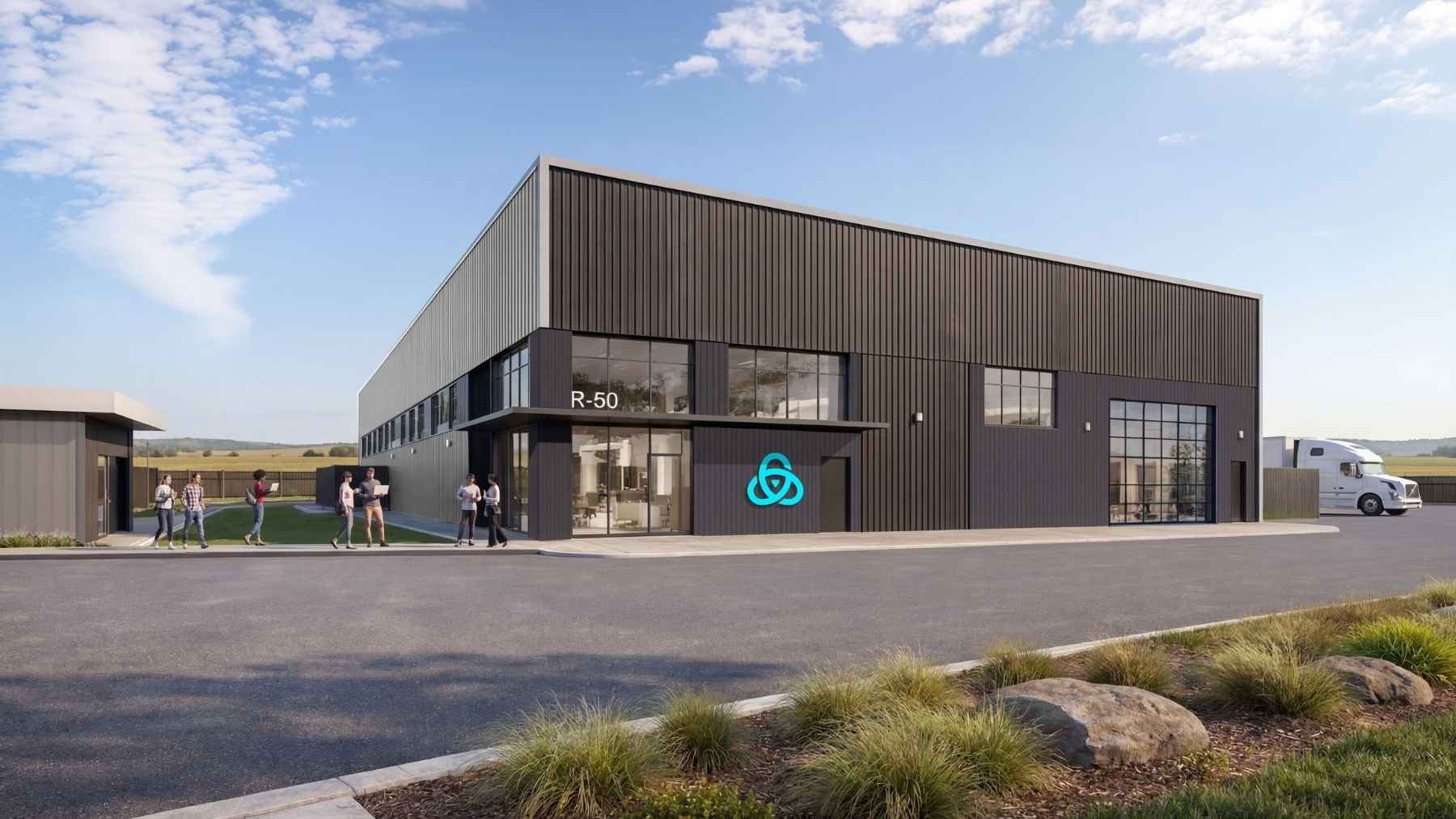
Radiant, a California startup founded in 2020 by engineers out of SpaceX, is betting the next generation won’t work that way. The company is putting up a factory in Oak Ridge, Tennessee, designed to turn out up to 50 sealed microreactors a year and ship them to customers on trucks.
And the Nuclear Regulatory Commission has agreed to review the license for that factory on an accelerated eight-month schedule, with a target date of December 18. If the timeline holds, America enters 2027 with the world’s first licensed reactor assembly line.
The NRC put a reactor factory on an eight-month clock
On May 5, the NRC formally accepted for review Radiant’s 10 CFR Part 70 license application for the R-50 Production Facility. Acceptance is not approval. It means the paperwork is complete enough for the agency to start a detailed technical evaluation of the plant’s design, safety basis, and operating programs.
The schedule is the story. A Part 70 review normally runs about 18 months. The NRC committed to finishing this one in eight, roughly 55% faster, and agency documents cited by the American Nuclear Society put the target completion date at December 18, 2026.
“This accelerated review reflects the NRC’s commitment to enabling advanced reactor technologies,” NRC Chairman Ho K. Nieh said in the agency’s announcement.
Part 70 governs the possession and use of special nuclear material, which in this case means enriched uranium. For a reactor factory, it’s the license that matters most. Without it, Radiant can weld together as many reactor shells as it likes and can’t put fuel in any of them. With it, the company gets to build and operate the fueling building at R-50 and load its reactors before they ever leave the plant.
Nobody in this corner of the industry has gotten that far. Radiant says it’s the first microreactor company to reach a Part 70 review at all.
The factory is going up on Manhattan Project land
Radiant announced the Oak Ridge site in October 2025, with Tennessee Governor Bill Lee on hand, after scrapping an earlier plan to build in Wyoming. The land covers portions of the historic K-27 and K-29 sites, purchased from the Oak Ridge Industrial Development Board. Eighty years ago, this ground enriched uranium for the Manhattan Project.
The company is putting $280 million into the buildout, which Tennessee’s economic development department says will create 175 new jobs in Roane County. Construction kicked off in early 2026, backed in part by a $300 million funding round Radiant closed late last year. The name R-50 nods to both the site’s heritage and the production target: 50 reactors a year at full capacity, with the first factory-built unit due in 2028.
Oak Ridge is quietly becoming the capital of small nuclear all over again. Kairos Power broke ground there in April on the first molten-salt reactor the NRC has ever cleared for construction, and Standard Nuclear, the outfit fabricating Radiant’s fuel, works out of the same town.
The industrial argument for the factory is the same one carmakers settled a century ago. Build the same machine over and over in one place and you squeeze out the variation, the defects, and the cost that come with doing everything as a custom job in a field. Radiant’s regulatory filings make exactly that case, promising assembly-line production insulated from the one-off problems that have made American nuclear construction famously slow and expensive.
The product fits in a shipping container
Kaleidos, the machine this factory exists to build, is a high-temperature gas-cooled reactor that produces roughly 1 megawatt of electricity from a 3-megawatt-thermal core, per the NRC’s project page. It can also supply up to 1.9 megawatts of usable heat for jobs like facility heating or water desalination.
The fuel is TRISO: uranium kernels wrapped in ceramic coatings that Radiant says can survive 1,600 degrees Celsius, enriched to HALEU levels. Helium carries heat out of the core, and helium doesn’t become radioactive, so a coolant leak isn’t a radiological event. Outside the core, fans and an air jacket handle cooling through natural convection.
There is no water anywhere in the system, which is a big part of why the thing can be parked in a desert, a mountain village, or next to a data center that never got a grid connection. One megawatt is enough electricity for roughly 1,000 homes, by the company’s own math.
The whole package, reactor, generator, and shielding included, fits inside a standard shipping container and moves by road, rail, sea, or air. A unit runs five or more years on one fuel load. When the fuel is spent, the container goes back to Tennessee for a reload, up to four times across a 20-year service life. Hundreds of deployed units would stream data back to a central monitoring room, closer to how a fleet operator watches its trucks than how a utility babysits a plant.
Which is the actual pitch. You don’t service a Kaleidos on site. You swap it, the way a rental company swaps out a generator that’s due for a rebuild. Radiant has spent years framing it as a diesel generator replacement for remote sites, hospitals, military bases, and data centers, and the order book reflects that: a 20-unit deal with data center operator Equinix and an agreement to deliver a reactor to a US Air Force base.
The fuel is already sitting in Idaho
While the factory review runs its course, the reactor itself is about to face its first real exam. On July 1, Radiant received its first shipment of TRISO fuel at the DOME test bed at Idaho National Laboratory, fabricated by Standard Nuclear to the company’s specifications.
That fuel will feed a five-phase test campaign this summer: zero-power criticality, then 1 megawatt thermal, then full power, then full heat, and finally a minimum of 150 hours at full power without operator intervention. Pass all five and Radiant owns a validated product instead of a very detailed rendering.
“We are de-risking a commercial product that will be manufactured and delivered within 18 months,” said Dr. Rita Baranwal, Radiant’s chief nuclear officer, in the fuel announcement.
The Idaho campaign feeds straight back into the Tennessee review. The test unit runs the same fuel form and specifications as the commercial reactors, and Radiant says the data will support the Part 70 application for R-50. One test, two regulators fed.
Radiant did skip one party, though. Four other microreactors reached criticality by July 4 under the Department of Energy’s pilot program, a sweep that started when America took three brand-new reactors critical inside a single month. One of those companies, Valar Atomics, has already wired its Utah reactor to an Nvidia AI chip live on stage. So Radiant is behind on the criticality photo op, and ahead on the thing photo ops don’t capture. Nobody else has a factory sitting in front of federal reviewers.
Plenty can still go sideways. The NRC review includes a full safety evaluation and an environmental assessment, and acceptance guarantees neither. The commercial Kaleidos design will also need its own separate NRC license down the road, a process the factory application doesn’t touch.
But the sequencing here is unusual for this industry. By December 18, Radiant will know whether it can legally fuel reactors in Tennessee. By the end of summer, it should know whether its reactor can run 150 straight hours in Idaho. If both answers come back yes, that 2028 delivery date stops being a slide in a pitch deck. Nobody has ever mass-produced a nuclear reactor. The first attempt now has a deadline you can circle on a calendar.
 @raybroz ROOKIE1 month ago