
The old way to deal with a sea mine is to put a ship directly on top of it. You build the hull out of fiberglass so it doesn’t trip the magnetic fuze, you crawl along at walking pace, and the crew spends the entire shift inside the blast radius. Belgium and the Netherlands have been doing it like that with Tripartite-class minehunters since the 1980s.
The replacement does the opposite. Oostende (M940), first of twelve ships in the joint Belgian-Dutch rMCM program, runs 82.6 meters long, or 271 feet, and displaces 2,800 metric tons. It is far too big and far too noisy to go anywhere near a live mine, and that is the entire design. It holds off outside the danger area and sends machines in instead.
The Belgian Navy took delivery in November 2025 and christened the ship at Ostend on June 24. Its first sea trials with the full kit aboard ran in early June, in Douarnenez Bay off the coast of Brittany.
There is a stranger piece to this, though. For most of this year the same work has been run out of a shipping container parked on a dock in Zeebrugge, with no ship involved at all.
The ship is a garage
Exail, the French robotics firm that designed and built the unmanned half of the program, published the inventory when it handed the first toolbox over at Zeebrugge. Nine systems in that first set, according to Exail’s own delivery spec.
Two Inspector 125 surface drones. Three A-18 autonomous underwater vehicles carrying UMISAS 120 synthetic aperture sonar. Two mine identification and destruction systems built around the Seascan and K-Ster C vehicles. And two Saab Skeldar V-200 rotary drones.
Two T-18 towed sonars were listed on the same sheet as planned for the second quarter of 2026. The influence dredger, five magnetic modules and one Patria acoustic module dragged as a single unit, was listed as 2026 with no quarter attached to it.
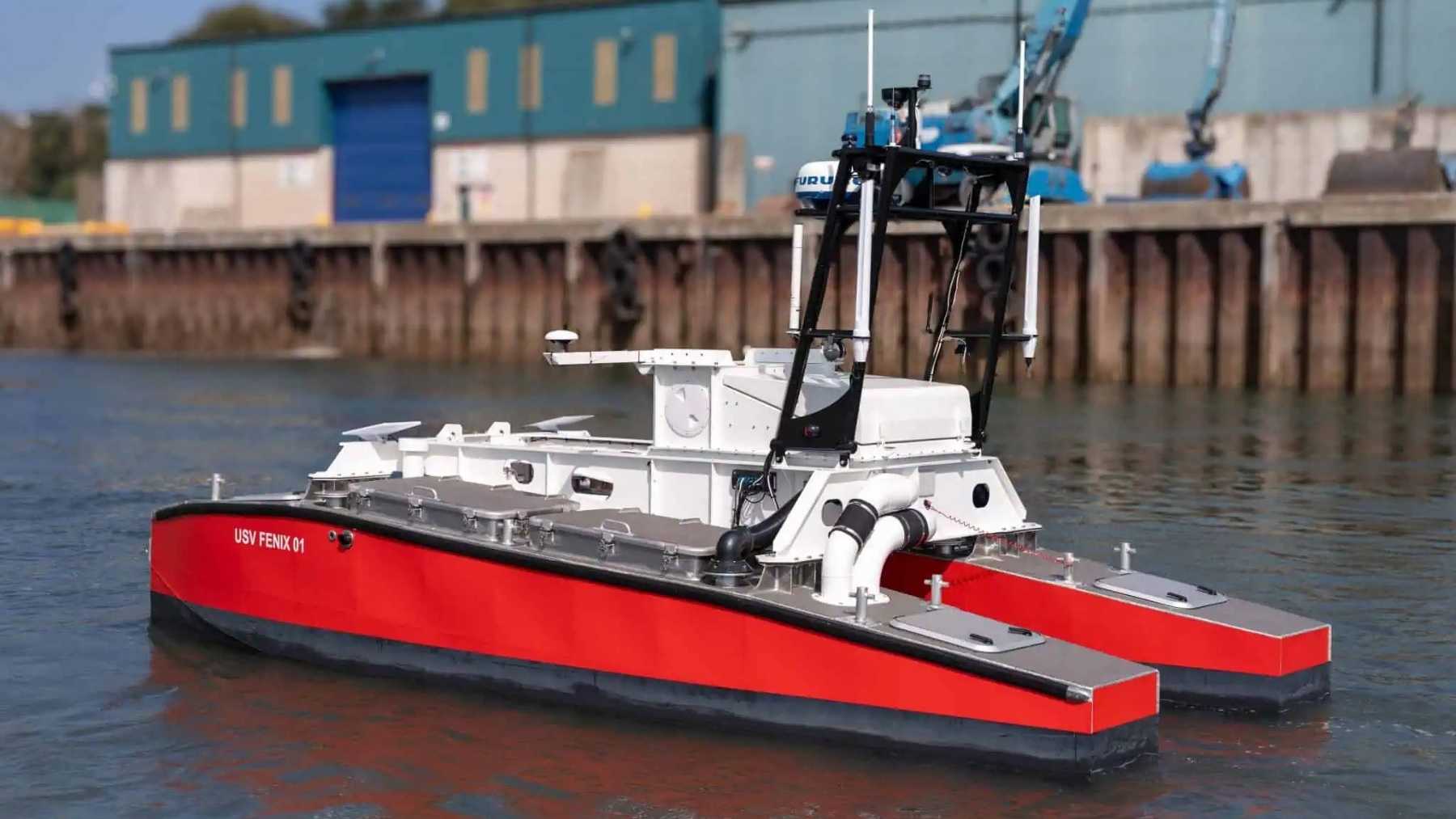
People tend to underestimate the Inspector 125. It runs about 12 meters and 19 metric tons, so call it 39 feet and 21 US tons. That makes it a proper boat rather than a toy.
It is also a mothership in its own right. It hauls the underwater vehicles out to the search box, puts them in the water, and relays what they find back to the ship.
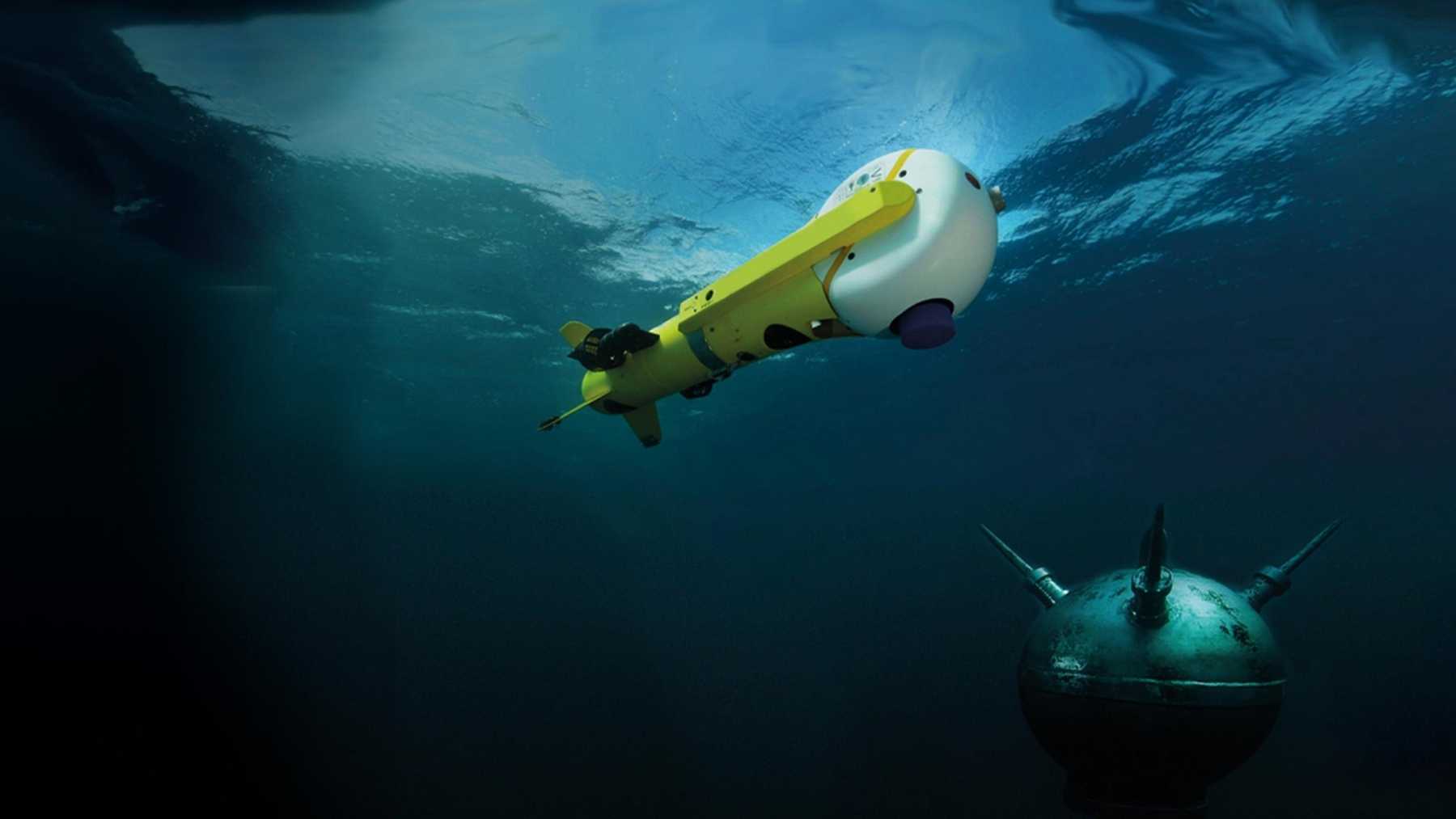
At the sharp end are the two ROVs. Seascan drops down, looks the object over with a camera and a reacquisition sonar, and comes home. The 110-pound K-Ster C, which tilts its own head at the mine rather than pointing its body at it, does not come home.
Naval News has reported each full toolbox is specced for four Seascans and up to 40 K-Sters, which tells you plainly which of the two the planners expect to spend.
The program was awarded in 2019 to Belgium Naval & Robotics, a consortium of Naval Group and Exail, under a contract Naval Technology put at €2 billion, roughly $2.4 billion. Twelve ships, six per navy, around 120 unmanned systems in total. Most of the robots come out of Exail’s factory in Ostend.
The control room comes off the ship
Belgium’s Ministry of Defence announced on February 17 that the navy had been running its drones from a containerized command post on land, validated during trials at Zeebrugge in January.
Inside the box, operators work at consoles almost identical to the ones fitted aboard the ships. That is deliberate: the crew that trains on the dock relearns nothing when it walks up the gangway.
The trials tested more than the machines. Belgian Army engineers set up the protected perimeter, and operators spent time on link configuration and antenna alignment, because a busy port is a lousy radio environment and a dropped link to an autonomous boat is not a minor inconvenience.
Commander du Bus de Warnaffe, who heads the Mine Countermeasures Module Group, framed the appeal to Army Recognition as using the same capability “from a ship, from the quay, or even in a foreign port.”
Belgium now wants a permanent shore setup at Zeebrugge with a bigger antenna on a port structure, so it can watch its own waters without sending a crewed ship out every time.
The sequence matters here, and the press releases blur it. The container came first largely because the ship was not ready. Naval Today described the June trials as the moment the work moved off the shore-based container and onto the vessel for real. The land-based command post was a stand-in that turned out to be useful on its own terms.
The robots work. The software is the problem
Commander Pierre Van Engeland, the Belgian Navy’s program manager for rMCM, gave the most useful status update anyone has offered publicly at the Combined Naval Event in June, reported by Naval News. Summing up the single biggest obstacle, he named “software integration on board the ship and with the tools.” Not the drones. The wiring between them.
The A-18 is apparently doing fine. Van Engeland rated the first synthetic aperture sonar imagery very highly, then immediately flagged the catch: nobody has worked out how to handle the sheer volume of data the thing produces. A sonar that images the seabed at centimeter resolution across wide swaths generates a mountain of imagery, and someone has to look at it.
Launch and recovery is also not finished. The requirement is to put the surface drones over the side and get them back in Sea State 4, and the crews are not there yet. Full automatic launch and recovery is not there either, so for now there is a human sitting aboard the Inspector 125 while it works.
The Skeldar V-200 is the odd one out. As of late June it was still restricted to training ashore, waiting on qualification for automatic takeoff and landing from a moving deck, with industry trials expected over the summer.
Van Engeland’s explanation was blunt and slightly funny. The concept of operations was written around mine countermeasures gear, and this thing is a helicopter, with all the certification and maintenance overhead a helicopter drags behind it.
Then there is the simulator, which program staff nicknamed the thirteenth ship. It went into the NATO Mine Warfare Centre of Excellence at Ostend in late 2024, but the software update that would let crews actually train on the systems is running late. So Belgian sailors are learning on the live hardware first and the simulator second, which is exactly backwards from the plan.
Two delivered, ten to go
Vlissingen (M840), the first ship for the Royal Netherlands Navy, was handed over at Den Helder on February 27. Nine more are in various stages of build. First steel for the eleventh ship was cut in early May, and the twelfth is meant to start before the end of this year, with the full dozen due by 2030.
Belgium’s second ship, Tournai (M941), had been scheduled for handover in March 2026. As of the June program update, two ships had been delivered, not three.
The lead ship has had a rough first year alongside, too. On the evening of February 3, smoke was noticed aboard Oostende at Zeebrugge, two days after she came out of dry dock. Defence Minister Theo Francken told the Belgian parliament the selective catalytic reduction unit in the exhaust had overheated, that there was no fire and no injuries, and that Bruges firefighters cooled the hot zones down.
He called the incident remarkable and pointed at the sabotage arrests then under way in Germany.
A month later there was an actual fire on board. In May, answering a parliamentary question, Francken said the technical investigation had turned up no indications of sabotage in either case, and that the fire traced back to insulation fitted incorrectly around the funnel. Which is a duller answer, and a more expensive one, since bad insulation on ship one usually means checking ships two through twelve.
The same kit now fits in a nine-meter inflatable
The interesting thing about this architecture is how far down it scales. On July 15 Exail announced a contract with an unnamed European navy for three light mine countermeasures systems built into 9.5-meter rigid-hulled inflatables, about 31 feet apiece.
Each boat carries three Seascan and K-Ster vehicles in whatever mix the mission calls for, a drone piloting console, a launch-and-recovery berth and an acoustic positioning system, all running the same Umisoft software as the big ships. Crew of three. It is aimed at very shallow water and at places with no naval infrastructure to speak of, where an 82.6-meter ship is not showing up.
So the same toolbox now comes in three sizes: a 271-foot warship, a box on a dock, and an inflatable with three people in it.
Exail’s maritime systems boss, Jérôme Bendell, has claimed the consortium is “the first in the world to bring such a fully robotic mine warfare capability.” That is the kind of line a vendor says and nobody outside the program can easily check.
Belgium is not doing this because it has a large navy. The country has 67 kilometers of coastline, about 42 miles. It is buying six robotic minehunters because the ports behind that coastline move a serious share of northern European freight, and a handful of mines in the wrong channel would shut them.
America has landed somewhere different on the same problem, building around a 26-pound expendable drone fired from a sonobuoy tube, while European yards are still arguing over what should power the next drone submarines.
What has to happen by December
Van Engeland set the target himself: an end-to-end mine countermeasures capability demonstrated from the ship before the end of 2026. That means the towed sonars aboard and working, the Skeldar cleared to land on a moving deck, launch and recovery holding up in Sea State 4, and the software tying all of it into one picture.
Four of those five are hardware problems with known answers. The fifth is not, and it is the one the program manager singled out himself.
Belgium has bought the machines and proved it can run them from a dock, from a ship, and soon from an inflatable. What it has not shown yet is all of them working together through one full mission, from first detection to a mine on the bottom in pieces, with nobody stepping in to bridge a gap in the middle.