
Defense companies love a spec number that does the selling for them. Germany’s Greyshark drone submarine got a great one last year, when the hydrogen version was rated for sixteen weeks underwater, and the internet took it from there. That figure has been quoted in more places than the company has vehicles.
The number that actually decides whether a machine like that gets built is smaller, duller and a lot harder to invent. It sits on a purchase order.
Bremen-based Euroatlas told Reuters, reporting from the Baltic coast at Damp, that it had signed its first two contracts with European defense ministries. Combined value: more than 100 million euros, about 116 million dollars. Chief executive Eugen Ciemnyjewski would not say which two countries, beyond noting that they work closely together.
He did say the drones will not be weaponized and are headed for what he called a special military application. He declined to elaborate, which in this business usually means the answer is interesting.
Eight months on, that quiet transaction has aged better than almost anything else in German naval procurement. In June, Berlin canceled a frigate program that had already burned roughly 2.3 billion euros without delivering a ship. The 3.5-metric-ton robot from Bremen kept its calendar.
Two European governments signed, and nobody will say which
Euroatlas is not a startup in the garage sense. It has been building power electronics and optical systems for naval programs out of Bremen for more than 60 years, and it developed the Greyshark line in roughly 18 months by buying maturity instead of engineering it from scratch.
Ciemnyjewski put the reason plainly to Newsweek during a Baltic demonstration in November: “In the past, we had a lot of time, but no money.” European defense budgets flipped that around, and the company built to the new constraint.
What can be verified about the two contracts is thin, and worth saying out loud. The 100 million euro figure comes from the company, not from a published tender. Neither buyer has been named, no delivery schedule is public, and there is no breakdown between vehicles, spares, training and support.
One structural detail does matter for anyone tracking who can sell what to whom. The Greyshark is ITAR-free, meaning it contains no US-controlled components, so exporting it to a NATO ally or an Asian customer does not require a decision in Washington. For a European ministry trying to buy fast, that removes an entire approval layer that American hardware drags along with it.
Rheinmetall got into shipbuilding, then Berlin canceled the ships
In August 2025, Rheinmetall and Euroatlas announced a partnership to fold the Greyshark into Battlesuite, Rheinmetall’s modular digital command layer, plus joint work on future mission-specific variants. At the time it read like a distribution deal. A small Bremen firm gets a sales force with a Düsseldorf letterhead.
Then Rheinmetall started buying yards. It closed its acquisition of Naval Vessels Lürssen on March 1, 2026, picking up four northern German shipyards and around 2,100 people, and folded them into a new Naval Systems division.
The plan was for that division to take over the F126, Germany’s six-frigate program. It did not survive the summer. On June 24, the Defense Ministry scrapped the whole thing, citing delays and foreseeable cost increases, and is buying eight smaller MEKO A-200 frigates from TKMS instead.
The receipts are ugly. Roughly 2.3 billion euros had already gone into design, software and construction work under Dutch prime contractor Damen Schelde. The ministry calculated that finishing the job would have pushed the total past 18 billion euros against an original program value near 10 billion.
Rheinmetall shares fell as much as 13 percent on the news. Chief executive Armin Papperger later told Der Spiegel in early July that the cancellation “caught us completely off guard,” and the company has since frozen plans to add 1,000 naval shipbuilding jobs.
Which reorders the picture if you follow defense industrials. Rheinmetall’s big crewed-ship bet collapsed in a single Wednesday, and the small uncrewed line it signed up to sell and integrate last August is the part still on schedule.
Sixteen weeks is real, but only if it crawls
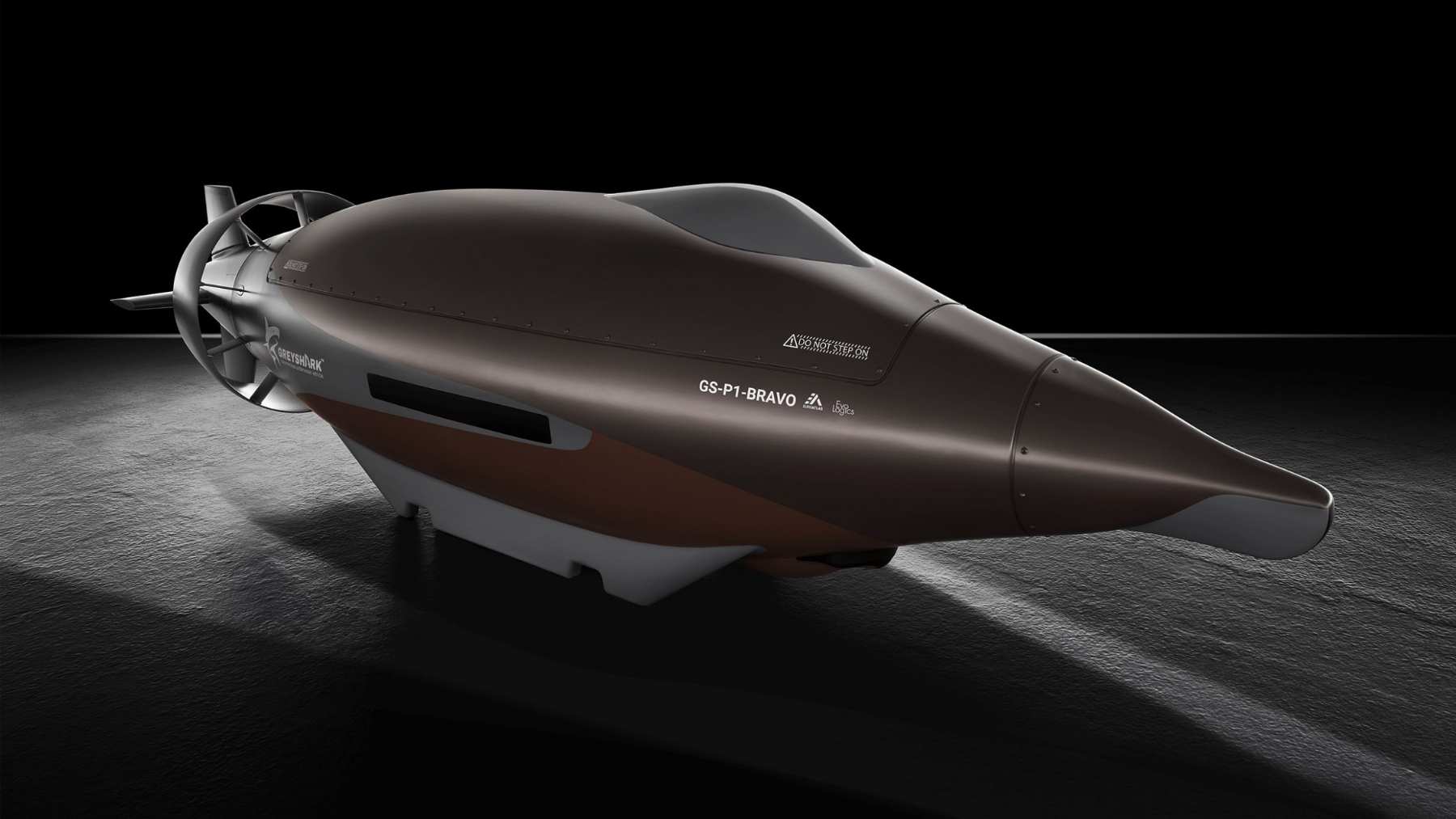
The Greyshark comes in two hulls that look identical and behave nothing alike. Bravo is 21 feet long, weighs about 3.5 metric tons, runs on lithium-ion cells and has been production-ready since late 2025. Foxtrot stretches to 26 feet and roughly 4.5 metric tons because it has to carry a hydrogen fuel cell and its tank.
Both share the same 17-sensor payload: synthetic aperture sonar, multibeam sonar, electromagnetic sensing, optical cameras and laser imaging. Both can rewrite their own mission underwater without surfacing, so a cable inspection run can turn into a submarine hunt on the strength of what the sonar just heard.
The endurance claim is where reporting has been sloppiest, including in places that should know better. At the UDT show in London in April, Euroatlas head of strategy Verineia Codrean told Janes the Foxtrot’s sixteen weeks equates to about 8,000 nautical miles, or roughly 9,200 land miles, at four knots.
Four knots is 4.6 mph. That is slower than you walk to the mailbox.
Push the same vehicle to its 10-knot maximum and hold it there, and Codrean said endurance collapses to six days. Sixteen weeks and six days are the same tank, the same fuel cell and the same hull. The difference is entirely how hard you ask it to work, which is exactly the tradeoff anyone who has watched a battery gauge on a highway already understands.
The fuel cell itself is lifted from the automotive industry rather than developed bespoke, and that is the actual reason Euroatlas can talk about building 150 of these a year. Car-industry fuel cells are the only ones on Earth made in volumes that make a 150-unit run look like a rounding error.
Foxtrot only left dry land this spring. Codrean described the April in-water runs as the milestone they were, because until then the propulsion and systems had been tested on land at technology readiness level four. Testing moved on to the Seabed Security Experimentation Centre off Rostock the following week.
There is one loose thread the company has not tried to hide. Chief technology officer Thiago Camargo told Janes that the recirculation pump keeping the Foxtrot’s fuel mix stable makes noise, and that engineers are still working out whether it hands the vehicle a detectable acoustic signature in certain states. He rated it not much louder than Bravo’s electric drive and added, “So far it’s not been a problem.”
For a vehicle whose entire pitch is sitting on the seabed unnoticed, that is not a trivial thread. It is also the kind of thing you only find out by putting the thing in salt water, which is what April was for.
Germany’s own navy bought someone else’s robot first
The Greyshark is German, built by a German consortium, with a composite hull from the 175-year-old Fassmer yard and an AI and acoustic-networking stack from EvoLogics in Berlin. So it is worth noting who the German Navy actually took delivery from this year.
On February 25, at the Eckernförde naval base, Israel Aerospace Industries and TKMS handed over the first BlueWhale, a 36-foot, 5.5-ton autonomous vehicle rated to 300 meters with an endurance of two to three weeks. The German Navy calls it the largest uncrewed underwater vehicle it operates.
Vice Admiral Jan Christian Kaack, the head of the German Navy, made a point of how fast it happened, saying the service relied on proven technology already on the market and got it done “in just a few months instead of years.” Read that as a compliment to the procurement process and a message to everyone still in development.
Euroatlas has not lost that race so much as it is running a different one. The German Navy took Bravo to NATO’s REPMUS exercise off Sesimbra last September, and a German military source described the vehicle to Newsweek as a useful asset. A signature at the bottom of a domestic order is still outstanding.
Portugal in late August is the next honest test
The demand side is not in doubt. NATO’s Baltic Sentry patrols have been running since January 2025 after a run of anchor-dragging incidents took out cables between Finland, Estonia, Sweden and Lithuania, and the alliance has been buying seabed robots at a pace that would have looked absurd in 2021.
Brussels moved money too. On February 5, the European Commission reallocated 347 million euros to submarine cable projects, published a Cable Security Toolbox and named 13 priority cable routes, noting that 99 percent of intercontinental internet traffic runs through these things.
Everyone is now building for that market. Britain commissioned a mothership designed to lower drones onto seabed cables through a hole in its own hull, Norway funded a robotic snake that lives on the bottom for six months, and Australia went the opposite way from Euroatlas with a container-sized drone sub built from commercial parts and sold on price rather than endurance.
REPMUS 2026 runs in Portugal from August 31 to September 25, and Codrean has confirmed the program is heading there. That is five weeks out, and it is the first event where a hydrogen Foxtrot could plausibly be worked in front of NATO evaluators rather than described to them.
None of this equals a navy with a robot on station. The first two customers are still anonymous, the sixteen-week figure is still a target rather than a completed run, and that pump still makes a sound somebody has to sign off on. What Euroatlas has that most of the field does not is a signed order and a hull in the water at the same time. Set against the frigate program Germany just wrote off, that is not a low bar so much as the only one anyone cleared.
 simonrockman DRIVER2 months ago