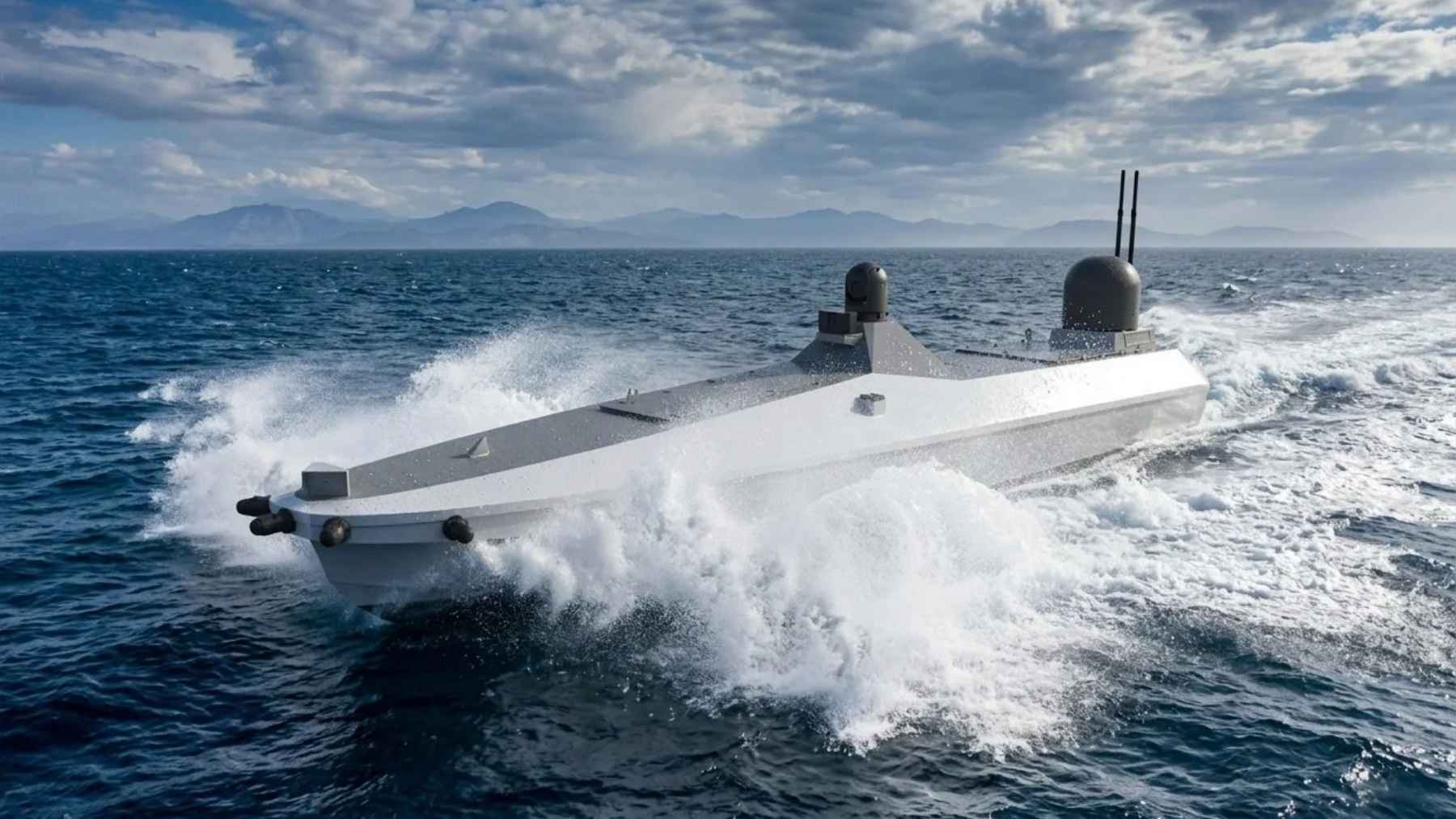

A rigid inflatable boat is about the least intimidating thing a navy owns. Roughly 31 feet of hull, a fat rubber collar around the outside, an outboard hanging off the back, normally used to move people between a warship and a pier or run a boarding team somewhere in a hurry.
In July, a French robotics company sold an unnamed European navy three of them fitted out to find sea mines and destroy them.
Exail announced the contract on July 15 from Ostend, Belgium. It did not name the customer, did not publish the value, and did not give delivery dates. What it did lay out is the load-out on each boat: the company’s UMIS mine countermeasures package built into a 9.5-meter hull, a drone piloting console, a launch-and-recovery berth, an acoustic positioning system, and three underwater vehicles carried in whatever mix the mission calls for.
Three people run all of it.
Exail is pitching the package at very shallow water and at places with no port infrastructure worth the name, which is where a conventional minehunter stops being useful. That is not an abstract sales pitch this year. Clearance and mine-surveying work is still under way across the Strait of Hormuz, with confirmed mine sightings, according to the July 19 advisory note from UKMTO and the Joint Maritime Information Centre. Britain has already sent a single 12-meter drone boat into the strait to do that job with nobody aboard.
The robot that actually kills the mine is the one you never get back
Mine clearance runs in stages, and most of the hardware that gets written about handles the early ones. A towed sonar or an autonomous vehicle sweeps a stretch of seabed and flags anything that looks wrong. Something else goes and has a proper look, because the bottom is full of oil drums, engine blocks and rocks that all read like mines on a sonar screen. Only at the end does anything go and touch it.
The two vehicles in this contract cover those last two stages. The Seascan is the inspector, a battery-powered ROV that Exail rates to 300 meters, fitted with a forward-looking reacquisition sonar and three high-definition cameras, sending its pictures home down a thin optical fiber rather than dragging a conventional umbilical around. It comes back.
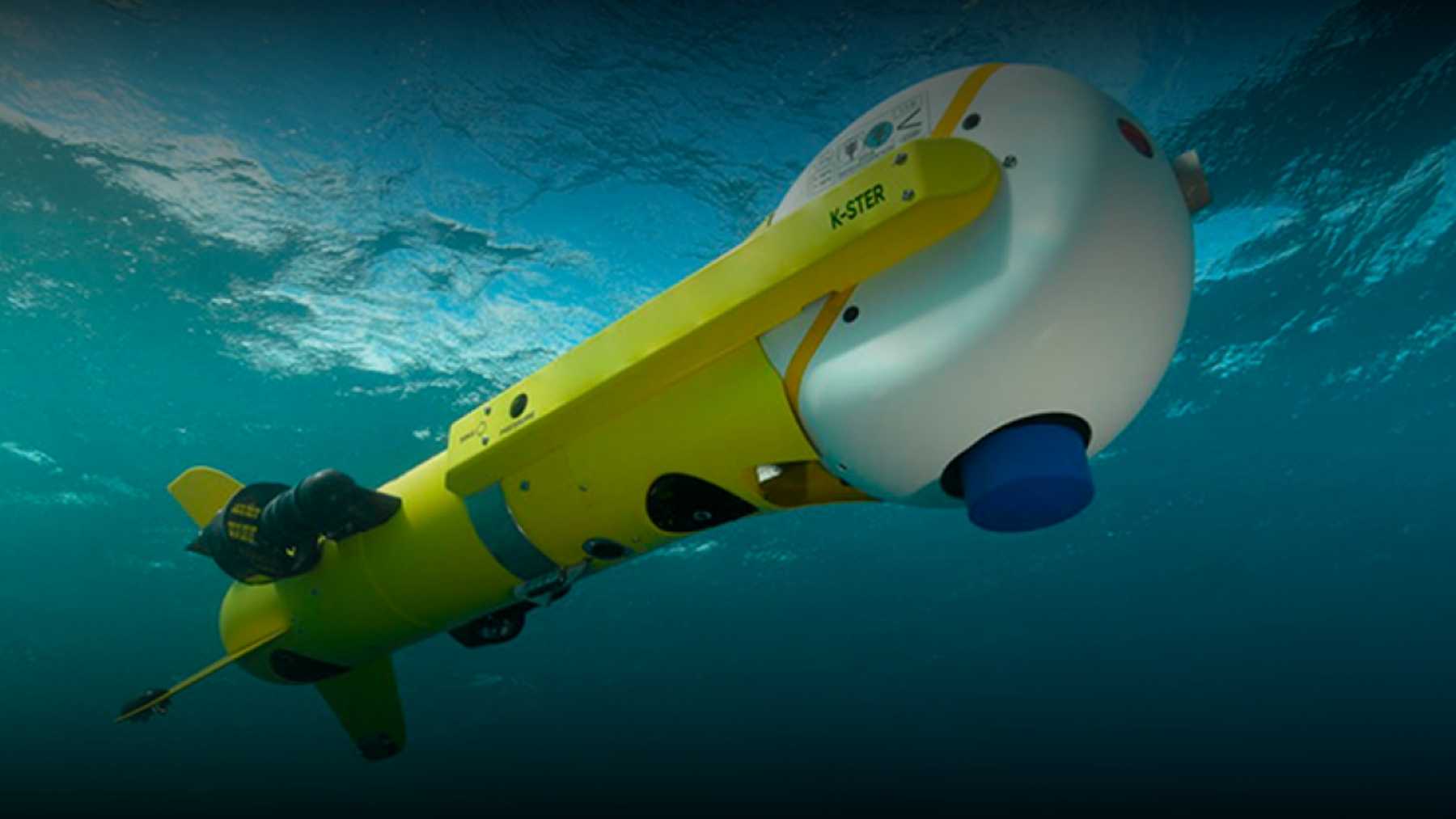
The K-Ster C does not. It swims to the mine, sets itself up, fires a shaped charge, and is destroyed along with the target. Exail describes it as an expendable vehicle and sells it that way, which means every mine a customer clears is another unit off the production line. Naval News, covering an earlier order, described the K-Ster as a consumable drone that generates recurring revenue across the life of a UMIS system.
The head tilts 90 degrees each way, and that is the whole trick
The interesting engineering on the K-Ster C is not the propulsion or the sonar. It is the front end. Exail’s product page describes a patented tilting head that swings from minus 90 to plus 90 degrees, with the shaped charge and its highly insensitive explosive filling housed inside.
Aiming the warhead instead of the vehicle is what lets one design work against everything. The operator holds the robot in a stable hover and points the charge, rather than maneuvering the whole hull into position on top of the target. Exail lists the coverage as bottom ground mines, floating moored mines, historical ordnance and modern smart mines, four very different geometries for one warhead.
The safety architecture assumes the thing will be handled by people in a small boat. Insensitive ammunition, multi-pole interlocks that stay engaged until the final firing command, and a separate variant called the K-Ster CT that carries an inert warhead so crews can train without live explosives on deck.
Exail says the design and qualification have been assessed by France’s DGA/IPE and by the relevant authorities at the British and Singaporean defense ministries. It does not publish dimensions. The Defense Post, citing Exail, put the vehicle at 1.5 meters long, 50 centimeters wide and 50 kilograms, rated to 300 meters, with a 2,000-meter range and a top speed around 6 kilometers per hour.
Two thousand meters is the number that matters on a boat this size. It is the distance between the three people driving and the explosive.
A 9.5-meter boat gets into water a 2,800-ton minehunter cannot
It is tempting to read this as robots replacing a warship. That reading is wrong, and the difference matters.
The current European benchmark is the Belgian-Dutch rMCM program, twelve ships awarded in 2019 to Belgium Naval & Robotics, the consortium of Naval Group and Exail, on a contract worth about €2 billion. Belgium’s Oostende was handed over in November 2025. The Dutch Vlissingen followed on February 27, 2026 at Den Helder, with the rest due by 2030. Each hull runs 82.6 meters, displaces 2,800 metric tons and has accommodation for 63.
Those 63 people do not go into the minefield either. The City and Vlissingen-class ships are stand-off motherships, and the robots they launch are largely the same Exail family. So the three-person boat is not a cheaper way to keep sailors alive. It is the tail end of that same kill chain, unbolted from the expensive platform it normally lives on.
Where it wins is geography and logistics. A 2,800-ton ship needs water under it and a berth to come home to. A 9.5-meter inflatable can be trailered, lifted onto a larger vessel or run out of a fishing harbor, and it works the shallow approaches, port entrances and infrastructure sites where the big hull is the wrong shape. Shallow water is where most mine-hunting robots quit, which is why other builders have gone as far as putting tank tracks on one to crawl through the surf.
The acoustic gear reflects that. Shallow water is awkward for underwater positioning, because a vehicle a few hundred meters out in ten meters of water sits almost horizontal from the boat tracking it, and most ultra-short baseline systems are built to look down. Exail’s Gaps series, the USBL fitted to these boats, is marketed on exactly that horizontal tracking, from extremely shallow water down to 4,000 meters.
Exail notes that the same boat can be configured to carry its A9-M autonomous underwater vehicles, its R7 ROV or small third-party drones. None of that is in this order. They are options.
Exail told its own investors this contract is a small one
The regulated statement Exail Technologies filed with the market alongside the announcement is more candid than the press release. It describes the deal as smaller in scope than the mine countermeasures programs the group has won since 2024, while calling it a new reference for its light drone systems.
That is a fair description of the position. Exail’s mine warfare business has been running on large orders: nearly €60 million through the NATO Support and Procurement Agency in August 2024 for K-Ster C disposal vehicles, K-Ster CT training rounds and associated kit for the Belgian and Dutch navies, then roughly €40 million more through the same agency on January 6 of this year for several hundred additional units. Production runs out of the Ostend plant, inaugurated in 2022. Buying small mine-hunting hardware by the hundred is not a European habit either, as the US Navy’s rolling orders for a 10-foot survey drone keep showing.
The K-Ster itself is not new. Naval News traces it to 2008, when Exail was still ECA Group, built on the older French PAP mine disposal vehicle. Operators include the Lithuanian Navy and the Republic of Singapore Navy.
The company’s July 23 quarterly update put second-quarter revenue at €144 million, up 17% organically, with first-half revenue of €275 million and a backlog above €1 billion. Order intake is the more relevant line for a contract like this one: €116 million in the quarter, with half-year intake down 63% year on year, which Exail attributes to the timing of notifications on its big maritime robotics programs rather than to demand.
Three boats will not move that needle. A product line that navies can buy in ones and twos, without a shipbuilding program attached, might.
“Navies need MCM capabilities that are faster to deploy, easier to operate,” said Gregory Leclercq, a business developer at Exail, in the company’s announcement.
Thales signed for the whole company two days ago
All of this is happening while Exail changes hands. Thales announced on July 6 that it had agreed to buy the Gorgé family’s 35.51% stake at €134 per share, a 44% premium to the price before the process became public on June 25, implying an enterprise value of €3.9 billion, or roughly $4.5 billion.
Safran had been there first. It announced exclusive negotiations on June 26 at €128.50 a share, and on July 3 both companies said the talks had ended without agreement.
On July 30 the two companies signed the tender offer agreement itself, announced the following morning, with the €134 price and every other term unchanged from the July 6 deal. Exail’s board appointed Ledouble as independent expert to produce a fairness opinion.
Nothing has closed. The purchase of the Gorgé stake is expected in the third quarter of 2027, subject to antitrust and regulatory clearance, and the tender offer for the remaining shares and bonds by early 2028 at the latest. That is a long runway for a company currently shipping mine disposal robots into an active clearance operation.
None of it touches the boats. The contract is signed and the hardware is off the shelf. The only genuinely new part is the packaging.
Exail will not say what three of these systems cost or who bought them, and until somebody publishes a number, any claim that this is cheaper than a minehunter is guesswork. What is verifiable is the shape of the thing. The same robot Exail builds by the several hundred for NATO now ships on a boat you could tow behind a truck, run by three people. For a navy trying to keep a harbor open this year, that is a much easier purchase order to sign than a 2,800-ton ship it has to wait until 2030 for.