
Almost everything the Navy buys is built to come home. Aircraft get refueled and flown again, a torpedo that misses gets logged as an expensive lesson, and a drone boat that takes a hit usually gets craned back aboard and argued about later.
Raytheon’s Barracuda is built on the opposite idea. It goes out once, finds one sea mine, and dies with it.
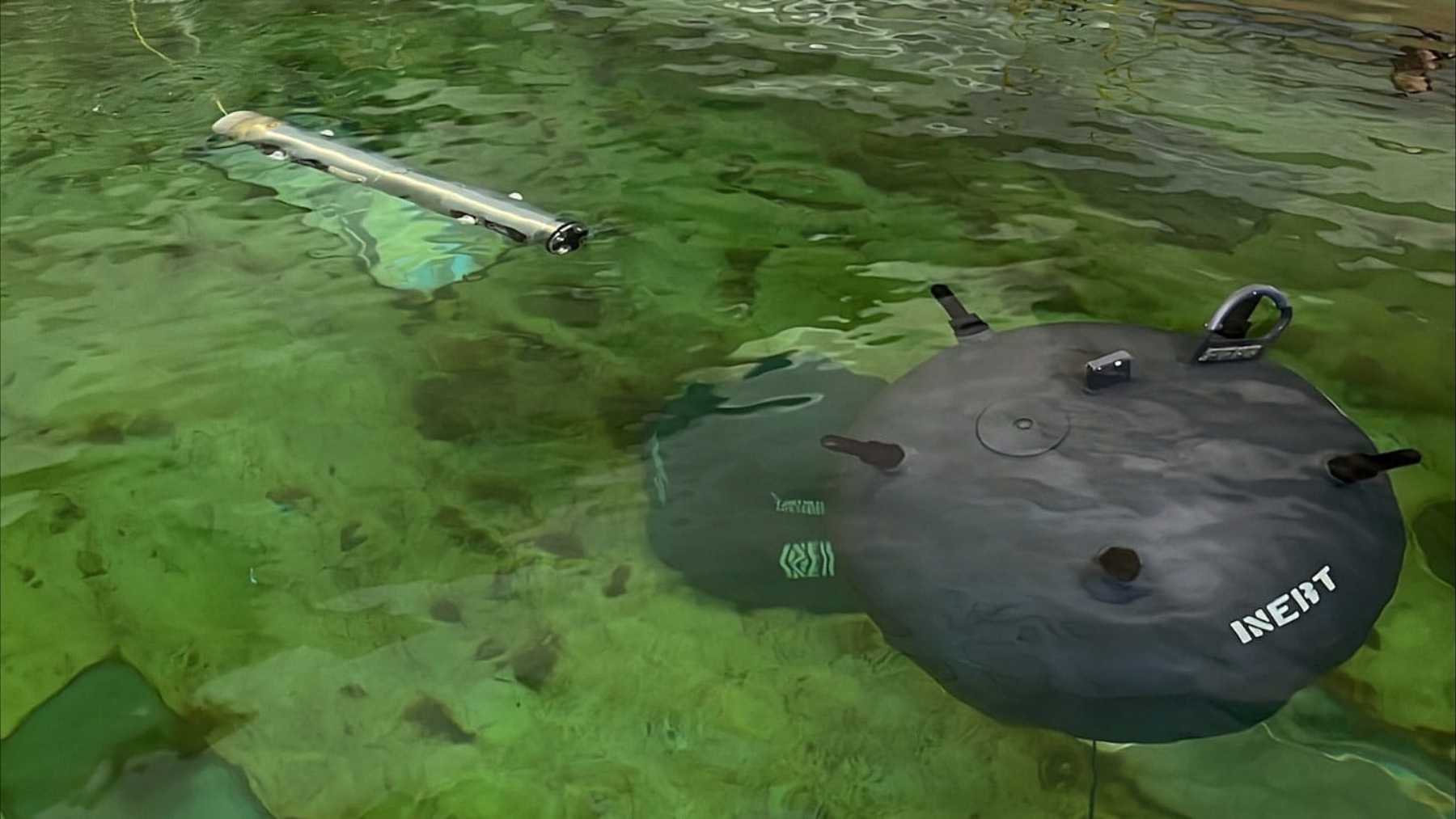
That is the entire product. A 26-pound robot, 48 inches long, packed into a tube the size of a sonobuoy, fired at a suspicious lump on the seabed and spent on purpose. One robot, one mine, nothing recovered.
The Navy has been paying for it since 2018 and it is still not in the fleet. And with mine clearance in the Strait of Hormuz still unfinished this summer, Raytheon’s own public materials currently give three different answers for when it actually shows up.
A sonobuoy tube, four water jets and one charge
The Navy designation is AN/WSQ-46. The shape is closer to a fat dart than a submarine.
According to Seapower magazine’s account of the system, the vehicle weighs 26 pounds, runs 48 inches long and sits in a tube sized to the Navy’s A-size sonobuoy standard. Four small water jets do the pushing.
The launch does not start with the Barracuda. It starts with the AN/AQS-20C towed sonar dragging behind a drone boat, painting the seabed and flagging something metal. That flagged position is the datum, and the Barracuda gets fired at it.
On the way out it drops an acoustic communications buoy and stays tethered to that instead of to a ship. The buoy passes navigation data down and mission status up, which is how the vehicle keeps talking to people who are nowhere near it.
Then the nose does the work. A sonar and a camera feed pictures back while the robot holds position on the target, and an operator sitting a long way off looks at what it found.
If the answer is yes, the vehicle steers into the mine and detonates. There is no second run. Each one is a single charge and a single sortie.
The human is still the slow part, and that is on purpose
Barracuda can navigate on its own, hold station on its own and identify a target on its own. What it cannot do is decide.
Raytheon is explicit about that. Its product page describes a human operator stationed well away from the mine making the final neutralization call using the data the vehicle sends up.
The Navy’s own fact file on the drone boat that carries the thing uses careful wording too, describing autonomous reacquisition of mine-like objects followed by operator-directed destruction. Autonomous up to the trigger, human at the trigger.
Seapower’s description of the kill chain slipped in a two-word caveat that is worth noticing: the man in the loop is there, in its phrasing, “for now.”
Nobody involved is pretending the loop is free. It costs time, it costs a comms link that has to survive salt water and noise, and it costs a person who has to be awake and looking at a screen when the picture arrives. It buys you a weapon that cannot start a war by accident, which most navies consider a fair trade.
France went the other way and got there first
The French version of this problem got solved with a wire and it got solved years ago.
Exail’s K-Ster C is also expendable and also blows up with the mine, but it stays connected to its controlling craft and swings a tilting head through 90 degrees in either direction to aim the shaped charge rather than aiming its whole body. We went through that design in detail recently, and the short version is that the wire is a feature, not a compromise.
The commercial scoreboard is not close. Exail announced a contract worth about $47 million (€40 million) in January 2026 for several hundred K-Ster C units, its second-largest order for the type after a roughly $70 million (€60 million) NATO deal in 2024, with the vehicles built at its plant in Ostend, Belgium.
America chased the harder version. Cutting the wire is genuinely a better answer if it works, because a tether limits how far your killer can go and gives you something to snag. Raytheon says Barracuda is the first untethered, semi-autonomous mine neutralization system able to track and identify bottom, volume and near-surface mines.
It is also the one that is not in service yet.
Raytheon’s website gives three different arrival dates
This is where it gets strange, and none of it requires a leak. All three numbers are sitting on rtx.com right now.
The AN/AQS-20C sonar page pairs the sonar with Barracuda and says the neutralizer is “expected to be deployed by 2026.”
The company’s October 2024 news release on hydrodynamic testing said the program would go into low-rate initial production in 2027.
Then the July 2025 release on the first untethered swim in Narragansett Bay put initial operational capability and the start of low-rate production in 2030.
None of that means anyone is being cute. Defense schedules slip constantly, product pages go stale, and a marketing line written in 2023 can survive on a website long after the program it describes has moved.
What it does mean is that the honest public answer to “when does America get a wireless mine-killer” is a four-year range, and the freshest formal number is the far end of it.
The volume of hardware involved is small by defense standards. Raytheon’s original 2018 award was $83.3 million with options that could take it to $362.7 million, and Seapower reported the company will supply 85 engineering development models for the Navy’s own test program.
Hormuz did not wait
All of this would be an ordinary acquisition story if the requirement had stayed theoretical. It stopped being theoretical in early 2026.
The four Avenger-class minesweepers homeported in Bahrain, wooden-hulled ships built to work inside a minefield, were decommissioned in 2025 after more than three decades each. Their replacement is a trio of aluminum littoral combat ships that carry the mine countermeasures mission package and have to stand outside the danger area while robots do the swimming.
The Pentagon’s testing office is not sold yet. Its fiscal 2025 annual report, released in March 2026, said it could not determine the operational effectiveness or suitability of the Independence-variant ship with that package because the Navy had not supplied enough data from operational employment. The report also noted no additional operational tests of that combination were conducted in fiscal 2025.
Meanwhile the water itself is still not clear. Lloyd’s List Intelligence figures reported by USNI News on July 31 put transits through the Strait down 52.4 percent week over week in late July, with daily crossings in the single digits and two ships on July 23.
Allied navies have been filling the gap with their own robots. Britain has been running uncrewed minehunting into the same chokepoint, and we covered the single 12-metre drone boat it sent to do it, which tells you how thin crewed minehunting has become on both sides of the Atlantic.
Barracuda is not in that fight. It is in Narragansett Bay.
The weapon is the production line
Raytheon is already thinking past the mine. The company says it is investing in a larger vehicle built on Barracuda technology with more depth, range, endurance, speed and payload, aimed at subsea and seabed warfare rather than mine clearance.
That is the sensible commercial move, and it is also a tell. The interesting part of this design was never the warhead. It was the idea that you can build an underwater robot cheap enough to throw away, which is the same argument now being made about torpedoes.
The arithmetic is what should worry anyone. A Congressional Research Service report cited by Navy Times put Iran’s mine stockpile at close to 6,000. Barracuda kills one per unit, and the Navy’s own test program involves 85 of them.
So the number that decides whether this weapon matters is not how clever it is at 200 feet. It is how many a plant in Rhode Island can press out in a month, and whether anyone orders enough of them before the next chokepoint gets seeded.