
Consumer drones are basically flying cameras. You buy a DJI, you charge it, and it hovers politely over your backyard until the battery dies.
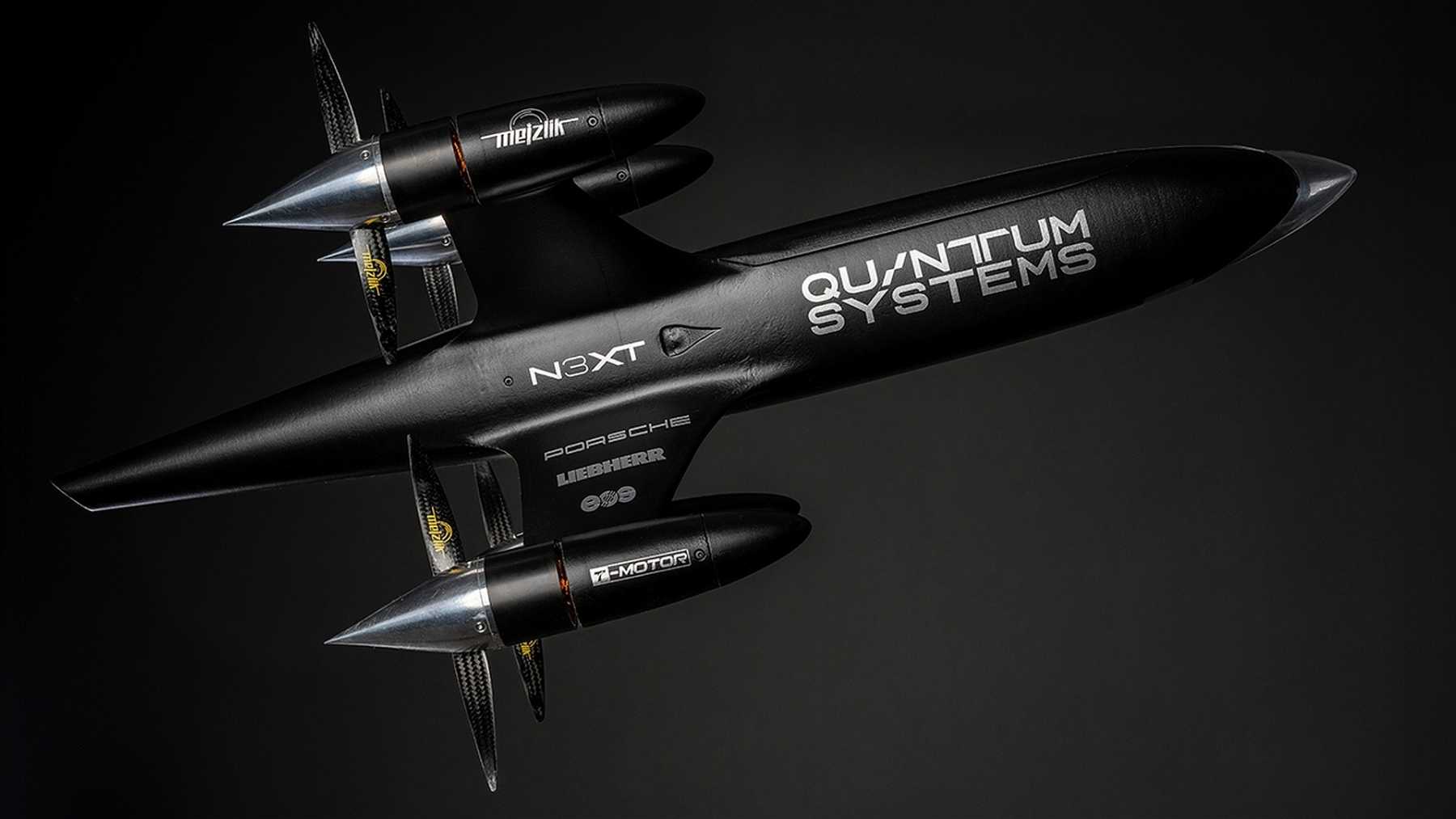
A German outfit called Quantum Systems took the same basic idea, battery and motor and propeller, and pushed it to a speed that would have any commercial quadcopter shedding parts mid-air. Their Apex Recordhunter reportedly hit 434 mph in level flight.
And the whole point of the exercise isn’t shipping burritos. It’s ramming Shahed-style kamikaze drones out of the sky over Ukraine.
During internal testing on June 26, the company’s German N3XT team clocked the Apex Recordhunter at 699 km/h (434 mph) in straight and level flight, per European Security & Defence. That’s an unofficial world best for a battery-electric flying object, and the Munich-area firm now wants it certified, with a formal FAI-standard attempt lined up in the coming weeks.
The number that actually matters
For a sense of scale, the benchmark in manned electric aviation is Rolls-Royce’s Spirit of Innovation, which held the crown for years at 555.9 km/h (345 mph) after dethroning a Siemens-powered Extra 330 LE. Apex Recordhunter clears that by nearly 90 mph, without a pilot on board.
The quadcopter world has its own separate record: South African father-son duo Luke and Mike Bell hit an official 657.59 km/h (409 mph) with their 3D-printed Peregreen V4 in Cape Town last December. But that’s a different category, a four-rotor helicopter-style build rather than the fixed-wing Apex, so the two aren’t strictly racing each other on paper.
The catch, as always, is certification. Guinness and the FAI both require a certified independent observer, calibrated measurement gear, a formal submission, and a controlled two-way run before anything counts as “official.” Quantum flew this in internal testing, so for now the 434 mph number sits in the same limbo as every other unratified drone claim. The company says the paperwork run is imminent.
This isn’t a hobbyist project
Quantum Systems isn’t a bunch of hobbyists gluing carbon fiber together in a garage. The Apex Recordhunter’s battery cells come from V4Smart, a Porsche subsidiary, and the company has been explicit that the drone is a technology demonstrator whose lessons will feed directly into next-generation interceptors and get field-tested in Ukraine.
That’s a very specific supply chain: German defense engineering, Porsche-affiliated battery chemistry, and a Ukrainian arm doing the ugly real-world testing.
Quantum is also not a stranger to the war it’s building for. The company already supplies Ukraine with its Vector reconnaissance drone, and it’s been testing a separate interceptor called the Jäger, which uses a combined electric-and-rocket drive to hit 4,000 meters in 30 seconds and kill NATO-class target drones out to 25 km on a hit-to-kill basis, no explosives.
Robert Gardemin, from the N3XT development arm, framed the June 26 flight as a starting point rather than a finish line. He called 699 km/h an incredible milestone, but only the beginning, and said the team would be back soon to go faster and make it official. Which is either boilerplate defense-industry swagger or a straightforward warning that the 434 mph number won’t stand for long.
Why interceptor drones are suddenly a big deal
The reason a German firm cares about 434 mph in an unmanned aircraft has nothing to do with airshows and everything to do with what’s crossing the Ukrainian border every night. Russia has been sending waves of Iranian-designed Shahed drones and their locally built cousins, and the newer jet-powered variants are getting quick. Per ESUT, jet-powered kamikaze drones like the Russian Geran-4 can hit up to 500 km/h, roughly 310 mph.
The scale is staggering. Ukraine’s Air Force has counted more than 22,400 Shahed and Gerbera-type drones thrown at the country since 2022, arriving in waves designed to swamp the defenses.
Shooting those down with a $3 million Patriot missile is a losing math problem, one the US ran into directly: the Pentagon burned through hundreds of Patriots against Iranian Shaheds before pivoting to cheap interceptors. Doing it with an electric drone that outruns the target and costs a few thousand dollars is a very different equation, and Ukraine has been rewriting the rulebook on exactly this, even launching interceptors off crewless boats to kill Shaheds out over the Black Sea.
That cost logic is the whole game. Ukraine’s homegrown interceptors run $1,000 to $3,000 a unit, and the US Army just bought 13,000 of a fixed-wing interceptor called Merops at roughly $15,000 each, against Shaheds that cost $30,000 to $50,000 to build. When your interceptor is a fraction of the price of the thing it kills, you can afford to lose one on every intercept.
That’s where Quantum’s Ukrainian side comes in. WIY Drones, part of the group, is chasing two official Ukrainian speed records in testing expected in the coming days: STRILA Interceptor, for the fastest FPV interceptor carrying a 0.5 kg payload, and SPYS, for the fastest anti-aircraft-class FPV interceptor. Different specs, same underlying idea, build something small, fast and cheap enough that losing it doesn’t hurt.
The certification asterisk, and the rival nobody can pin down
The Europeans aren’t the only ones chasing electric drone speed, and this is where the record books get messy. Back in the fall, Australian aerospace engineer Benjamin Biggs briefly held the quadcopter crown at 626 km/h with a build he called Blackbird, and reporting on Quantum’s run references an uncertified fixed-wing claim as high as 730 km/h (about 453 mph), faster on paper than the Apex.
The problem is that the number was reportedly measured downwind. A one-way downwind screamer and a controlled two-way average with observers are two very different things. That single-direction asterisk is exactly what keeps a claim off the Guinness page.
Apex Recordhunter’s 434 mph is still unofficial too, for now. But the fact that Quantum is publicly setting up the certification paperwork, rather than just posting a number and moving on, suggests they think it’ll survive scrutiny. The uncertified rivals, as far as anyone can tell, haven’t done the same.
What this says about electric propulsion
Electric propulsion has spent a decade being the polite alternative: quieter, cleaner, slower, shorter-range. That framing is harder to defend when a battery-powered airframe is outrunning turboprops and closing on small jets in level flight.
The interceptor use case forces engineers to solve problems consumer EV work rarely touches: peak power density, thermal management under sustained full throttle, and packaging a battery inside something the size of a large model aircraft. Which is exactly why the Porsche battery connection matters, since that’s the same discipline that shows up in high-performance road cars.
None of this makes battery-electric a solution for long-haul aviation. Energy density is still the wall nobody has climbed. But for short-duration, high-speed, single-use missions, which is exactly what an anti-Shahed interceptor is, the math suddenly works. You don’t need 500 miles of range. You need to launch, sprint to intercept, ram the target, and stop existing. That’s a mission profile electric propulsion is genuinely good at.
If Quantum gets its stamp in the next few weeks, the record book updates. If WIY’s tests go the way the company is signaling, there’ll be operational data, not marketing data, on how fast an electric interceptor actually needs to be to reliably run down a Geran-4. And if one of the uncertified rivals ever bothers with certified observers, the whole ceiling moves again.
For anyone still thinking of drones as delivery vehicles, that’s a lot of ceiling to keep track of.