
Hydrogen trains have been racking up first-in-the-country headlines on standard-gauge track for years now. Alstom’s Coradia iLint has hauled passengers in Germany since 2018, freight giant CSX rolled out its first fuel-cell locomotive at its Huntington, West Virginia shop in 2024, Stadler’s own FLIRT H2 has been running commuter trips in California since 2025, and China has hydrogen switchers shuffling freight on its networks.
Every one of those, though, runs on standard-width rail. That left a huge slice of the world map, the skinny mountain and mining lines that move freight and people in something like 40 countries, locked out of the zero-emission party entirely.
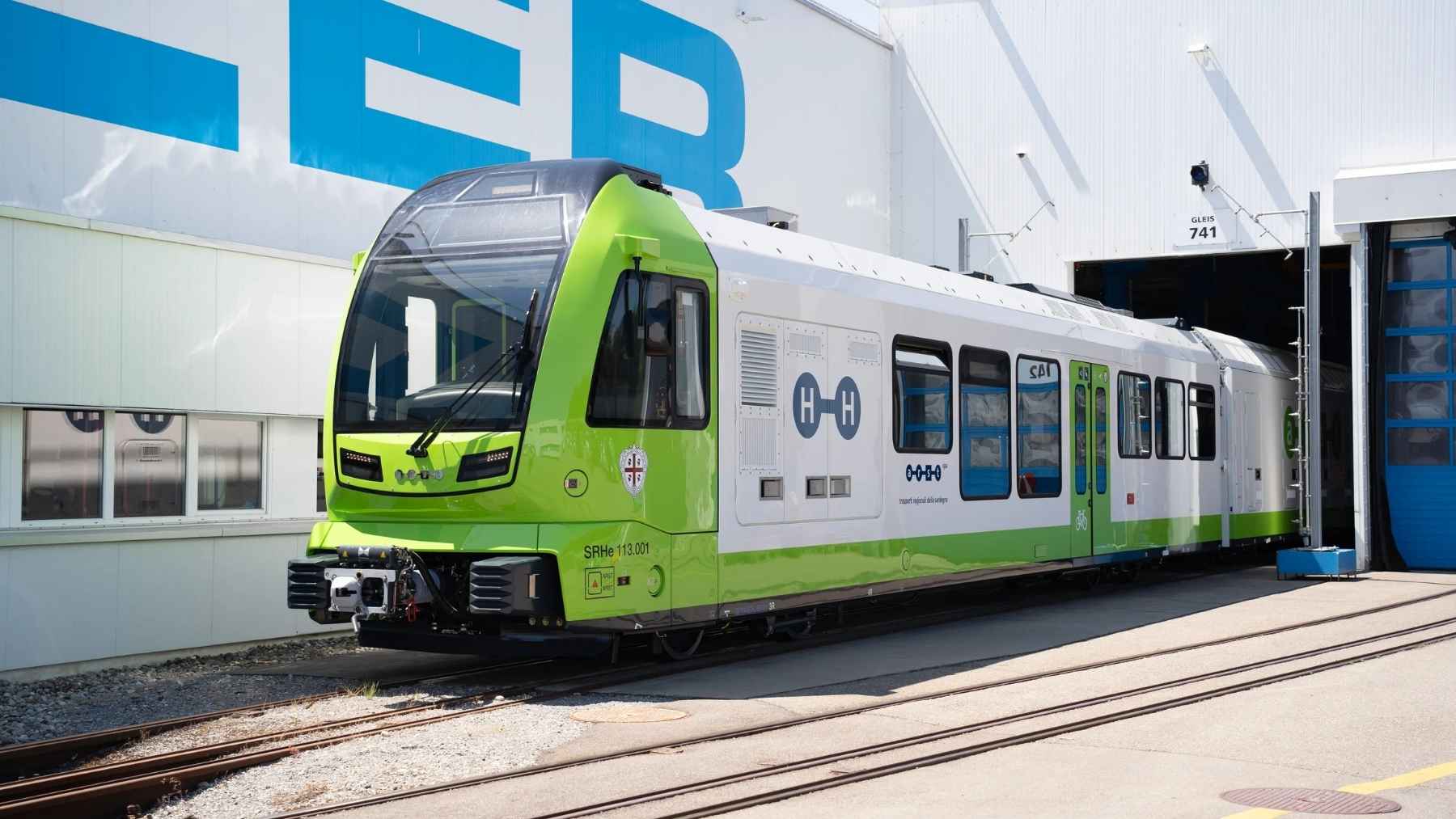
That changed on June 19 in a shed in Switzerland. At Stadler’s commissioning center in Erlen, the Swiss manufacturer and Sardinian operator ARST pulled the covers off the world’s first hydrogen train built specifically for narrow-gauge lines. It’s called the Class SRHe 113, and unlike the converted diesels other outfits have shown off, this one was designed from the wheels up to fit track barely three feet wide.
If that company doesn’t ring a bell for American readers, it should. Stadler builds railcars in Salt Lake City, put the first hydrogen-powered passenger train in the US into commuter service in California, and holds the Guinness world record for the longest distance a train has ever covered on a single tank of hydrogen. This is the outfit that just cracked narrow gauge.
Why narrow gauge got stuck on diesel
If you’ve never thought about track width, here’s the short version. Narrow gauge is what you build when the terrain is too steep, the curves too tight, or the original budget too thin for a standard 1,435mm railroad. Italy runs most of its narrow-gauge network at 950mm, which leaves roughly three feet between the rails and threads through Sardinia, Sicily, Calabria and a long list of mountain and mining railways worldwide.
The problem with putting hydrogen on those lines is geometry. Fuel cells, high-pressure hydrogen tanks and the batteries that smooth out their power all eat up space and add weight, and narrow-gauge track is fussy about both. Italian narrow-gauge lines only take vehicles with a very low axle load, so you can’t just grab a Coradia iLint and shrink it. You redesign the whole thing with a custom profile and lightweight materials, or you don’t play.
The Power Pack does the heavy lifting
The clever part rides in the middle of the train. Stadler bundles the fuel cells, hydrogen tanks and traction batteries into one central module it calls the Power Pack, which turns hydrogen into electricity to drive the train and recharge the batteries. It’s a series hybrid: the fuel cell works as an onboard generator topping up a battery, and the battery actually turns the wheels. Same architecture as most modern hydrogen trains, just crammed into a much tighter package.
The SRHe 113 is a two-car, aluminum-bodied set with that Power Pack in the center. Stadler quotes a top speed of about 100 km/h (roughly 62 mph) and a range of up to 800 km (around 500 miles) on a tank, which is plenty for the routes it’s headed for. ARST’s order covers ten of them, placed under a framework deal signed in 2023 and worth a reported 200 million euros (about $235 million), with assembly at Stadler’s plant in Bussnang.
Sardinia goes full closed-loop
Here’s the part that turns this from a novelty train into an actual policy experiment. Sardinia isn’t planning to truck in hydrogen from some fossil-fuel reformer on the mainland. ARST will make the hydrogen on the island using electricity generated entirely from solar, building a chain that runs from sunlight to fuel cell to wheels with nothing fossil in the middle. Production sites are already going up in Mandas, Alghero and Macomer.
ARST’s central director, Carlo Poledrini, frames it as the company turning itself from a transport operator into an energy company that powers its own network. That’s the kind of vertical integration hydrogen boosters have promised for years and rarely delivered. Stadler’s math says the ten trains will cut more than 2,100 metric tons of CO2 a year versus diesel, which it pegs at roughly 450 trips around the world by car. Whether that number holds depends entirely on the solar-to-hydrogen plants getting built on time, but the plan is real and the shovels are in the ground.
What the trains do once Italy signs off
The SRHe 113 isn’t carrying anyone tomorrow. First it has to pass testing under Italy’s rail safety agency, ANSFISA, the same certification gauntlet every new train on the Italian network runs. Assuming it clears, passenger service starts in 2028 on short regional runs: Alghero Airport to Mamuntanas, Sassari to Alghero, and Sassari to Sorso. Those are exactly the routes that still run diesel because nobody was ever going to string up overhead wire for them, non-electrified, low-traffic lines where electrification would cost more than the railway earns in a decade. That’s the sweet spot for hydrogen.
And Sardinia isn’t alone in the queue. Stadler is building nine more of these for Calabria’s Ferrovie della Calabria and two for Sicily’s Ferrovia Circumetnea, all on the same 950mm gauge with the same non-electrified problem. The platform unveiled in Erlen is basically the answer for the whole southern Italian narrow-gauge map.
Spain built one of these first, then let it die
What makes this a real first is the part Stadler isn’t advertising. Back in 2011, Spain’s now-defunct narrow-gauge operator FEVE converted a retired Serie 3400 car into a hydrogen fuel-cell tram, nicknamed Fabiolo, and ran it around Pravia in Asturias. So a fuel cell on a narrow-gauge train isn’t new. What’s new is someone building one from scratch for paying passengers and putting a fleet order behind it, instead of parking the prototype in a shed and walking away, which is exactly what happened to Fabiolo.
Stadler’s deputy CEO, Ansgar Brockmeyer, wasn’t shy about the distinction, calling Stadler “the only train manufacturer in the world” currently building hydrogen trains for narrow gauge. True enough, in the strict sense of having a live production line and signed contracts. Whether anyone else jumps in depends on whether the Sardinian fleet actually works in service.
Why this matters past one Mediterranean island
The interesting question was never really about Sardinia. It’s about every other 950mm and meter-gauge network strung across mountain regions, mining districts and old colonial railways from the Andes to Southeast Asia, almost all of them still running diesel because nobody ever offered them a credible alternative. A purpose-built narrow-gauge hydrogen platform changes the math for those operators in a way that shrinking a standard-gauge train never could.
It still has to prove itself, and hydrogen rail has had a rough couple of years to temper the optimism. Germany, home of the original iLint fleet, pulled most of those trains out of service in late 2024 for fuel-cell rework, and the broader Italian hydrogen push leans on the same Alstom supply chain that just went through a messy ownership shakeup.
The SRHe 113 has to clear ANSFISA, the solar plants in Mandas, Alghero and Macomer have to come online, and the closed loop has to deliver something near that 2,100-ton number. If it does, Stadler owns a market nobody else was building for. If it doesn’t, Sardinia still ends up with ten of the most interesting trains in Europe sitting in a shed. Either way, the three-foot-gauge world is finally in the conversation.