
If you have ever been stuck at a railroad crossing in the US, you know the routine. A couple of locomotives up front, then a long parade of boxcars and tank cars, and a minute or two of your life you can write off. A long American freight train these days might stretch a mile or two. Out in the Australian desert, a mile or two barely registers.
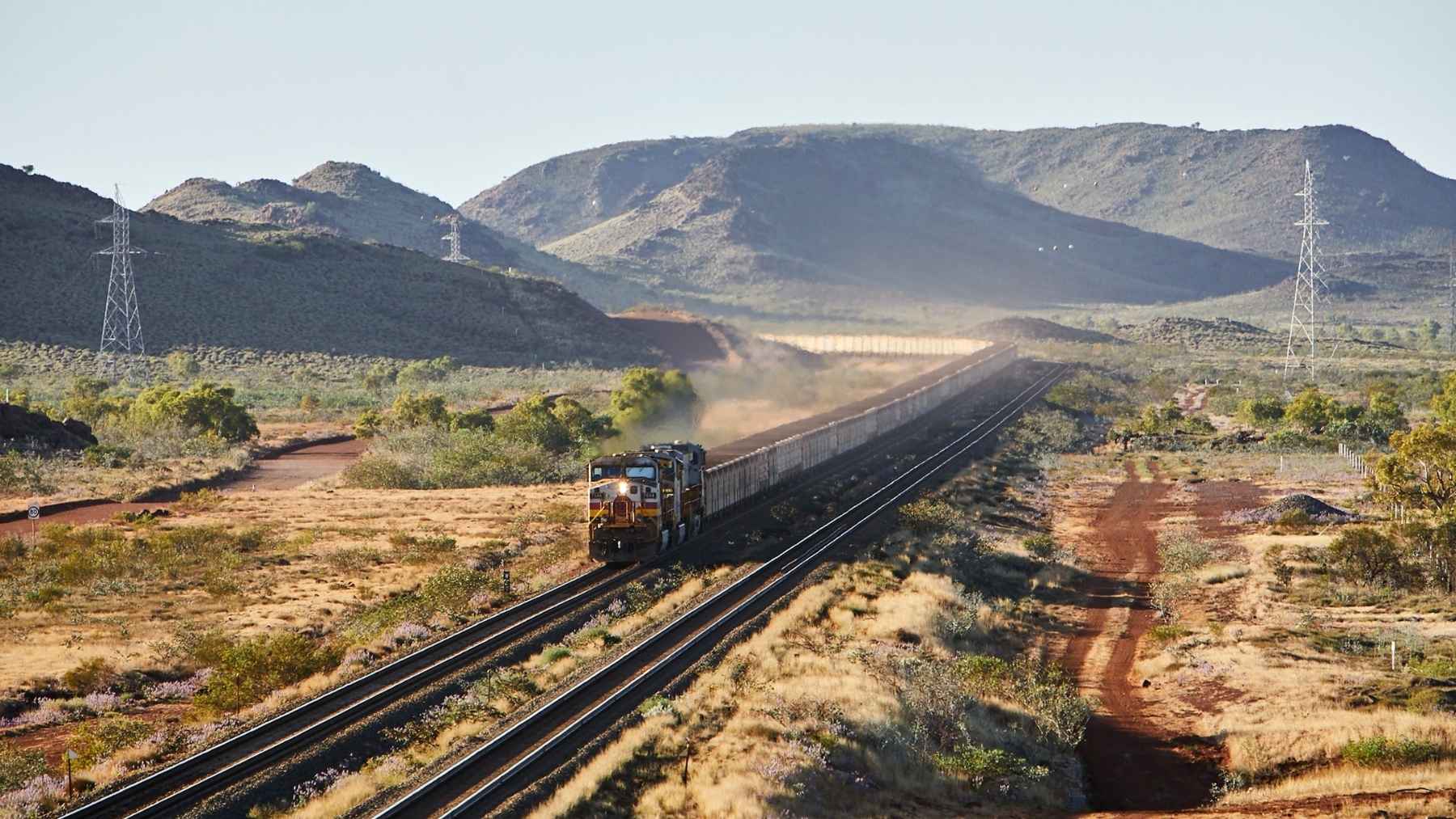
The longest train ever assembled ran on June 21, 2001, across the iron country of Western Australia, and it measured 4.57 miles (7.353 km) end to end. That was 682 loaded ore cars behind eight locomotives, grossing almost 110,000 US tons (99,734 metric tons). Twenty-five years later, almost to the day, nobody has built a longer one.
And the desert has gotten stranger than the record itself, because a lot of the trains crossing that same ground today run with nobody in the cab. Not a guy with a joystick steering from somewhere else. A control room in Perth sets the route and watches the network, but the train drives itself. The Pilbara now runs the largest fleet of driverless heavy trains on the planet, around the clock, and it has been doing it for years.
The 4.57-mile record was a test, and they retired it the same day
The train belonged to BHP Iron Ore, and it ran on the company’s Mount Newman line, a private heavy-haul railroad built to move iron ore to the coast. According to Guinness World Records, the consist was 682 ore cars pushed by eight 6,000-horsepower General Electric AC6000CW diesel-electric locomotives, riding on 5,648 wheels.
Those eight units were the most powerful locomotives in Australia when BHP bought them. The train carried about 82,000 metric tons of ore and grossed 99,734 metric tons all in, which made it both the longest and the heaviest train ever recorded. The run covered 275 km (171 miles) from the Newman and Yandi mines to Port Hedland, and it was handled by a single driver.
One driver for a train nearly five miles long sounds like a typo, and that was the whole point of the exercise. The locomotives were not bunched at the front. They were spaced down the length of the train, roughly a kilometer apart, and all of them answered to the lead cab through a distributed power control system. Railway Gazette International reported at the time that BHP ran it to push the technology as far as it would go, and it went far. The couplers held. The forces at the curves stayed manageable. The brakes behaved across the whole 4.57 miles.
Then they parked the idea. Once the control system proved it could hold a train that long together, there was no reason to run a five-mile giant every day. The spectacle was never the goal. The goal was a control system you could bolt onto a normal-length train, and that is exactly what BHP did. The record has been sitting untouched ever since, and the more recent attempts have not come close. India strung together a 4.5 km freight train called Rudrastra in August 2025 and made plenty of headlines for it, and it is still well short of what rolled to Port Hedland back in 2001.
Why the giants live in the Pilbara
There is a reason the world’s longest trains keep showing up in this one stretch of northwest Australia. The Pilbara is iron ore country, a rust-colored desert that supplies a huge share of the world’s seaborne iron, and several companies run their own private railroads across it. BHP operates the Mount Newman and Goldsworthy lines. Rio Tinto runs the Hamersley and Robe River network. Fortescue and Hancock’s Roy Hill operation have their own track too. None of these lines carry passengers. They exist to move rock to the coast and nothing else.
When the pit is hundreds of miles from the port and you are shipping hundreds of millions of tons a year, the math pushes hard toward fewer, bigger trains. One long train needs one crew instead of three, burns less fuel per ton, and frees up slots on the timetable. The catch is physics.
Stretch a train past a mile or so and the forces in the couplers spike on curves, and a snapped coupler in the middle of the desert is an expensive afternoon. Distributed power is the fix, with locomotives placed in the middle and at the rear and commanded remotely from the front, spreading the pulling and braking forces so the train does not tear itself apart.
That same appetite for cutting cost and diesel runs through everything out here. One Western Australian gold mine recently ran 155 straight hours with every engine switched off, powering the whole site on sun, wind and a battery. The trains have not gone that far, but they have gotten smarter. A routine Pilbara ore train today runs around 1.5 to 1.7 miles, somewhere between 240 and 270 cars, grossing roughly 28,000 to 43,000 metric tons depending on the operator. Still enormous. Just not record enormous.
The driverless part is the real headline now
The fresh record out here is not about length at all. On its own network, Rio Tinto runs AutoHaul, which the company describes as the world’s first fully autonomous, long-distance, heavy-haul rail system. It went fully operational in June 2019 after a program Rio Tinto pegs at around $940 million, built with Hitachi Rail STS. Rio Tinto has called the result one of the world’s biggest robots, and for once the marketing is not far off.
Here is how a run works. A worker boards the locomotive near the port to get it ready, then hands control to the operations center in Perth, about 930 miles (1,500 km) away. The center sets the route, the train heads out to a mine, loads itself, and drives itself back to the coast to dump, all at what the industry calls Grade of Automation 4, the level where nobody is onboard at all.
According to International Railway Journal, Rio Tinto runs up to 53 of these trains autonomously at any one time, each around 240 cars and a mile and a half long, hauling about 28,000 metric tons of ore per trip on 18-minute headways, 24 hours a day. The network covers roughly 2,000 km of track linking 18 mines to the ports of Dampier and Cape Lambert, and in 2025 it moved 326.2 million metric tons of iron ore.
The trains are not blind, either. On a typical journey the system clocks around 130,000 detected objects along the line, sorts out the roughly 2,000 it flags as possible hazards, and works out which ones actually matter. The control center handles the calls a driver used to make, watching for alerts and deciding how to respond, just from a desk most of a continent away. There is a safety dividend buried in the boredom of all this. Not having to drive people out to trains and back across an empty region saves Rio Tinto close to 1.5 million km of road travel a year, which in country this remote is its own kind of win.
Meanwhile, the US is still laying its first mile of fast track
The contrast with the US is hard to ignore. Australia automated heavy freight years ago and barely made a fuss about it, while driverless mainline freight in the US is still a labor fight rather than a running fleet. On the passenger side the gap is just as stark. California only approved its first stretch of true high-speed track this month, 62 years after Japan’s bullet trains started running.
Other countries keep moving fast on big transport too, from China putting the world’s largest all-electric container ship into service to the robot trains in the Pilbara. Completely different machines built for completely different jobs, but it is a useful reminder that the train of the future looks like whatever the desert in front of you happens to need.
Nobody is going to beat the 2001 train, because there is no money in beating it. A five-mile consist was only ever a way to prove a control system, and once it was proven the giant went back in the box. The real evolution went the other direction, into the boring everyday train that loads itself, runs itself to the coast, dumps, and comes back while the people who used to drive it sit 900 miles away watching screens.
The record is frozen in time. The desert around it is anything but, and the next change to these trains is more likely to show up under the hood, where Rio Tinto has already been trialing battery-electric locomotives to cut the diesel. The length stopped being the interesting number a long time ago.