
Every developer pitching solar panels over farmland says some version of the same thing, which is that the shade helps the crop. The line turns up at county hearings, in permit filings and in glossy project brochures, almost always with no number attached to it. Giuseppe Ferrara has attached one.
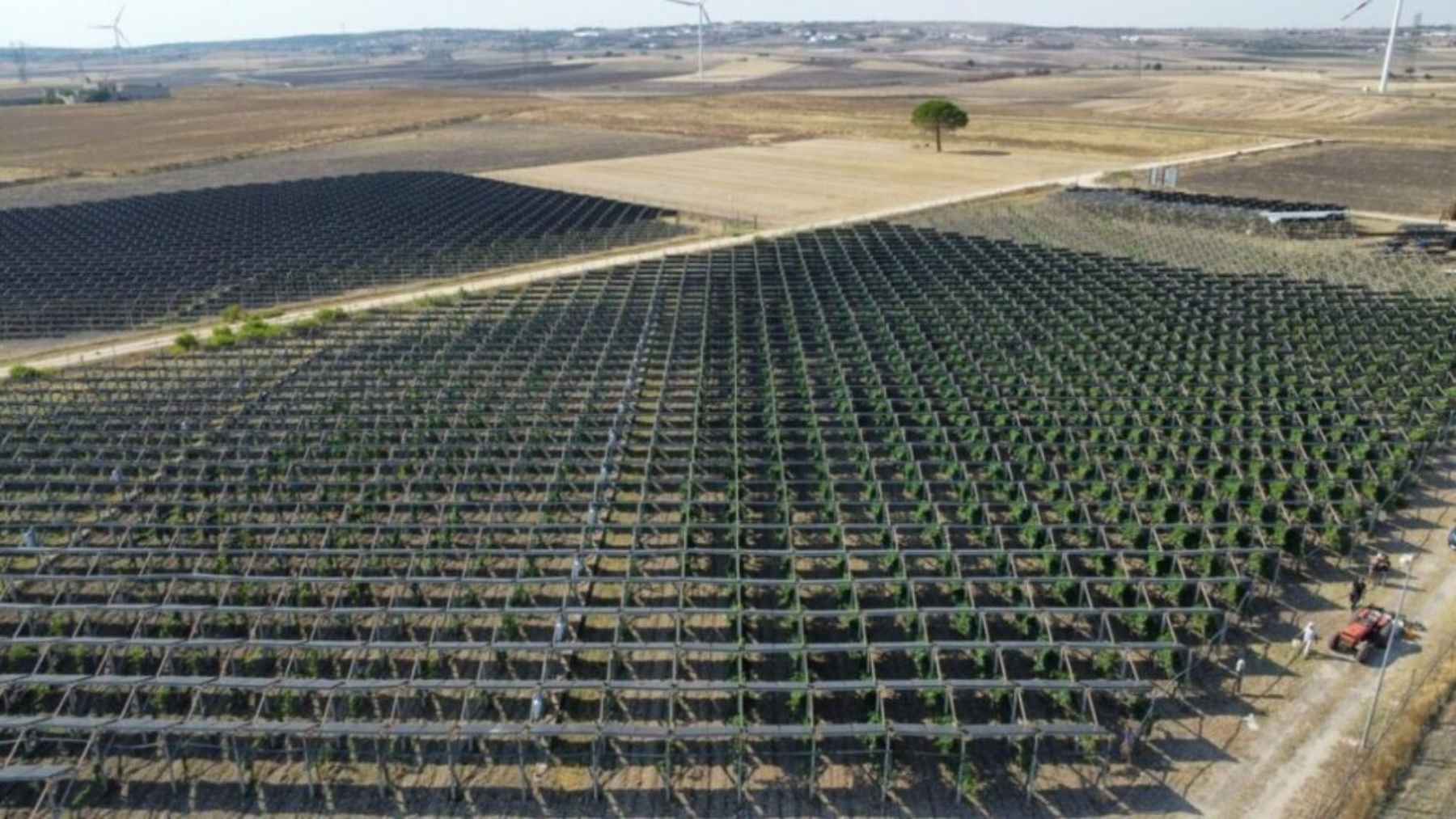
Ferrara teaches fruit tree crops at the University of Bari Aldo Moro. He told pv magazine that soil under an agrivoltaic array at a farm in Puglia registered more than 20 degrees Celsius below soil sitting in open sun a short walk away. A 20 degree gap in Celsius is a 36 degree gap in Fahrenheit, because a Celsius degree is 1.8 times the size of a Fahrenheit one. He logged it at around 11 in the morning.
The 20 degree reading came at 11 a.m. on a hot day
Ferrara flagged the limits of his own figure. He recorded it during a stretch of unusually high temperatures, which makes it a peak rather than an average reduction over a season. He told pv magazine the difference moves with latitude, time of day, ambient temperature and soil characteristics. Dark dirt runs hotter.
Anyone quoting 36 degrees as a farm-wide average is quoting it wrong.
Ferrara’s own group put a ceiling on the good news two years ago. A 2024 review he wrote with Magarelli and Mazzeo at Bari recommended holding shading below a 30% threshold to avoid substantial declines in fruit yield and quality. Shade past that point costs a grower fruit, whatever it does to the ground temperature.
Two farms, four crops, different hardware at each one
Ferrara’s team is measuring at two Italian sites built through a collaboration between the University of Bari, the state research agency ENEA, the startup Agridatalog and other partner companies.
The first is the Vigna Agrivoltaica di Comunità at Laterza, in the province of Taranto. Winemaker Svolta Srl runs a 970 kilowatt array there across roughly 7,770 thin film panels rated at 135 W, 125 W and 100 W, tilted at 28 degrees and carried on reinforced concrete frames modeled on a pergola vineyard, according to pv magazine’s September 2024 write-up of the installation. Ferrara’s researchers are studying fig and olive under that glass.
The second sits at Scalea, in Calabria, where the Le Greenhouse consortium handles the farming. ENEA and EF Solare Italia built it to run lemons under fixed panels against lemons under single-axis trackers, with bifacial modules, a lithium battery rack scaling from 5.12 to 20.48 kWh and a reverse osmosis unit that turns brackish water into up to 240 liters an hour, or 63 gallons, on 0.55 kW. Ferrara’s group is tracking lemon and lavender at that one.
Fixed at Laterza, fixed and tracking at Scalea, panels at different heights across both. Ferrara told pv magazine the two projects are designed to complement each other, since they put different crops under different environments and different photovoltaic setups. Farmers have been finding out the hard way that those variables are not interchangeable. A Bavarian hop grower who mounted panels on his existing bine poles got good electricity and fewer cones out of the first version, and a Cognac grower running an array that flattens to shield his vines from hail pays for the protection with the geographical indication on every bottle. A Japanese operator in Tokushima went the other way and built panels that turn edge-on to the rice below them.
A Princeton model ran the same question over a New Jersey tomato field
Erfan Hosseini and Elie Bou-Zeid published their own version of this on August 28. They did not stand in a field.
Hosseini, a PhD candidate at Princeton, and Bou-Zeid, who works in civil and environmental engineering there, built a model that simulates how air, heat and moisture move between panels, soil and plants, then ran it on tomato farm data under a typical New Jersey summer day. Their paper landed in the Journal of Advances in Modeling Earth Systems.
Their simulated tomato leaves came out at least 1.84 degrees Celsius cooler under panels, or 3.3 degrees Fahrenheit, and up to 7.56 degrees Celsius cooler at the hottest part of the day, or 13.6 degrees Fahrenheit. Those shaded plants took 47% less direct sunlight and gave up 31% of their photosynthesis. Water loss from the leaves fell 22.4% per day, and from crops and soil together 42.6% per day. The panels themselves ran 5.6 degrees Celsius cooler, or 10.1 Fahrenheit, which trimmed heat-related efficiency losses by 15%.
Hosseini and Bou-Zeid also put a figure on the people doing the picking. Farm labor in the simulation felt an average drop of 4.46 degrees Celsius, or 8 degrees Fahrenheit, with perceived temperature falling from 39 degrees Celsius to about 35, which is 102 down to 95 in Fahrenheit.
Hosseini and Bou-Zeid generated those numbers in software. Ferrara generated his with instruments in dirt. Neither result substitutes for the other, and neither one measures the same thing: Ferrara read the ground, Princeton modeled leaves, panels and workers. American readers may recognize a third measurement from Arizona, where researchers logged skin temperature 21 degrees Fahrenheit lower under raised arrays. Soil, leaf and skin are three different surfaces and three different numbers.
America grows figs and olives in basically one state
USDA puts close to 98% of US olive production in California, along with most or all of the country’s figs. Ferrara is measuring two crops that, in American terms, live almost entirely inside one hot, water-constrained state.
USDA’s National Agricultural Statistics Service forecast the 2025 California table olive crop at 44,000 tons on 12,000 bearing acres, down from 48,634 tons the year before, and the 242 growers sampled named labor shortages, rising input costs and marketing problems as the biggest pressures on the business. The 2022 Census of Agriculture counted 1,613 olive-farming operations across 41,828 bearing acres statewide.
Agrivoltaics is already common in the US, though rarely in orchards. The Department of Energy’s lab in Golden, Colorado had catalogued 596 agrivoltaic sites across 65,699 acres and 10,473 megawatts as of early 2025, according to an analysis from the Kleinman Center at the University of Pennsylvania. That lab was still called the National Renewable Energy Laboratory when it built the count, and the Department of Energy renamed it the National Laboratory of the Rockies on December 1, 2025. Most of those sites carry pollinator habitat or sheep rather than fruit trees.
The professor behind the reading co-founded one of the partner companies
Ferrara’s lab listing at Bari names him as co-founder and scientific chief officer of Agridatalog, the academic spin-off that appears on the partner list for both pilots. He has published more than 230 papers.
He also told pv magazine that pulling several institutions into one project produces fuller field data instead of a focus on the technology’s upside alone, and that the job of the work is to hand usable information to decision-makers. “Research should not be marketing,” he said.
Ferrara sits on both sides of that sentence. His spin-off is on the partner list, and he is also the one telling reporters that shading past 30% costs growers fruit and that his 20 degree reading is a hot-morning peak instead of a season average. Solar developers quoting him in a permit hearing will want to quote the whole thing.
Ferrara’s team is still logging both sites. Neither has published a full season of fig, olive, lemon or lavender yield. pv magazine ran his soil figure on August 18, 2026: more than 20 degrees Celsius, more than 36 Fahrenheit, at Laterza, at 11 in the morning, on one hot day.
 garyhalmbacher DRIVER2 months ago