
Navies have gotten pretty good at swatting cheap flying drones. Jammers, guns, nets, lasers, interceptor drones; there’s a whole crowded toolbox for anything buzzing over a ship, and it keeps growing. The toolbox for a hostile drone under the water is a lot thinner, because almost nothing in it survives the trip below the surface. You can’t jam a machine that isn’t listening to radio, and radio barely works in seawater anyway. So if you want to kill an underwater drone, you pretty much need another underwater machine to do it.
A German sonar company has built one, and in September a cargo drone carried it to a NATO exercise.
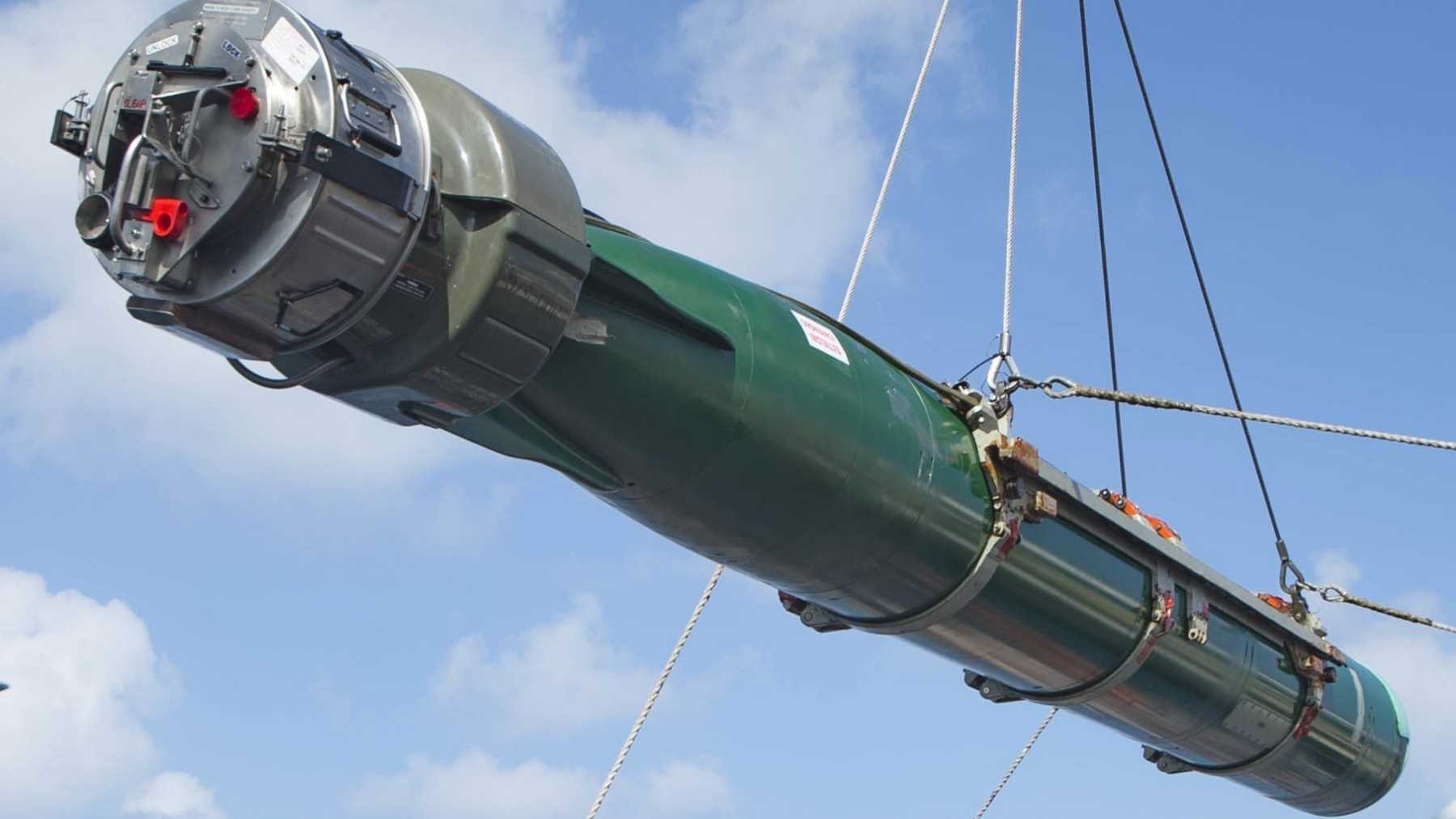
The company is ELAC SONAR, an underwater-acoustics outfit that’s been working out of Kiel, Germany, since 1926, and the weapon is called the ERAZOR: a self-propelled mini-torpedo with an explosive charge, built for exactly one job, which is putting holes in unauthorized underwater drones. Avientus, a Swiss cargo-drone startup, said in a September 16 post that it had run a deployment trial of the torpedo at REPMUS 2026, NATO’s big unmanned-systems exercise in Portugal, with its own aircraft acting as the airborne carrier. ELAC posted its own sign-off from the exercise on September 25. Neither company has published the day the trial took place, what the deployment looked like, or how it went. Which sounds cagey until you remember what a deployment trial is: a check that the handoff between two systems works at all, not a live-fire event. It’s the plumbing getting checked, more or less.
So what’s actually new here?
Mostly the flying. Expendable underwater kill vehicles already exist as production items; Ukraine is taking delivery of a French-built one-shot mine killer by the boatload, and the US Navy lowers its own expendable mine-hunting drone into the sea from a hovering helicopter. The ERAZOR points that same one-shot logic at a target that moves, and the Avientus trial swaps the helicopter and its crew for a drone that flies itself. That’s a pretty tidy division of labor, and if the pairing worked the way both companies describe it, no human went anywhere near the water.
So what exactly is the ERAZOR?
Small, mostly. ELAC’s leaflet, dated March 2026, puts it at about 3.3 feet long and 4.3 inches across, weighing roughly 24 pounds. For scale, a Mk 48, the torpedo American submarines actually shoot, runs about 3,500 pounds. This thing is closer to carry-on luggage.
The rated numbers: 32 knots flat out, and that’s about 37 mph underwater, a range of up to 5,000 yards (the leaflet rounds that to 2.5 nautical miles, call it 2.8 regular ones), and a working depth of up to 328 feet. One oddity I’ll flag: the same leaflet also lists the speed as 17 meters per second, which works out to 33 knots, so ELAC’s own one-pager disagrees with itself by a knot. I’m going with the knots.
The guidance is where ELAC’s day job shows. The concept in the leaflet runs like this: a command system hands the torpedo a target location, the torpedo swims out, and from there it handles detection, tracking and localization on its own before the charge does its thing. ELAC says the seeker works on active sonar, which means the torpedo pings and listens for the echo, the way a bat finds a moth in the dark. That matters here, because a small electric drone doesn’t make much noise of its own, so a passive listener could sit there all day and hear nothing. Pinging gets around that problem.
Why fly a torpedo out on a drone?
Because the torpedo doesn’t much care what throws it. ELAC’s leaflet pitches “cross-domain integration,” which is brochure-speak for launching it from whatever you’ve got, and talks up keeping high-value assets at a standoff distance. What the Portugal trial adds is a carrier that never touches the water. Underwater drones are cheap, they’re getting cheaper every year, and the things they snoop around (cables, pipelines, harbors, moored hulls) don’t move. Parking a guard boat over every pipeline is a staffing nightmare. Flying a 24-pound weapon out from a shelf on shore when a sonar hears something is a much smaller ask, and frankly it’s an easier sell to whoever pays for the boats.
About that carrier. Avientus hasn’t been around long: it’s a Zurich startup founded in September 2024 that builds fully electric cargo drones of the tailsitter type, meaning the aircraft stands on its tail, takes off straight up like a helicopter, then tips over and cruises like an airplane, so the whole system needs little more than a flat spot on the ground. The company’s CEO, Johannes Aicher, has said in interviews that defense is currently the door-opener for the business, and from the looks of things he’s right.
Here’s what I can’t square from the outside: the drone’s payload. Aicher told one Swiss interviewer the aircraft hauls about 22 pounds and stays under 55 pounds all-in; another interview has it carrying up to 55 pounds for 112 miles. The torpedo weighs 24 pounds. So at least one Avientus airframe lifts it with margin, and I can’t tell you which one did the lifting in Portugal, because neither company has said.
So what’s REPMUS?
The right venue for this kind of show-and-tell, basically. REPMUS stands for Robotic Experimentation and Prototyping with Maritime Unmanned Systems, and the 16th edition ran from August 31 to September 25 at Troia and Sesimbra, on the coast south of Lisbon. The Portuguese Navy organizes it together with NATO bodies, the European Defence Agency and the University of Porto, and the Navy’s own count for this year was more than 1,500 participants from 36 navies, over 60 companies and 13 universities. If you build something uncrewed that floats, flies or dives, you’re taking it here sooner or later to meet everyone else’s uncrewed thing.
Now, some brake-pumping. Both companies have confirmed a deployment trial, and that’s the full extent of the public record. Nobody’s published footage or results of an ERAZOR destroying anything, at REPMUS or anywhere else. The spec numbers above are ratings on a datasheet, and a rating on paper isn’t a demonstration in Portuguese water. No navy has announced an order that I can find. And the carrier and the torpedo remain two separate products from two separate companies that, from the looks of things, met at an exercise.
Everything that’s on the record comes with a date attached: Avientus announced the trial on September 16, ELAC posted its send-off from Portugal on September 25 as REPMUS 2026 wrapped up, and the Portuguese Navy counted more than 1,500 participants from 36 navies across the exercise’s 26 days.