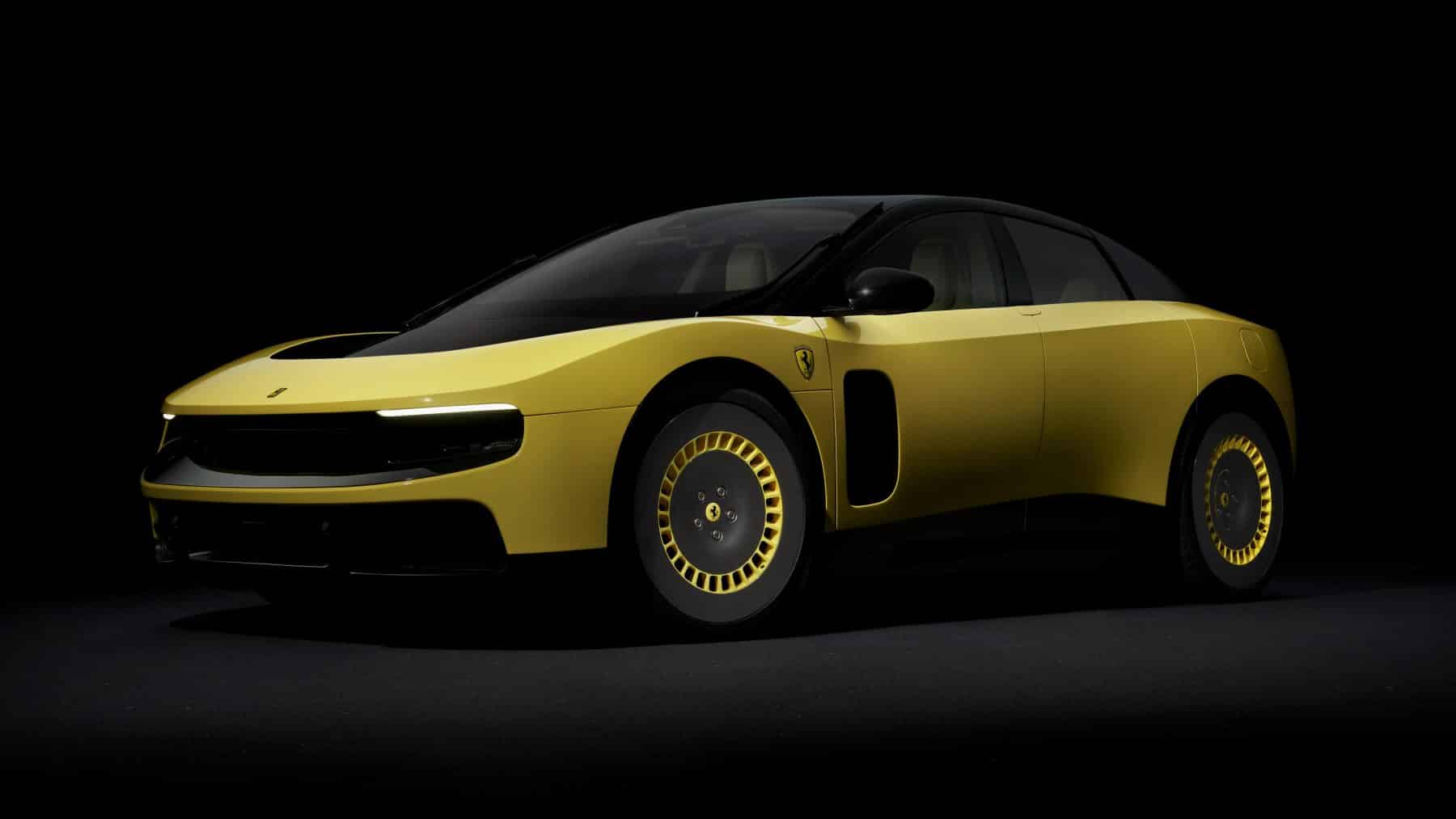

Ferrari has finally unveiled its first all-electric vehicle. The long awaited “Luce” combines obscenely efficient aerodynamics and hypercar performance with family friendly features like four doors and a new infotainment system.
Despite many performance companies pulling away from EVs, Ferrari seems to be sticking to its plans to make 20% of its output electric, and a further 40% run on a hybrid powertrain. Those plans should give you some idea of the scale Ferrari has planned for its $640,000 EV. It isn’t a one off, nor is it a limited-run model. Instead it’s something that’s going into general production.
Under the hood, we’re not really sure what’s happening. Ferrari hasn’t mentioned a frunk at all, so it may have joined the Mustang Mach E in that respect. But as you may expect, the Luce is a lot more powerful than Ford’s performance EV.
It puts out more than 1,000 horsepower thanks to a four-motor setup that is capable of launching the car from 0-60 in just 2.5 seconds. The individual motors provide real torque vectoring, something Ferrari calls the Ferrari Lateral Optimisation Wheeltorque (FLOW). There’s also a virtual limited-slip diff at the rear, and the e-trac system that cuts power to the slipping wheel was adapted from tech used by Ferrari’s F1 team.
According to Ferrari it also has the lowest drag coefficient of any vehicle the company has ever produced. Which should boast performance as well as range. Other records include the staggered wheel dimensions, which feature the largest difference of any Ferrari. 23 inches at the front, 24 at the back.
But perhaps the most interesting element of the Luce isn’t performance related at all. Instead, it centers on the experience the vehicle provides.
Ferrari avoids a common pitfall with its “engine sound”
The main concern for Ferrari enthusiasts isn’t going to be power, or aerodynamics. They may not even factor any sense of range anxiety into the purchase, after all up to 330 miles is pretty standard for an EV these days.
What they will be worried about is the sound, and the feedback, usually provided by the hefty V12s Ferrari is known for. Many of Ferrari’s competitors have decided to get around this by providing synthetic noise through carefully placed speakers. Maserati has arguably done the best job of this with the Grecale Folgore, which uses over 20 carefully placed speakers to make that engine sound as natural as possible. On the other end of the scale, the Dodge Charger Daytona sounds like a cheap animatronic dinosaur whenever you fire it up.
Ferrari being Ferrari, it’s absolutely ignored what everyone else is doing and insisted on keeping things natural. Instead of playing a digital recording of a V12 and hoping their customers will buy into the illusion, the Prancing Horse has instead decided to amplify real sounds and vibrations made by the motors and aerodynamics.
This is actually a fantastic idea, and one of the best things about the Luce. I’ve previously attended a Formula E race, and one of the more standout things for me was the noise. Those things sounded like missiles or fireworks whipping past. Ferrari’s plan is authentic, unique, and if an EV’s sounds are ever going to be enjoyable then it’s going to be through a system like this.
The infotainment system also has a bit of a unique twist, with what appears to be another nod to F1 in there. Ferrari recently partnered with former Apple designer Jony Ive in an attempt to make its infotainment system less generic and boring. Ive himself came out and blasted fixed central displays as a bit dull.
So while the driver cluster is still a 12.5-inch OLED screen (you probably can’t do much with that for safety reasons), the central display is a central 10.12-inch touchscreen mounted on a ball socket joint. Which means the driver can use a fixed handle on the bottom of the display to adjust its angle, with the whole thing looking a bit like the screens they slap in front of an F1 driver before the race.
The Luce is a four-door, two-row, vehicle much like the Purosangue. And in the EV, the rear passengers have something to keep them occupied as well with a set of 6.3 inch rear displays. Though, as with the Purosangue, the auxiliary displays seem to be there to provide HVAC controls and driving information as things stand. There are also a fair number of physical controls in the Ferrari, with a physical volume knob and climate controls present.
Ferrari’s first EV is expected on US roads at some point in early 2027, with European deliveries beginning in late 2026.