
Almost everything happening in solar right now is a race to the bottom on price. Panels that used to cost a fortune sell for pocket change, they go up by the million, and the whole industry is bent on one job: turning sunlight into the cheapest electricity on the grid.
There is one solar machine that never joined that race. It doesn’t make electricity. It doesn’t care about cheap. Bolted to the side of a building in the French Pyrenees, it has spent more than half a century chasing the opposite of cheap power: raw, concentrated heat. And 57 years after it switched on, nothing built since has out-cooked it.
The machine is the one-megawatt solar furnace at Odeillo, run by the PROMES lab of France’s national research agency, the CNRS, in the mountain town of Font-Romeu-Odeillo-Via near the Spanish border. It is still the most powerful solar furnace on Earth, a title it shares with exactly one other machine, built by the Soviet Union. Everyone who drives past it stops to take a photo. Almost nobody explains what it actually does.
It’s a magnifying glass the size of a building
Point a magnifying glass at a dry leaf and you already know the principle. Odeillo just runs it at a scale that’s hard to picture.
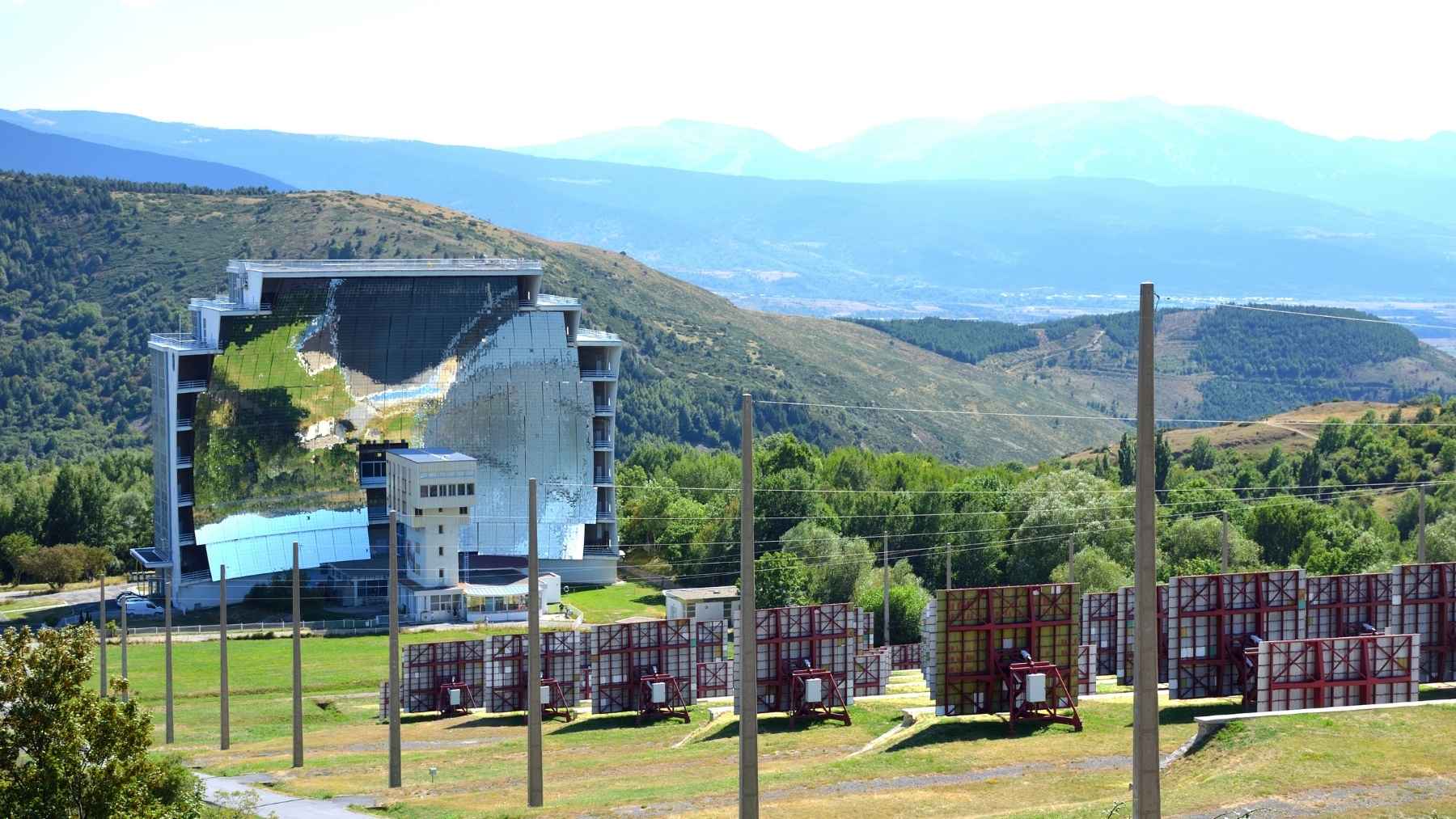
The concentrating happens in two stages. On the slope below the building sit 63 flat mirrors called heliostats, spread across roughly 2,835 square meters, and their only job is to track the sun all day and bounce it onto one fixed target.
That target is the showpiece: a curved parabolic mirror covering 1,830 square meters, fixed to the entire north face of an eight-story building. Picture a mirrored drive-in movie screen turned into the side of an office block. It catches all that redirected light and funnels it down to a single point.
The point is tiny. As PROMES-CNRS puts it in the lab’s own spec, “The MWSF focuses 1 megawatt on an area approximately 80 centimeters in diameter,” with a peak intensity of 10 megawatts per square meter at the focus.
Ten megawatts per square meter works out to about 10,000 times the strength of ordinary sunlight hitting the ground. A full megawatt of power, squeezed onto a spot the size of a large dinner plate.
The building is 48 meters tall and 54 meters wide, or 157 by 177 feet, and it has been sitting there doing this since 1969.
Hot enough to melt the metals that melt nothing else
All that concentrated light becomes heat, and the numbers climb fast. PROMES says the furnace clears 3,000°C, which is about 5,400°F. In the technical literature, CNRS descriptions of the setup put the ceiling for materials testing at around 3,500°C, roughly 6,300°F.
For scale, steel melts somewhere near 2,700°F. Tungsten, the metal with the highest melting point on the entire periodic table, holds out until 6,192°F. Odeillo’s focal spot plays right at that line.
And it gets there with no flame, no fuel, and nothing leaving a smokestack. The energy source is daylight, and the only moving parts are mirrors.
The furnace still has a day job
None of this is a museum exhibit. The furnace runs live experiments, and the work falls into a few buckets.
One is making and studying materials that only exist at these temperatures, from advanced ceramics to compounds you can’t cook any other way. Another is solar chemistry and solar fuels, using the heat to drive reactions like splitting water for hydrogen without burning a thing. A third is thermochemical energy storage, working out how to bank the sun’s heat in chemical form and pull it back out later.
Then there’s the one that sounds like science fiction and isn’t: testing how materials survive extreme conditions, including the beating a spacecraft’s skin takes on the way back into the atmosphere. Re-entry heat is hard to fake on the ground. A megawatt of focused sunlight fakes it well.
Outside research teams book time on the furnace through an access program called SFERA, which opens the CNRS facilities to scientists from across Europe.
If using concentrated heat as a factory tool sounds familiar, it’s having a moment elsewhere. A reactor built to melt raw Moon dust into finished solar cells at 1,600°C runs on the same basic bargain, and so does a black metal panel that turns seawater drinkable on sunlight alone. Odeillo just got there first, and bigger, and hotter.
It has exactly one rival, and it’s in Uzbekistan
For all its fame, Odeillo isn’t quite alone. It splits the title of most powerful solar furnace with a single Soviet-built machine near Parkent, Uzbekistan, about 45 kilometers from Tashkent, commissioned in 1987.
The two are close cousins. Same one-megawatt class, same trick of a heliostat field feeding a giant parabola. The Uzbek furnace is even a little wider and runs a comparable number of heliostats.
But Odeillo keeps the edge where it matters. Its optics are sharper and its target is more compact, so the French furnace packs its megawatt tighter and reaches higher temperatures. When people say most powerful solar furnace on the planet, this is the one they mean.
Five kilometers away, the Pyrenees are cooking again
Odeillo isn’t the only concentrated-solar hardware in this stretch of mountains. About five kilometers away, at Targassonne, sits Themis, a solar power tower that belongs to the same PROMES-CNRS operation.
Themis is mid-rebuild. A European project called Powder2Power is converting it into a demonstration plant for a newer style of concentrated solar, one that heats a stream of fluidised solid particles to as much as 750°C and uses them to store and shuttle heat for electricity and industrial processes.
As SolarPACES reported, crews spent two years reconfiguring the tower and moved roughly 50 tonnes of equipment down from the top to ground level, with the project entering commissioning in June 2026.
So inside a five-kilometer circle you’ve got two answers to the same question, separated by more than fifty years. The furnace from 1969 crushes sunlight into the hottest point it can to learn what materials do at the edge. The particle tower from the 2020s spreads that heat across a working fluid to keep the power flowing after dark.
The consumer end of solar keeps chasing cheap and good-looking, right down to panels engineered to pass for terracotta roof tiles. This corner of the Pyrenees has spent 57 years chasing the other extreme.
Fifty-seven years and the mirrors still work
There’s something stubborn about the whole thing. The rest of the industry got obsessed with making sunlight cheap, and it succeeded, which is why a solar panel now costs about as much as a nice dinner.
Odeillo went the other direction and stayed there. No fuel, no flame, no emissions, just 63 mirrors on a hillside, one enormous parabola, and a clear high-altitude sky. Aim all of it at a single spot and you get the most concentrated heat source on Earth, hot enough to melt the metals that shrug off everything else.
It’s been doing exactly that since 1969. The mirrors still work.















Obvious alternative... 1 megawatt of solar panels... 333 watts a panel x 3000 panels, then convert the electricity to heat at target, probably much more bang for buck, which is why only 2 of these in entire world