
Your phone holds less charge than it did two years ago, and there is nothing you can do about that. Lithium cells shed a sliver of capacity every time you cycle them, and the enormous lithium farms utilities now park next to substations shed it the same way, just with more zeros on the replacement invoice.
Which is why gravity storage always sounded like the sane option. Hang a steel weight in a deep hole. Winch it up with cheap wind power at 3am, then let it fall through a generator when everyone gets home and turns the oven on.
Steel does not degrade. It does not catch fire, it does not want cobalt, and in fifty years it is still a steel weight in a hole.
The Scottish company that made that argument better than anyone spent almost 14 years making it. It built a working rig on the Edinburgh docks. It signed a memorandum of understanding with ABB, which has been electrifying mine hoists since the 1890s. It picked out a shaft in Europe’s deepest base metal mine.
Then on October 1, 2025, in a Microsoft Teams meeting, Gravitricity Limited resolved to wind itself up. It took four months for anyone to notice.
Wound up on a Teams call with £7,913.82 ($10,600) left
The liquidation surfaced in February 2026, when Solar Power Portal went through the Companies House filings and found what was left of it. Callum Carmichael and Graham Smith of FRP Advisory were appointed joint liquidators. Assets available to creditors: £7,913.82, about $10,600.
The 82 pence is in the filing.
Two and a half years earlier, the company had appointed advisors to lead a £40 million ($54 million) raise meant to carry its demonstrator projects through to 2028. It was still fundraising on the retail platform Crowdcube when the resolution passed. Investors there found out by email, and by Solar Power Portal’s account were given very little else.
Nobody has alleged wrongdoing. The filings point at the company’s finances rather than any single event, which is the ordinary way a first-of-a-kind hardware startup dies: heavy overheads, no revenue, and the runway ends before the engineering does.
Then came the part that makes this a story instead of a footnote. The liquidators handed the intellectual property to Hilco, which put the whole estate up for sale.
Granted patents, pending applications, 3D CAD models, the control software, the customer contact list, the LinkedIn and YouTube accounts, the trade mark, and the gravitricity.com domain itself. Offers were due February 25, 2026.
Hilco’s sale page, last updated in May 2026, now carries one word across the top of it: SOLD. The buyer has not been named.
The website is still live, incidentally. It still has an Invest tab.
The machine Gravitricity never got to build
Strip out the press releases and the design was genuinely elegant. According to the company’s own technology page, a full GraviStore would hang up to 24 separate weights of 500 metric tons each from cabled winches inside a single shaft. Twelve thousand metric tons of suspended steel, going up and down forever.
Any shaft deeper than roughly 984 feet (300 meters) would qualify. Zero to full power in under a second, which beats pumped hydro and drops it straight into the frequency response market where the money actually is. Round-trip efficiency up to 80%. A 50-year design life with no cycle limit and no degradation, because there is no chemistry there to degrade.
The company reckoned about 14,000 mine shafts worldwide were deep enough, an estimate that got picked up and repeated in the academic literature on shaft gravity storage. Its own project database held more than 300 specific sites, including 35 shafts a kilometer deep in South Africa and thirty-odd across Czechia and Poland.
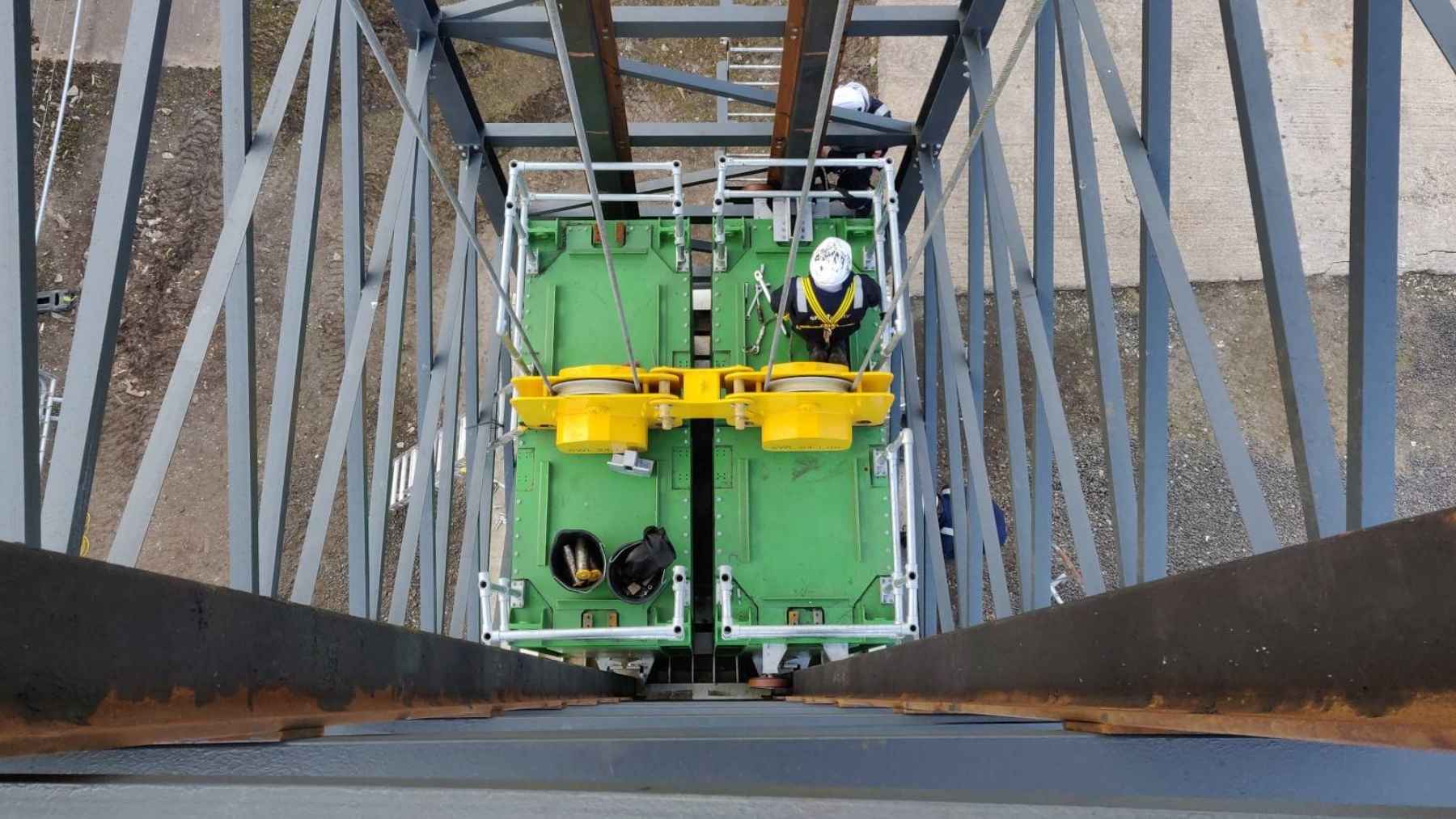
What it actually built was a 49-foot steel frame at the Port of Leith in Edinburgh holding two 25-metric-ton weights, rated at 250 kilowatts. It ran for three months in 2021, and the company said the results confirmed its modelling.
In February 2024 it announced the real one. A 1,738-foot (530-meter) auxiliary shaft at the Pyhäsalmi mine in central Finland, which runs 4,738 feet down and shut in August 2022 after 60 years of copper and zinc.
The plan was two megawatts, tied straight into the Finnish grid, in a town of 5,000 people that had just lost 220 mine jobs and roughly 400 contractor jobs on top of them.
It was going to be the first full-scale gravity store in Europe. Nothing was ever installed.
The number that killed it
Here is the arithmetic nobody puts on a slide. Green Gravity, an Australian firm chasing the same idea, says a 40-metric-ton weight dropped 328 feet (100 meters) stores about 10 kilowatt-hours.
The average American home burns through roughly 10,500 kilowatt-hours a year, per the Energy Information Administration, which works out to about 29 a day. So a 40-ton block of steel, falling the height of a 30-story building, covers one house for roughly eight hours.
Gravity is free, and gravity is feeble. To get from that to a number a grid operator cares about you need mass and you need height, and both of them cost real money before you have banked a single kilowatt-hour. Hence 12,000 metric tons of steel. Hence the kilometer-deep shafts.
The physics was never the problem. Lithium spent a decade getting cheaper on the back of Chinese factory scale-up while gravity storage had a handful of startups and some grant money. A weight in a shaft still does not degrade. It just costs too much per kilowatt-hour for anyone to care that it doesn’t.
At the Finnish mine, the money went to water
Pyhäsalmi did not sit around waiting. Callio, the development company set up by the town of Pyhäjärvi to find new tenants for the hole in the ground, has spent the past two years pushing a different kind of gravity battery down the same rock.
Callio’s energy storage page now describes underground pumped hydro. Pump water up when power is cheap, drop it back through a turbine when it isn’t, using nearly 4,600 feet (1,400 meters) of head. Consultants sized the sweet spot at 75 megawatts and 530 megawatt-hours. There is an 85-megawatt battery project alongside it, and in April 2025 Callio announced a joint venture with Swedish developers SENS, Vimab and Mine Storage to move the pumped hydro forward.
Read those two numbers next to each other. Gravitricity told the world a future GraviStore would hold more than 20 megawatt-hours. In the same mine, moving water instead of steel gets you 530.
Neither Callio nor the liquidators have said what happens to the 2 MW gravity project. First Quantum Minerals, which owns the mine, still lists gravity storage among the site’s proposed uses. Nobody has hung a weight down there.
Energy Vault landed in the same place in Sardinia. Its concrete tower on the Chinese coast stacks 35-ton blocks and is the first commercial grid-scale gravity plant of its kind, by the company’s own account.
But when Energy Vault went underground at the retired Nuraxi Figus coal mine, into shafts up to 500 meters deep, within a hundred feet of the depth Gravitricity had chosen in Finland, it did not send blocks down. It sent water, in modular prefabricated tanks. Pumped hydro in a box.
Two companies started from the same premise: a dead mine is a free vertical drop somebody else already paid to dig. Both ended up filling it with the cheapest heavy thing on Earth. Water is heavy, water is free, and water does not need a 500-ton forging.
One company is still going down there with weights
Green Gravity holds a binding lease on the number 4 shaft at the Russell Vale colliery outside Wollongong, a coal mine that ran from the late 1800s until 2023. The plan is to move weights up and down 1,312 feet (400 meters) at 150 kilowatts, off-grid, purely to find out whether handling them autonomously works in a real shaft rather than in a lab.
It has filtered an original list of 175 Australian shafts down to about 75, a pipeline worth roughly 10 gigawatt-hours if every one of them gets built. Backers include HMC Capital and BlueScopeX. Founder Mark Swinnerton told RenewEconomy in late September 2025 that he was back in the market for more capital, and that raising money for untried storage technology had been “tough.”
Gravitricity passed its winding-up resolution nine days later.
The wider market has been voting with its checkbook. Switzerland’s FlexBase is digging an 88-foot pit for a 2.1 GWh flow battery, with more than a billion dollars of private money behind it.
Grid operators are still buying enormous spinning steel, but for stability rather than storage, like the 300-ton synchronous condenser Australia switched on to unlock 600 megawatts of stalled wind and solar. Heavy mechanical hardware has plenty of work on a modern grid. Banking eight hours of one household’s electricity in a suspended block of steel is apparently not part of it.
The shafts are still down there
The thing Gravitricity spotted was real, and it hasn’t gone anywhere. Hundreds of thousands of abandoned mines are scattered across the United States, most of them a liability, a few of them a kilometer of free vertical drop with a hoist house and a grid connection already sitting on site. That asset does not expire, which was always the whole point.
What went into liquidation was one answer to the question, not the question itself. Somebody thought the patents, the drawings and the name were worth buying. The deepest mine in Europe is going to become a battery regardless, just a wet one.
Gravitricity spent 14 years proving a weight in a shaft will hold its charge for fifty years without breaking a sweat. It never got the chance to prove anyone would pay for that.
 irabloomgarden DRIVER1 month ago