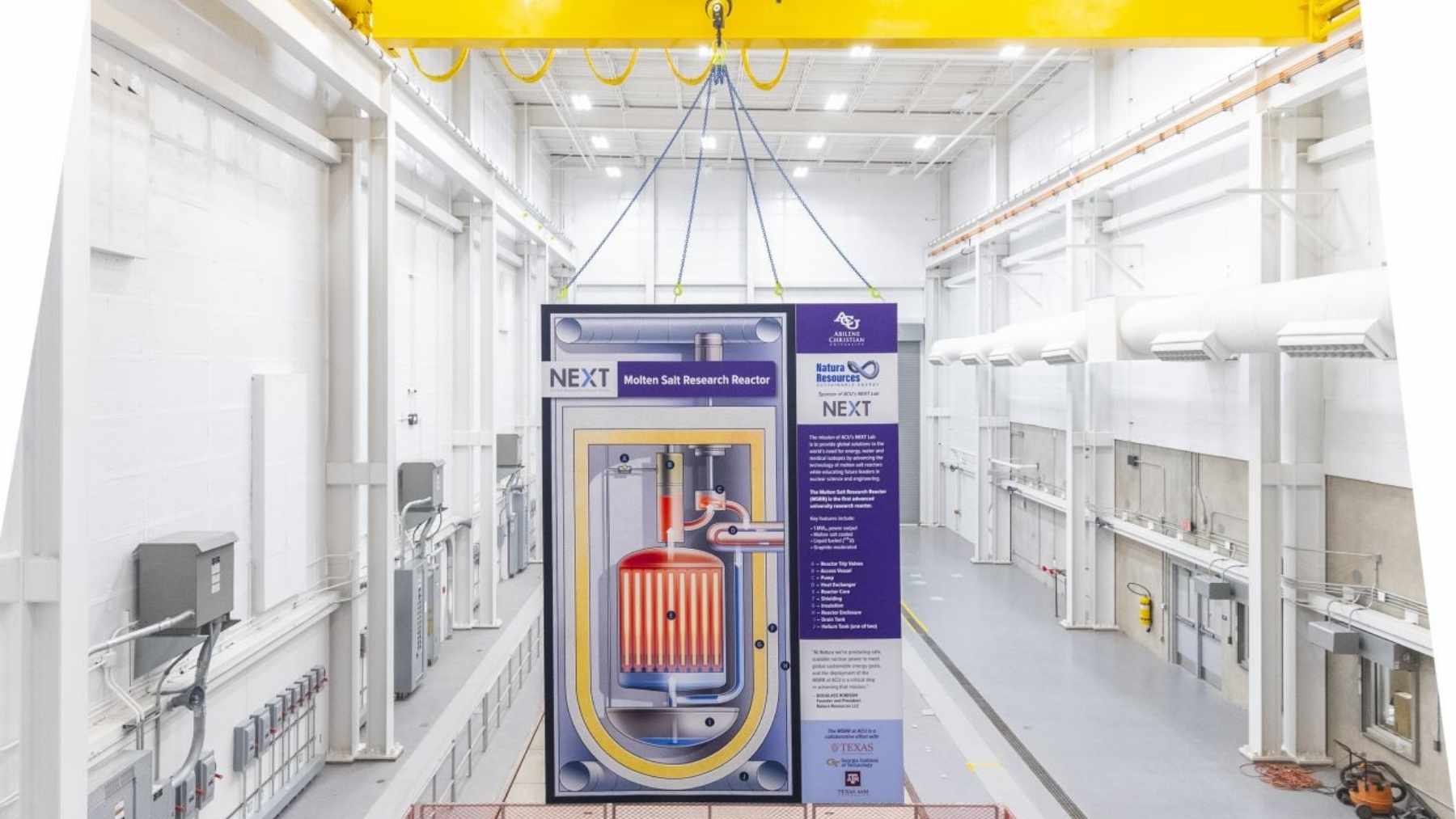

Nuclear reactors usually live behind fences, at the end of long access roads, surrounded by a few square miles of nothing at all. That isn’t decoration. It’s what you do with a machine that holds water at roughly 150 times atmospheric pressure, where the thing you’re guarding against is all that water leaving at once.
Then there’s the one going into a science building at Abilene Christian University, a private school of a few thousand students in West Texas.
Doug Robison, the founder and CEO of Natura Resources, described it to Fortune on July 4 as “sitting in the middle of Abilene right across the street from a dormitory.” His reasoning is the whole pitch: the machine doesn’t run under pressure, so there’s nothing to blow down.
Robison is a third-generation oilman who spent his career in the Permian Basin. His reactor is called the MSR-1, it’s rated at 1 megawatt of heat, and its fuel isn’t solid. There are no rods, no pellets, no zirconium tubes. The uranium is dissolved into a molten fluoride salt and the whole mixture circulates as a liquid.
No other machine in America has a federal construction permit to do that. Natura’s has been sitting on the shelf since 2024, and the reactor still hasn’t been switched on.
Natura was an organic farming company until an oilman needed a shell
The origin story is genuinely odd, and Robison tells it on himself. Roughly a decade ago he was winding down toward retirement and preparing to sell his petroleum company when he visited ACU, where his kids had gone to school.
He sat through a talk by Rusty Towell, a professor of engineering and physics who runs the university’s Nuclear Energy eXperimental Testing lab. Towell’s subject was molten salt reactors as a cheap power source for poor countries. Robison walked to the back of the room afterward and asked what Towell would do with full funding. He had to ask three times before Towell answered.
A $3.2 million research donation followed. Word got around, and then-Energy Secretary Rick Perry sent a team down to look at the work. In 2019 the Department of Energy made an offer: fuel and salt, if somebody would build a test reactor. ACU raised its hand to host it. Robison raised his to pay for it.
To incorporate the startup, he reached for a corporate shell he already owned: Natura, an organic farming venture he’d started in the 1980s and shut down. On paper the hot new advanced-nuclear company is over 40 years old. Robison, who told Fortune the transition from organic agriculture to advanced nuclear at least keeps him in clean energy, seems fully aware of how that sounds.
Natura says it has raised more than $120 million privately, plus a $120 million commitment from the State of Texas. More than 150 researchers across ACU, UT Austin, Texas A&M and Georgia Tech are attached to the program.
This is not the same molten salt story as the one in Tennessee
Two American reactors under construction right now involve molten salt, and they are not doing the same thing. The distinction gets flattened constantly, so it’s worth nailing down.
Kairos Power’s Hermes 2 in Oak Ridge, which broke ground in April and has Google lined up to buy the electricity, uses solid fuel pebbles sitting in a bath of molten salt. The salt is the coolant. Pull the fuel out and you’re holding a solid object.
Natura’s MSR-1 has no such object. The fuel is in the salt, chemically. Coolant and fuel are the same liquid.
That’s the harder version, and it’s harder for reasons the industry has known since the 1960s: corrosion, chemistry, and the fact that your radioactive inventory is a fluid moving through pipes rather than a stack of ceramic you can lift out with a crane.
The payoff is pressure, or the absence of it. The salt is already liquid at operating temperature, so there’s no need to squeeze it. The system runs near atmospheric pressure. Robison’s argument is that a leak in a pressurized reactor is a dispersal event, while a leak here is a puddle that freezes. Radioactive, contained, and on the floor.
Worth being precise about what the MSR-1 is, though. Per the NRC’s own announcement, it will not generate electricity. It’s a research machine and a proving ground. The commercial product, a 100-MW unit Natura wants in the Permian Basin or near Texas A&M in Bryan, is a 2032 target.
The salt has been sitting in a tank at Oak Ridge since 1969
Here’s the part that makes this a supply chain story as much as a nuclear one.
The salt these reactors need is FLiBe, a mix of lithium and beryllium fluorides. The lithium has to be nearly pure lithium-7. The other natural isotope, lithium-6, eats neutrons and makes tritium, which is not what you want circulating through a core.
America made that material once, at the Y-12 plant in Oak Ridge, using a column exchange process that ran on mercury. Roughly 11,000 tons of it. The plant shut down in 1963 and, according to the Government Accountability Office, has never operated since. Enriched lithium production has been a Russian and Chinese business ever since.
Which leaves two options if you want salt in 2026. Kairos chose to build it: the company developed its own mercury-free lithium-7 process and is standing up a salt plant in Albuquerque.
Natura chose the warehouse. In August 2025 the DOE opened a competitive offer for the roughly 2,000 kilograms of FLiBe left in storage from the Molten Salt Reactor Experiment, the Oak Ridge machine that ran from 1965 to 1969 and proved liquid fuel worked before the country dropped the idea. On January 5, Natura announced it had won the allocation.
One correction to how this usually gets written: it’s the MSRE’s coolant salt, from the secondary loop, not the fuel salt that had uranium in it. And it is not a museum piece in pristine condition. The DOE’s own solicitation assumed impurities and noted the salt was most likely exposed to humid air at least once between 1969 and 1999. It was remelted in 1999 and split into storage vessels holding about 530 kilograms each.
So: sixty-year-old salt, assumed to be dirty, probably rained on once, and Natura still wanted it. That’s how tight the lithium-7 market is.
ACU won a permit its reactor will not run under
The regulatory turn here is the most interesting thing in the file, and almost nobody covers it.
ACU filed a letter of intent with the NRC in March 2020 and a construction permit application in August 2022. The agency spent two years on it. On September 16, 2024, it issued the permit, and Andrea Veil, who directs the NRC’s Office of Nuclear Reactor Regulation, called it “the first research reactor project we’ve approved for construction in decades.”
Read the NRC’s notice closely and two things stand out. The permit went to the university, not to Natura. And it authorizes construction only. Operating requires a separate license application that hasn’t been granted.
Then the rules changed. Executive Order 14301, signed in May 2025, told the DOE to build a Reactor Pilot Program that could authorize test reactors on its own, skipping the NRC queue entirely. Natura was one of ten companies picked in August 2025, and in December it signed on.
Towell’s read at the time, given to the American Nuclear Society, was that “switching to DOE authorization will not slow this project down.” Which is a sentence that has aged into something worth checking.
The plan now is to go critical under DOE authorization, then circle back and finish NRC licensing afterward. The hardest-won permit in the program is, for the moment, a trophy.
2026 quietly became 2028
In October 2025, Robison said Natura was on track to deploy the MSR-1 in 2026. In the January 5 salt announcement, the company was still saying it would “deploy our MSR-1 in 2026.” Fortune’s July 4 piece puts first operation in 2028.
The American Nuclear Society’s rundown of the program on July 2 explains why better than any press release. DOE authorization runs through four gates: the OTA, then a nuclear safety design agreement, then a preliminary safety analysis, then the final safety analysis that lets you operate.
Natura has cleared one of the four. Aalo had its final analysis approved in April and went critical on July 4. Radiant and Oklo cleared the third gate months ago. Natura signed its OTA in December and hasn’t publicly reported a gate since.
Meanwhile the machines that beat it to the finish line were, by design, simpler. The three reactors that went critical before the Fourth were zero-power test articles. Antares’ Mark-0 shipped with neither power conversion nor a heat removal system, because it didn’t need them for a physics demonstration.
Natura’s chief operating officer Jordan Robison, who is Doug’s nephew, drew that line for Fortune directly: passing a criticality test and building a complete reactor system are two different jobs.
He has a point, and the scoreboard doesn’t capture it. Natura has a finished reactor building on the ACU campus, completed in 2023. It has detailed engineering done. It has a DOE fuel commitment, an NRC permit nobody else in the liquid-fuel business has, and 2,000 kilograms of irreplaceable salt with its name on it. What it doesn’t have is a reactor that has ever run.
The Fourth of July deadline rewarded whoever could get a chain reaction going fastest. Robison is building the thing he’d recognize from the oil patch, where you either have a rig or you don’t. If the MSR-1 lights up in 2028, it’ll be the first American reactor since 1969 to run on fuel you can pour. If it doesn’t, the salt goes back in the tank, and Oak Ridge waits for the next guy.
 mikeconley DRIVER2 months ago