
Big infrastructure projects run late, and there is usually something obvious to point at. A machine broke. A trench collapsed. A boring machine hit rock and sat there for a year while the lawyers worked out who was paying for it.
None of that happened under the Baltic Sea.
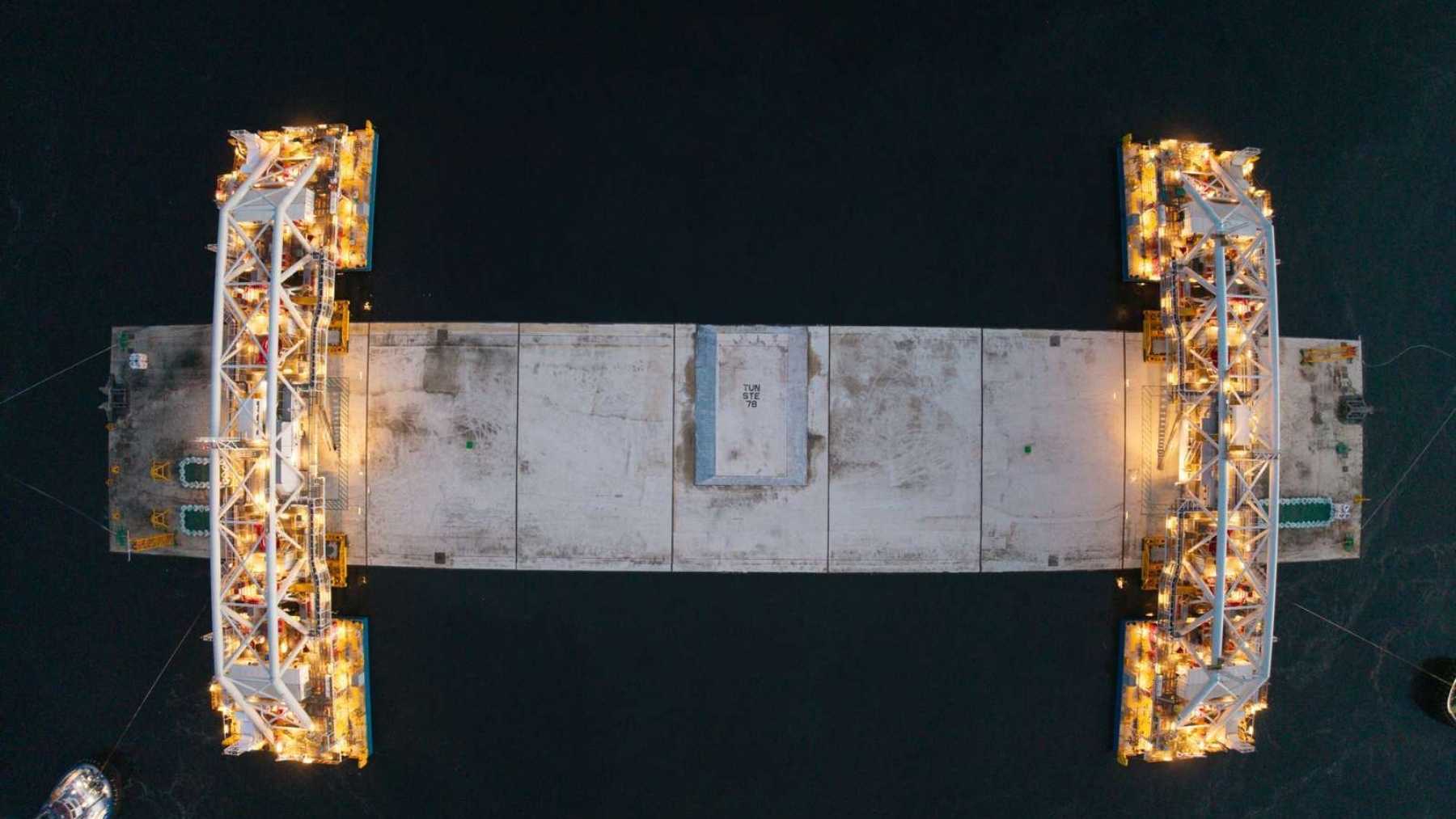
The factory on the Danish island of Lolland casts 73,500-metric-ton concrete boxes. A purpose-built pontoon carries each one out and lowers it onto the seabed. Both work. The pontoon did the job for the second time on June 27, and Denmark now has a little over 1,600 feet (500 meters) of an 11-mile tunnel lying on the floor of the Fehmarn Belt.
The project is still running about two years behind. And on May 17, Sund & Bælt, the Danish state company that owns it, stopped promising one opening and started promising two: the road first, the railway later, whenever Germany is ready to run a train through it.
Cars can’t get through before 2032. The trains don’t have a date at all.
So the hardest part of this job, the part nobody had done at this scale, is going roughly fine. The schedule broke somewhere else entirely.
Two boxes down, 87 to go
Element one left the work harbor at Rødbyhavn at 9 pm on May 4 and was locked onto the Danish tunnel portal three days later, in an operation we followed step by step at the time. Element two, named Lund, went out on a Tuesday evening in late June behind five tugboats, got walked into position on steel wires, and was on the bottom by Saturday morning.
That is 51 days between the two.
Sinking a concrete box into the sea is not a new trick. Belgium is dropping 22,000-ton caissons into the North Sea in a ring to build an artificial island for its offshore wind, and Singapore has put 448 of them down to manufacture new coastline. Neither of those has to line up with the one before it.
These do. Element two wasn’t parked against a portal on shore. It had to couple onto element one, underwater, and keep the Baltic out for the next 120 years.
The 51 days matter because of what the original master schedule assumed. It gave the immersion phase three years to place all 89 elements. Divide that out and you get roughly one element every 12 days. Danish trade outlet FemernBusiness, which has been getting project documents released under freedom-of-information rules, puts the internal target at exactly that.
So the first real interval came in at about four times the plan.
Run it forward and it gets uncomfortable. There are 87 elements left. At 51 days each you are looking at more than 12 years of sinking boxes before this thing is even a tunnel, which is roughly where FemernBusiness landed when it did the same sum.
Nobody thinks that is what happens. The first three elements go into the first 2,100 feet (650 meters) of trench, the stretch closest to shore, where the currents have given the crews the most trouble and where Sund & Bælt paid the contractor separately to get the seabed ready. Lasse Vester, deputy project director at Sund & Bælt, said after the second immersion that they “expect to increase the pace of the work” as the contractor gets more reps in.
He is probably right. But 51 and 12 are the only two numbers anyone has, and only one of them was measured.
The tunnel now opens twice
On Sunday, May 17, Sund & Bælt published a release under a headline that does not sound like much: the Fehmarnbelt tunnel will open in two stages.
What it means is that the road and the railway have been decoupled. The motorway opens when the tunnel is finished and tested. The railway opens later, once Germany has track to connect it to.
Mikkel Hemmingsen, CEO of Sund & Bælt, called that “unfortunate for the green transition and for rail passengers” in the same release. He also argued the split lets the tunnel go into service earlier and takes complexity out of the final phase, which is true, and is also what you say when the alternative is holding a finished motorway shut while you wait for a neighbor.
The actual date came separately. Hemmingsen told Danish business daily Børsen that drivers cannot expect to use the tunnel before 2032. Public broadcaster DR carried the same line that day.
The slippage reads like this. The original opening was 2029. In January, Sund & Bælt moved it to 2031. In May it became 2032, and only for cars. The railway timetable wasn’t moved. It was dropped.
The trains are stuck behind a German permit
Denmark builds the tunnel. Germany builds what connects to it. That has been the deal since the two countries signed the treaty in 2008, and it is where this comes apart.
In July 2025, Germany’s federal transport ministry said the German rail facilities on land would not be running in 2029 as planned. Sund & Bælt’s own release blames lengthy and complex approval and permit procedures for starting construction work in Germany. Not concrete. Paperwork.
Then there is the water. The German plan approval that lets Femern A/S build in German waters carries conditions: hard limits on underwater noise, plus rules governing where and when work can happen at all.
Hemmingsen told DR those conditions include not being allowed to work in German waters year-round, and not being allowed to make much noise while you do it. He also pointed out that Germany only issued the permit after a trip through the courts. That part checks out: the challenges to the German approval went to the federal administrative court in Leipzig, which threw all of them out on November 3, 2020.
Sund & Bælt’s position, in writing, is that these conditions make it difficult to recover lost time and may cause further delays. That is a state-owned builder publishing a complaint about a partner government’s permit, which for this kind of company is roughly the equivalent of shouting.
Germany is not standing still, to be fair. When the three transport ministers involved toured the sites together on June 22, about 90% of the 600-meter tunnel entrance at Puttgarden was done. The entrance is not the problem. The 88 kilometers of railway behind it is.
Drivers get in first, and the freight keeps waiting
Right now the only way across the Fehmarn Belt is a ferry between Rødbyhavn and Puttgarden, and it takes about 45 minutes. The tunnel turns that into a 10-minute drive, seven minutes by train, and it roughly halves the Hamburg to Copenhagen rail run.
That last one is the part getting delayed.
The Fehmarnbelt link is a piece of the EU’s Scandinavian-Mediterranean corridor, and the pitch has always leaned hard on freight: containers off trucks, onto electrified rail, between Scandinavia and central Europe. Sund & Bælt is naming the tunnel elements after towns along that corridor. Number two is Lund, in Sweden.
Until the railway opens, none of that shift happens. Trucks keep taking the ferry or the 160-kilometer (100-mile) detour across the Danish mainland, and once the tunnel opens they will take the motorway through it, which is faster but is still a truck.
Sund & Bælt says the phasing gets the tunnel working sooner, and for anyone with a car it plainly does. It also means the first thing to come out of Northern Europe’s largest construction site, a place the company puts at 300 soccer fields employing more than 2,000 people from over 40 countries, is four lanes of motorway.
Element three is the tell. Sink it in a couple of weeks and the 51 days reads as a slow start in the worst stretch of trench. Take another seven weeks and the schedule Sund & Bælt has promised to publish becomes a much longer document.
That schedule is tied to the elements themselves. The May release says the new plan waits until the company has real experience with both standard and special elements, and knows how it will handle the German conditions. Danish transport minister Signe Munk said after the June visit that it should land in the autumn, according to regional broadcaster TV2 Øst.
So: 500 meters of the world’s longest immersed tunnel exist. The machine that puts them there works. And the reason you can’t drive through it until 2032 is a stack of approvals, not a stack of concrete.