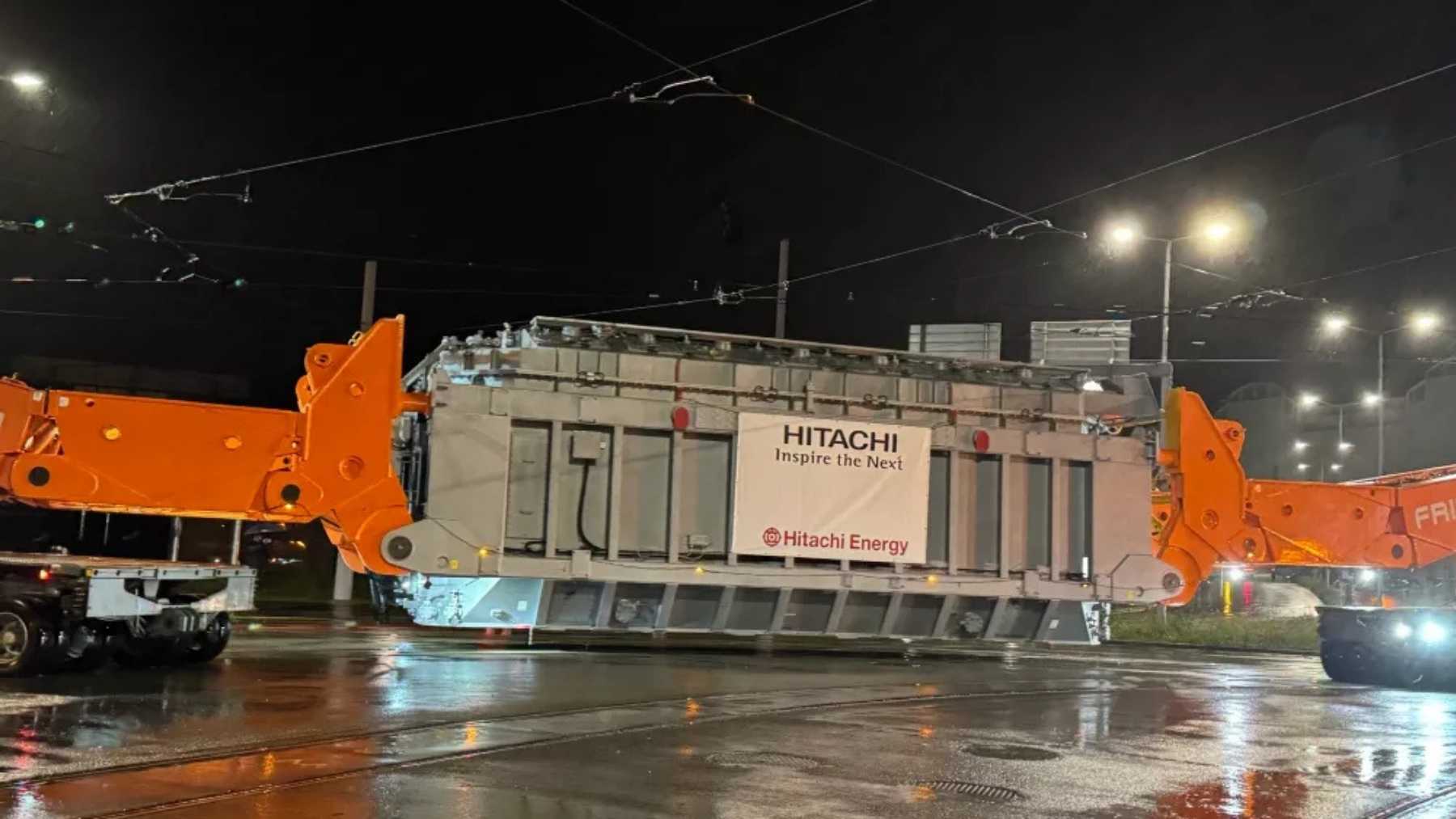

If you have ever been stuck behind an oversized load on the highway, hazards blinking and a pilot car crawling out front, you know the routine. It is wide, it is slow, and it is somebody else’s problem for the next ten minutes. The load Hitachi Energy moved out of Sweden this spring was a different category of slow.
It took a year to plan, rode on a custom trailer roughly 350 feet (107 meters) long with more than 300 wheels under it, and needed 14 lorries just to drag the empty rig into the country. Even then it could only manage something close to walking pace. The cargo was a single transformer headed for China, and it is the most powerful machine of its kind ever built.
It left the factory town of Ludvika on March 1 and is now somewhere out on the water, due in Shanghai around the middle of this year. The machine is rated at 750 MVA and built for a ±800 kV system, the kind of numbers that mean nothing until you see what they do at the far end. This one is going to help drag electricity out of the Chinese desert and across the country to roughly 10 million households. But the figure everyone fixated on was the weight, and the weight comes with a small piece of fine print.
The 820-ton number is the truck, not the transformer
Almost every headline put the figure at 820 tons, and that number is real. It is the heaviest load that has ever left the Ludvika factory, and Hitachi owns Europe’s largest railway wagon, good for about 400 tons, which could not come close to handling it. That is why the thing traveled by road and sea instead of rail. But 820 tons is the whole convoy: the transformer plus the 350-foot trailer, its 38 axles, and all that steel underneath.
The transformer by itself weighs 446 tons, which is still roughly the takeoff weight of a fully loaded Boeing 747, so nobody is shrinking the achievement here. It just helps to know whether you are weighing the machine or the truck carrying it.
The route reads like a logistics exam. From Ludvika the convoy crawled by road to Köping, where the 446-ton transformer was lifted onto a barge, floated to the port of Norrköping, and loaded onto an ocean vessel run by Maersk for the long haul to Shanghai. That sea leg alone runs about four and a half months, according to Ny Teknik, which means the machine spends more of its trip floating than most cargo spends existing.
Biggest of its kind, with an asterisk worth knowing
“Most powerful ever built” is the kind of claim that usually falls apart the second you check it, so it is worth being precise. This is the largest HVDC transformer ever built using voltage-sourced converter technology, the newer VSC approach that switches fast and runs a cleaner current. Inside that category, nothing else is close, and Hitachi Energy says VSC every single time it says record.
There is a reason for the caution. The older line-commutated style of HVDC transformer can be physically bigger. Siemens built ±1,100 kV converter transformers for a different Chinese line that weigh roughly 909 metric tons each in operation and run 37.5 meters long. So the Hitachi unit is not the heaviest HVDC transformer in existence.
It is the most powerful one of the VSC type, which happens to be the type the grid is increasingly being built around, because VSC can do things the classic gear cannot. That distinction is basically the whole reason this machine exists.
Where it is headed, and why China needs the VSC version
The transformer is bound for the Gansu–Zhejiang ±800 kV ultra-high-voltage line, a 1,470-mile (2,370 km) link running from the deserts of northwest China to Zhejiang province on the east coast. Gansu has the Gobi on its doorstep, which is to say it has wind and sun and not a lot of people. Zhejiang has the factories, the population, and a regular habit of running short on power.
The line exists to carry the first to the second. Once it is up, Hitachi says it will move more than 36 billion kWh a year, about what 10 million households burn through, and more than half of that is meant to come from renewables.
The reason VSC matters here, and the reason Hitachi keeps repeating the acronym, is that this is the first ultra-high-voltage DC project anywhere to run VSC technology at both ends of the line. Older HVDC links are excellent at shoving a fixed slab of power down a wire, but they are stubborn about reversing it or fine-tuning it, and they need a strong AC grid to lean on.
VSC can throttle the flow up and down, hold a wobbly grid steady, and even help restart one that has gone dark. When your power source is a desert full of wind and solar that surges and sags all day, that flexibility is the gap between a line that works and one that fights you. The project was designed and is being built by State Grid Corporation of China, with Hitachi supplying the converter transformers, the power semiconductors, and the DC-link capacitors that make the whole thing switch.
Sweden built one and handed China the blueprint
Here is the part that says more about the next decade of grid hardware than the tonnage does. This 446-ton unit is one of seven identical transformers the line needs, and it is the only one shipping from Sweden.
The other six are being built inside China, under Hitachi’s supervision, to Hitachi’s design. Ludvika built this first one so the company could run the full type test and validate the design before the Chinese factories copy it at scale. The engineering responsibility for all seven, electrical and mechanical, stays with Hitachi even though most of the metal gets cut on the other side of the world.
The leap is bigger than it looks. The last VSC transformers this factory delivered went to NordLink, the power cable between Norway and Germany, and this new unit is twice as powerful with about 60% more voltage than those. Pushing that much energy through one machine is mostly a safety problem. “The size has been the greatest challenge, especially from a safety perspective,” engineer Andrea Rodriguez told Ny Teknik, and Hitachi had to rebuild parts of the factory to make and test it.
The transformer itself uses a feature the company calls TXpand, a tank engineered to act like a crumple zone: if something faults inside, the walls give and soak up the energy instead of letting the whole thing rupture.
It is easy to get hung up on the 820-ton figure, and Hitachi clearly does not mind that everyone did. But the more interesting number is seven, because it tells you this is a template, not a one-off stunt.
The grid that ties a desert to a coastline is built out of exactly this kind of unglamorous, enormous hardware, the same way a record-setting undersea cable between Britain and Denmark only works because of the converter stations behind it, or the way Australia is rebuilding 287 transmission towers on a live line nobody is allowed to switch off. The wind farm gets the photo. The 446-ton box gets the electricity to your house.
 @alancampbell ROOKIE4 months ago