
Tunnel boring machines have an image problem in Seattle, and the city earned it fair and square. In December 2013, a machine named Bertha stopped dead roughly 1,000 feet into a 9,270-foot dig under downtown. Her cutterhead was 57.5 feet across, the largest in the world at the time.
Crews couldn’t reverse her out. So they dug a pit down from the street instead, hoisted her broken front end up into daylight, rebuilt it, and lowered it back into the hole. That repair took two years, and the SR 99 tunnel she was cutting didn’t open to traffic until February 4, 2019, per Washington State DOT.
There is a tunnel boring machine working under Seattle right now. It’s 7 feet across, nobody rides inside it, and by the start of July it had passed under NW Market Street on its way north beneath 24th Ave NW.
Most of Ballard has no idea it’s down there. Which is precisely the plan.
Bertha is the reason you picture these things as monsters
Bertha showed up from Osaka in more than 40 pieces weighing 6,700 tons, stretched 326 feet end to end, and cost $80 million. Tunneling trade magazine TBM counted roughly 700 cutting tools on that 57.5-foot face and more than 100 people a day operating and maintaining her.
The spec sheet for the machine under Ballard fits in one line. Per Seattle Public Utilities’ June bulletin, filed under the headline Honey, I shrunk MudHoney!, it’s 7 feet in diameter with 10 disc cutters at the front.
Ten. Not 700.
Seven feet is about four inches wider than a standard interior door is tall. Line eight of those bores up side by side and you’d just about span Bertha’s face.
The crew is 6 to 10 people, and every one of them works above ground. They steer from a control station on the surface that SPU cheerfully calls “our own NASA mission control center”. Generous. The underlying fact is real, though: nobody goes in the hole.
Set that against the pair of 1,680-ton Herrenknecht borers waiting in a New Jersey trench, where roughly 40 people work inside the machine while it digs.
It doesn’t drive itself forward. It gets shoved.
This is where the small machines stop being a shrunken copy of the big ones and turn into a different animal entirely.
A borer like Bertha carries its own drivetrain. It shoves off the ring of concrete segments it just built, grinds ahead a few feet, stops, builds the next ring, repeats. Montreal’s 2,000-ton Lisette works the same way under the city’s east end, erecting her tunnel wall behind her as she chews.
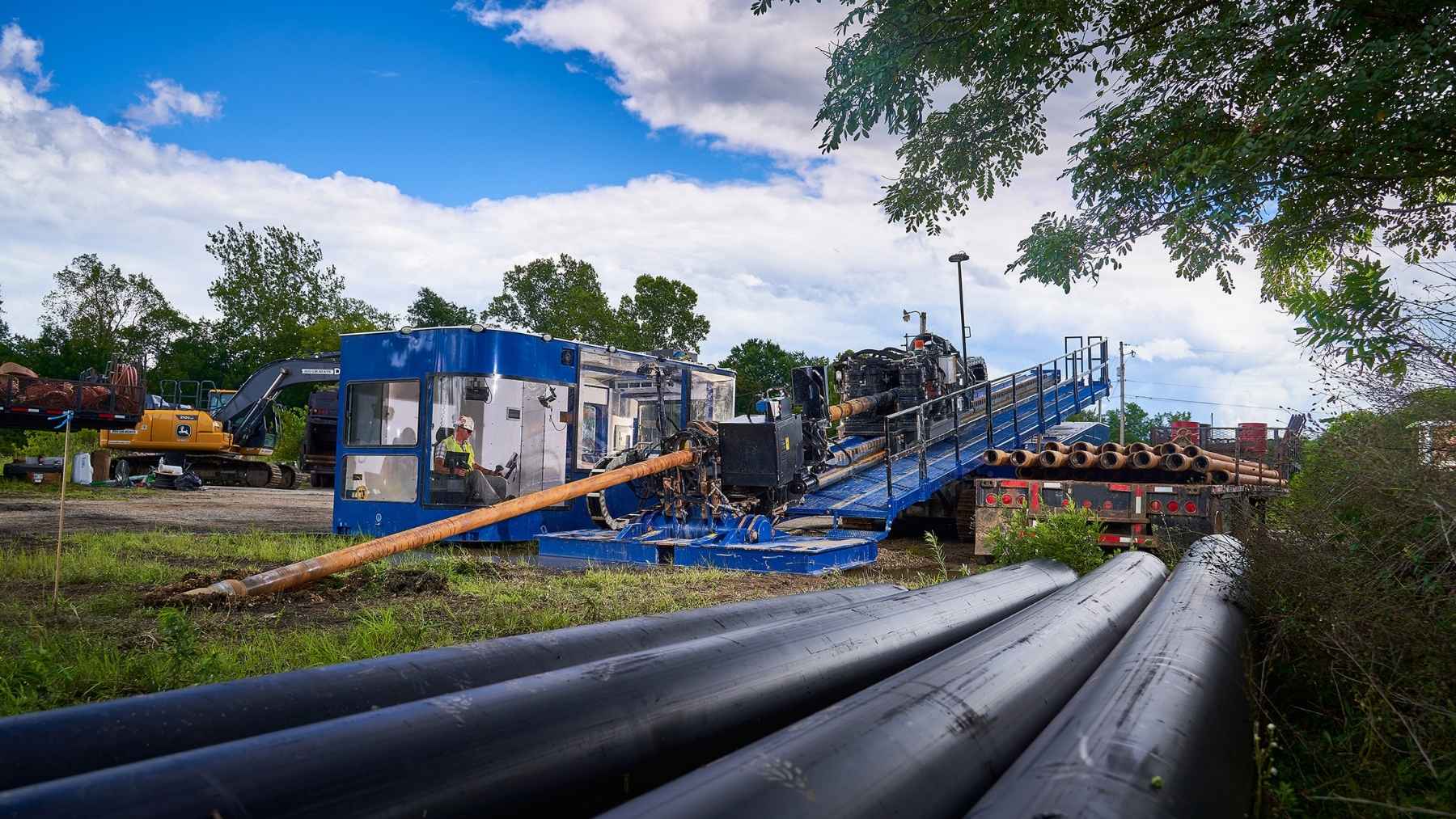
The Ballard machine has none of that. Behind the cutting head and its steering joint there is nothing but pipe.
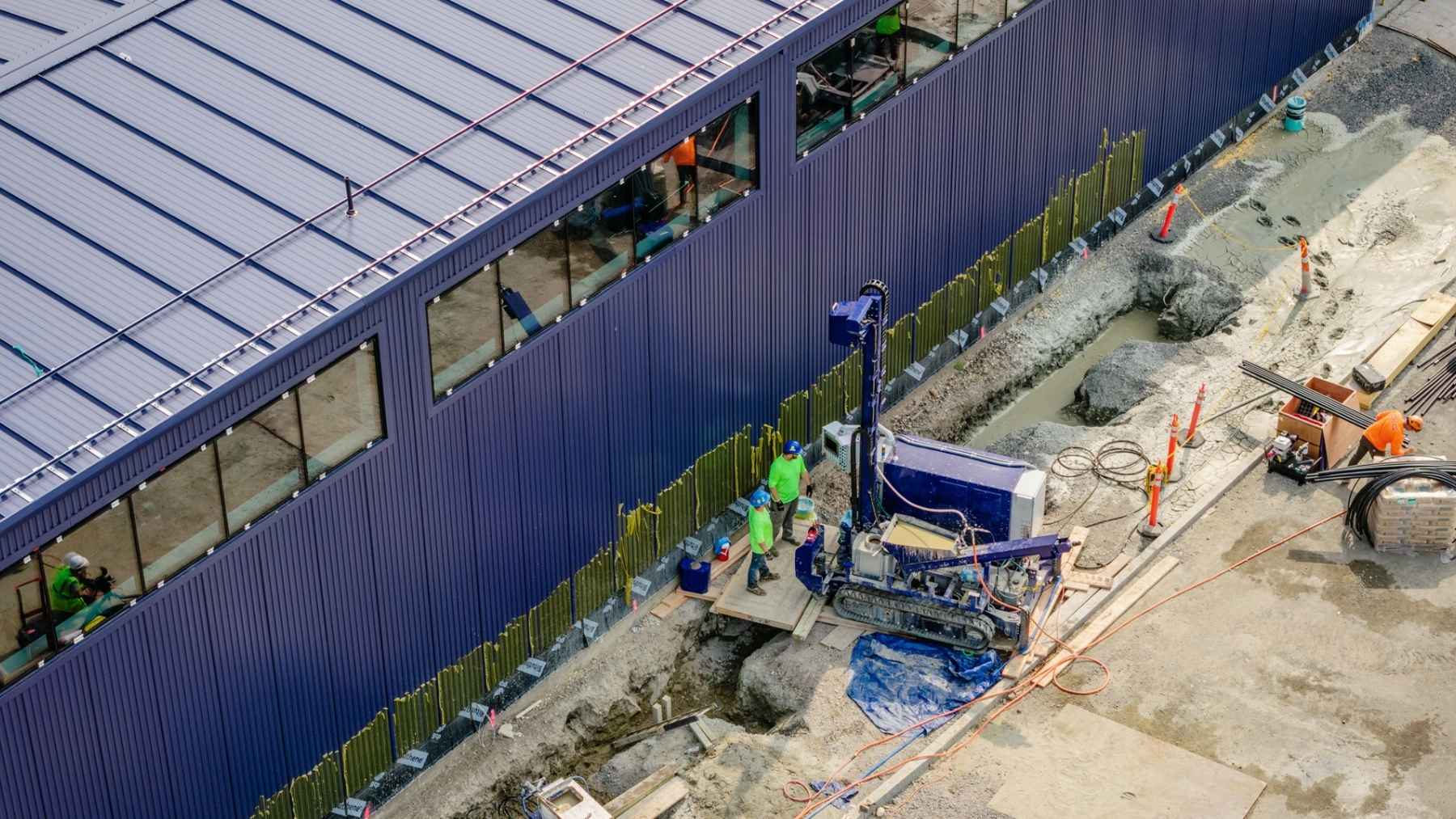
The push comes from hydraulic jacks parked in the launch shaft, braced against a purpose-built reaction wall. The project’s July construction update, reported by neighborhood outlet My Ballard, has crews at 24th Ave NW and NW 56th St building exactly that: a support wall to push the tunneling equipment forward.
Then it’s a cycle. Crews lower a section of pipe into the shaft, slot it in behind the machine, and the jacks drive the whole train ahead one pipe length. Jacks retract, next pipe drops in, push again. SPU describes the same sequence in plainer words: pipe segments lowered into the shaft, then pushed into place.
So the pipe isn’t a liner fitted after the tunnel exists. The pipe is the tunnel, and it’s the drivetrain too. Every foot the cutter head gains, it gains because the entire string of concrete behind it is being squeezed forward from a shaft it left weeks ago.
That comes with an obvious catch. The longer the string, the more ground friction it drags along with it. Pipe jacking crews fight back by cutting the bore slightly wider than the pipe and pumping bentonite slurry into the gap as lubricant, which is why these drives get planned around how far apart you can afford to sink shafts.
It’s an unglamorous corner of the industry, too. Unglamorous enough that an American engineer could build a microtunneling robot that cooks quartzite with an 1,800-degree gas jet instead of grinding it, and almost nobody noticed when the company folded.
At NW 56th Street, they pull it out of the ground and turn it sideways
A pipe jacking drive is a straight shot between two shafts. The steering jacks in the machine’s articulated head let an operator correct alignment by inches. They don’t let it take a corner.
Ballard’s route needs a corner. The new pipe runs north up 24th Ave NW, then west along NW 56th St, then finishes at 28th Ave NW.
SPU’s solution is not subtle. When the machine reaches 24th and 56th, crews haul it back out of the ground, rotate it, and send it west. No curve. A lift, a spin, and a fresh launch.
They’re already at that intersection getting the receiving end ready, building the reaction wall for the westbound drive and the walls the machine will punch through when it turns up. That work zone is scheduled to stay put through spring 2027.
Ballard is doing all this because of a plumbing decision from the 1800s
Older parts of Seattle run on a combined sewer. One set of pipes carries what leaves your house and what runs off your street, together, in the same water.
In dry weather that’s fine. Everything reaches King County’s West Point plant and gets treated. In heavy rain the pipes run out of room, and the mix goes out the nearest outfall into open water.
Lane Construction, which built the storage tunnel, puts that overflow at 90% stormwater and 10% sewage. The 10% is the part that closes beaches and kills fish.
Seattle didn’t invent the problem. DC Water has a 1,200-ton machine named Mary grinding under the Potomac right now for the identical reason: Victorian sewers that can’t swallow a modern storm.
Seattle’s answer is a 2.7-mile storage tunnel, 18 feet 10 inches across inside, running Ballard to Wallingford and holding more than 29 million gallons. It catches the surge, sits on it through the storm, and feeds it to West Point once there’s room downstream.
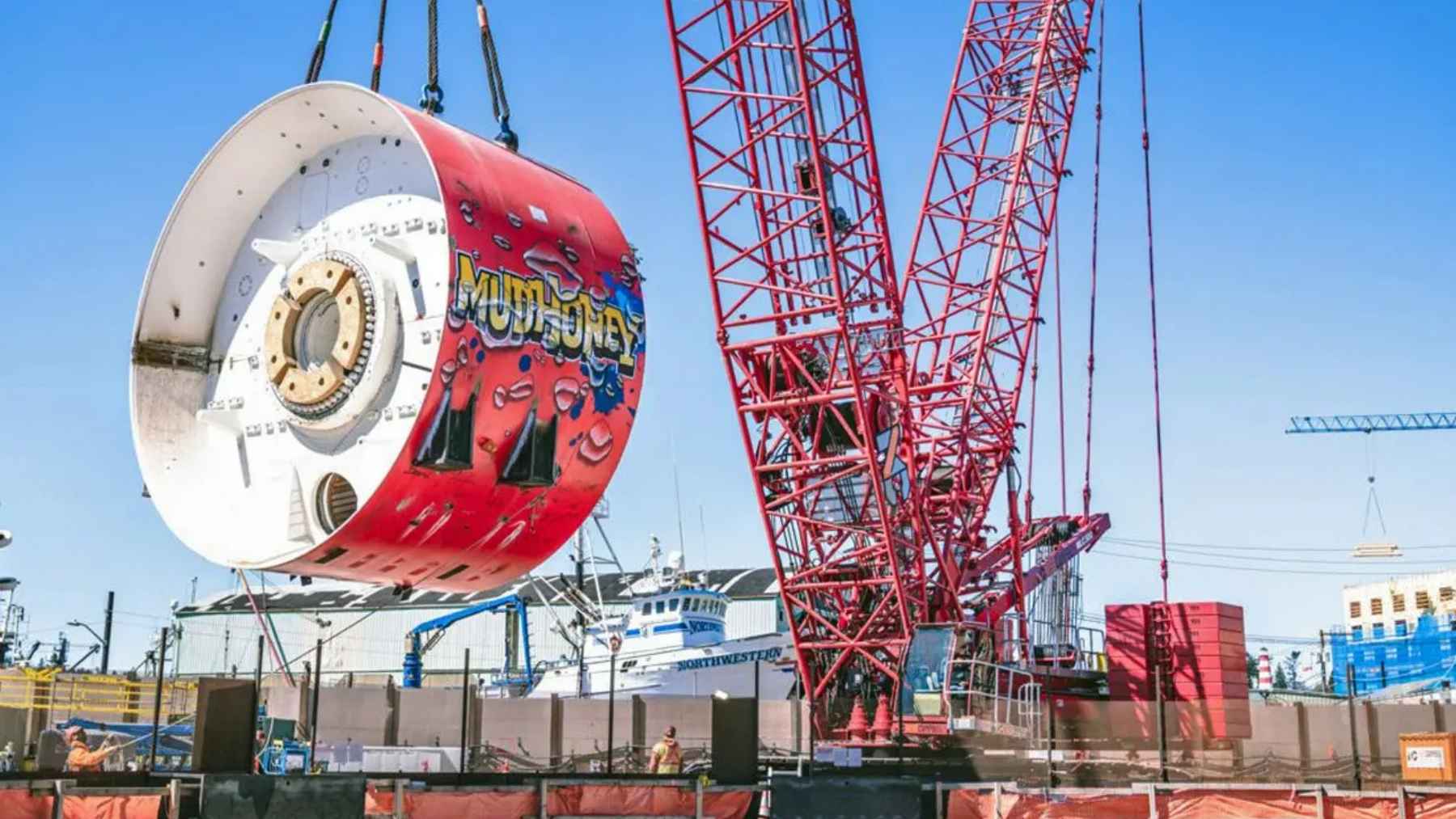
MudHoney dug that one, an 18-foot machine named by public vote. More than 30,000 people cast one. SPU’s shortlist included Boris the Plunger, Molly the Mole and Sir Digs-A-Lot; MudHoney, after the Seattle band, took it, and finished the drive in June 2023.
The tunnel has been sitting there ever since. It’s also useless without pipes to feed it, and that is the entire job of the 7-foot machine.
The payoff is worth the mess. The EPA expects the finished system to cut combined sewer overflows to an average of one a year or fewer at all six affected outfalls, and to reduce pollutant discharges into the Ship Canal by roughly 84% a year.
Lane puts the volume kept out of the Ship Canal, Salmon Bay and Lake Union at more than 75 million gallons a year.
It hasn’t been cheap. SPU’s June 2024 update pegged the project at $710 million at 80% confidence, up from an original $570 million estimate, with the whole system due to be operational in 2027.
The World Cup closed the street. Underground, nothing changed.
Seattle hosted six World Cup matches at Lumen Field between June 15 and July 6, and the city’s Department of Transportation paused most construction in busy areas from June 8 to July 7 to keep everyone moving.
The Ship Canal job complied. Per the July update, the work area was handed back to traffic through July 8.
The machine underneath kept going. It cleared NW Market Street inside that same window.
Which is the whole pitch for doing it this way. The street got returned to drivers for a month. The sewer pipe under it never stopped moving.
SPU tells neighbors they probably won’t notice a thing while the machine is running, and it has hardware in the ground to keep that honest. Settlement monitoring points track surface elevation. Utility monitoring points rest on buried pipes and watch them for vertical movement.
The third kind is where it gets faintly unnerving. Optical survey targets are small glass markers fixed to the outside of buildings, read with surveying gear, sensitive enough to pick up the slightest structural movement.
So if you live on 24th Ave NW, there’s a machine crushing rock under your street on a schedule, and there’s a piece of glass on your wall confirming your house hasn’t budged. Tunneling runs 6 a.m. to 6 p.m., six days a week including Saturdays. It’s happening while you’re at work, not while you sleep.
Nobody is going to name a bar after this one
MudHoney got a naming contest, more than 30,000 votes and a grunge band’s blessing. The machine actually finishing the job doesn’t have a name at all in SPU’s updates. It’s the 7-foot-diameter TBM, and it’ll disappear into a shaft at 28th Ave NW sometime late this year.
Which fits. Bertha made headlines for two years because she was the biggest in the world and because she quit. This one will make none, and that’s the measure of the thing working: Seattle already knows what happens when a boring machine gets famous.
 @catherinebasset ROOKIE3 months ago