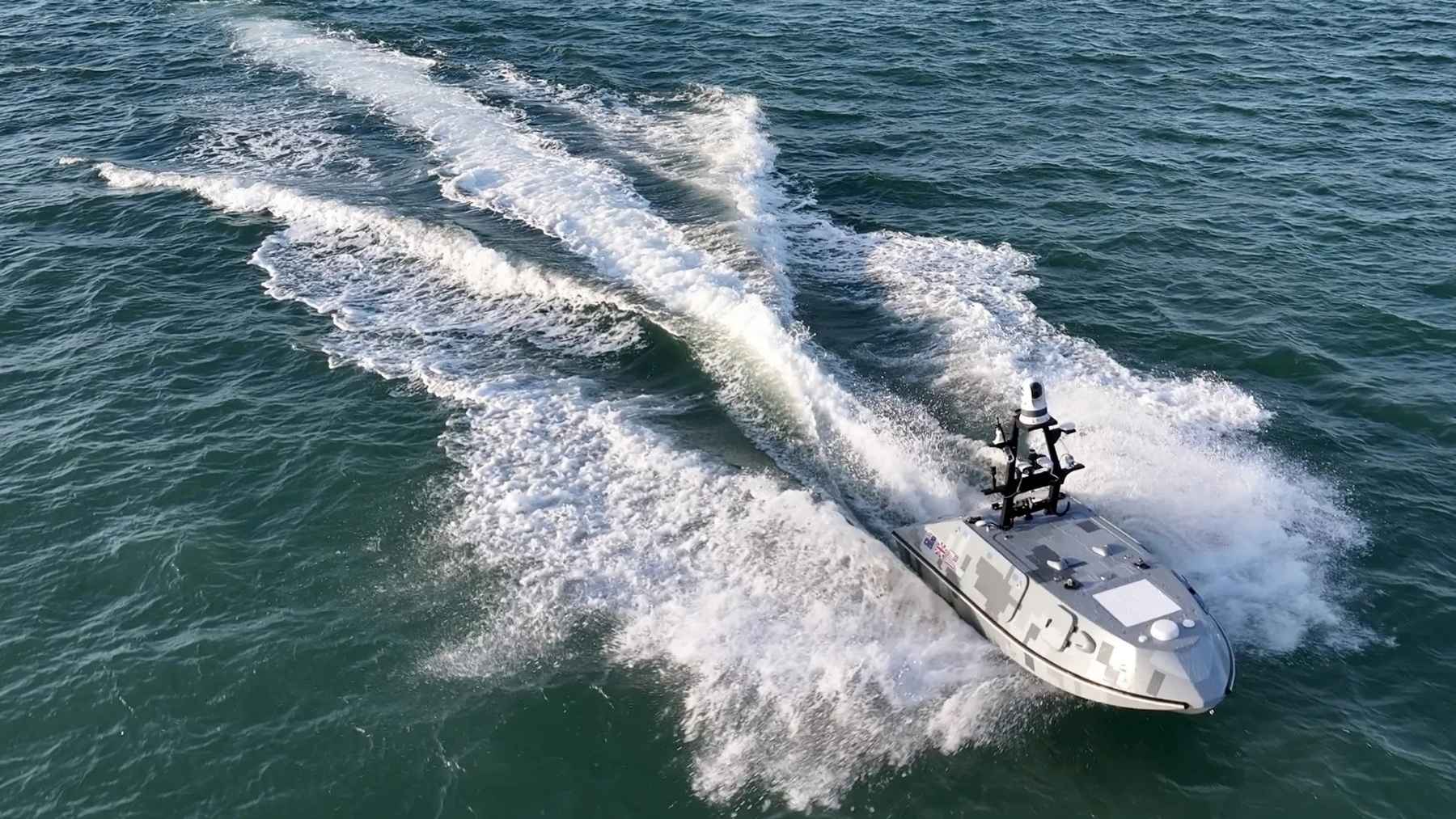

If you ever owned a car with a tape deck, you already understand the pitch here. The hardware never changed. You pushed in a different cassette and the same machine did something new. The deck didn’t care what was on the tape. SubSea Craft, a maritime tech company based in Portsmouth, England, announced on September 4 that its MARS drone boat now handles weapons exactly that way: as cassettes that slide into the hull and come back out, swapped by a two-person team wherever the boat happens to be deployed.
The system’s patent-pending, and SubSea Craft’s announcement says a swap doesn’t involve modifying the vessel itself. The company lists loitering munitions, miniature torpedoes, aerial drones and sonobuoys as potential cassettes, all delivered from the same hull. “Operators can swap cassettes quickly and easily,” in the words of Tom Harkin, SubSea Craft’s chief commercial officer.
So why does a drone boat need a tape deck?
Because bolting a new weapon onto a boat is normally a project, not a chore. Somebody has to engineer the mounts, run the wiring, integrate the software, and then prove at sea that none of it broke anything else. That work happens at a dock, it takes engineers, and it starts over with every new payload. So plenty of drone boats spend their whole careers doing the one job they were wired for on day one.
The cassette moves all of that work into the box. The boat keeps one standard slot; the payload shows up already packaged to fit it. SubSea Craft says the point is cutting integration timelines so new payloads get to sea faster, and the field-swap part is what separates this from a shipyard upgrade. A two-person team handles it.
That’s the whole pitch.
You’ve seen other answers to the same question here before. A British 56-footer we covered in August was built around a 20-foot shipping container slot, and Ukraine’s newest Magura carries 18 interceptors in boxes bolted to its deck. The cassette is the smallest of the three approaches and arguably the most portable: a container needs a crane and a port, deck boxes are built around whatever sits inside them, and a cassette needs two people and wherever the boat already is.
An Anduril ALTIUS has already gone out the slot
This isn’t a concept render. SubSea Craft says the cassette system has already been used to integrate Anduril’s ALTIUS, and it released an image that Naval News ran with a caption describing MARS launching the ALTIUS through the new system. SubSea Craft’s own image says it happened.
If you haven’t met the ALTIUS, it’s a tube-launched drone from Anduril that flies out, loiters, and either watches something or dives into it. Anduril builds it to launch from the ground, the air or the sea, so a tube sitting in a cassette is, frankly, about as natural a fit as this idea gets.
What SubSea Craft hasn’t said is when or where that launch happened, and I can’t find a date or a location for it anywhere else. That’s a fairly big blank in an announcement built around the event. So the launch stands confirmed by the company, and nobody’s published a date.
So how big is this boat, exactly?
Here’s the odd part: the company’s MARS page doesn’t publish the boat’s dimensions today. It calls the craft low-signature and high-speed, says it went from design to the water within 100 days, and sums up the resume as built in the UK, trialed in open water in Australia with the Australian Maritime College, and tested with US payloads. SubSea Craft pitches it for maritime domain awareness, persistent surveillance, countering other unmanned systems, and full ISTAR work, which is the military’s umbrella term for finding things, watching them and lining up a shot.
SubSea Craft has put numbers on this hull before, though. You’ll just have to go back to when the boat first got wet. A company official told the defense outlet Shephard that MARS reaches up to 30 knots (about 35 mph) and up to 300 nautical miles (roughly 345 miles), and reporting around the debut put the hull at about 19.7 feet (6 meters). None of that made the current spec sheet. The upgraded MARS went into production in May, and I’d treat all three figures as the company’s claims for the first boat rather than measurements of the one now being built.
Compare that with how the neighbors do it. ZeroUSV cut a 20-foot container slot into a 56-foot hull; SubSea Craft’s cassettes go into a boat roughly a third that length. The Magura MV11 hauls its 18 interceptor boxes on a 39-foot deck. A smaller hull gives up payload, sure, but it also buys a boat that’ll launch from a bigger ship, work rivers as well as open water, and get rearmed on-site by the same two people. I suspect that last part’s what the patent application is really about.
SubSea Craft published the cassette announcement on September 4 with the ALTIUS already through the slot, and the upgraded MARS it slides into has been in production since May. Tom Harkin’s team now gets to find out which cassette a customer asks for first.