
Tunnels are supposed to be for cars and trains. You bore a hole through a mountain so a highway doesn’t have to climb over it, or you thread a subway under a city, and the whole exercise is about moving people and freight across land that happens to be in the way. Norway just put up the money to build one for ships.
On June 19, in its last session before the summer break, the Norwegian parliament signed off on the revised national budget, and tucked inside it was the funding to start the Stad Ship Tunnel. That sounds like a footnote. It isn’t. It’s the final step that takes a decades-old idea off the drawing board and points it at a 2027 construction start.
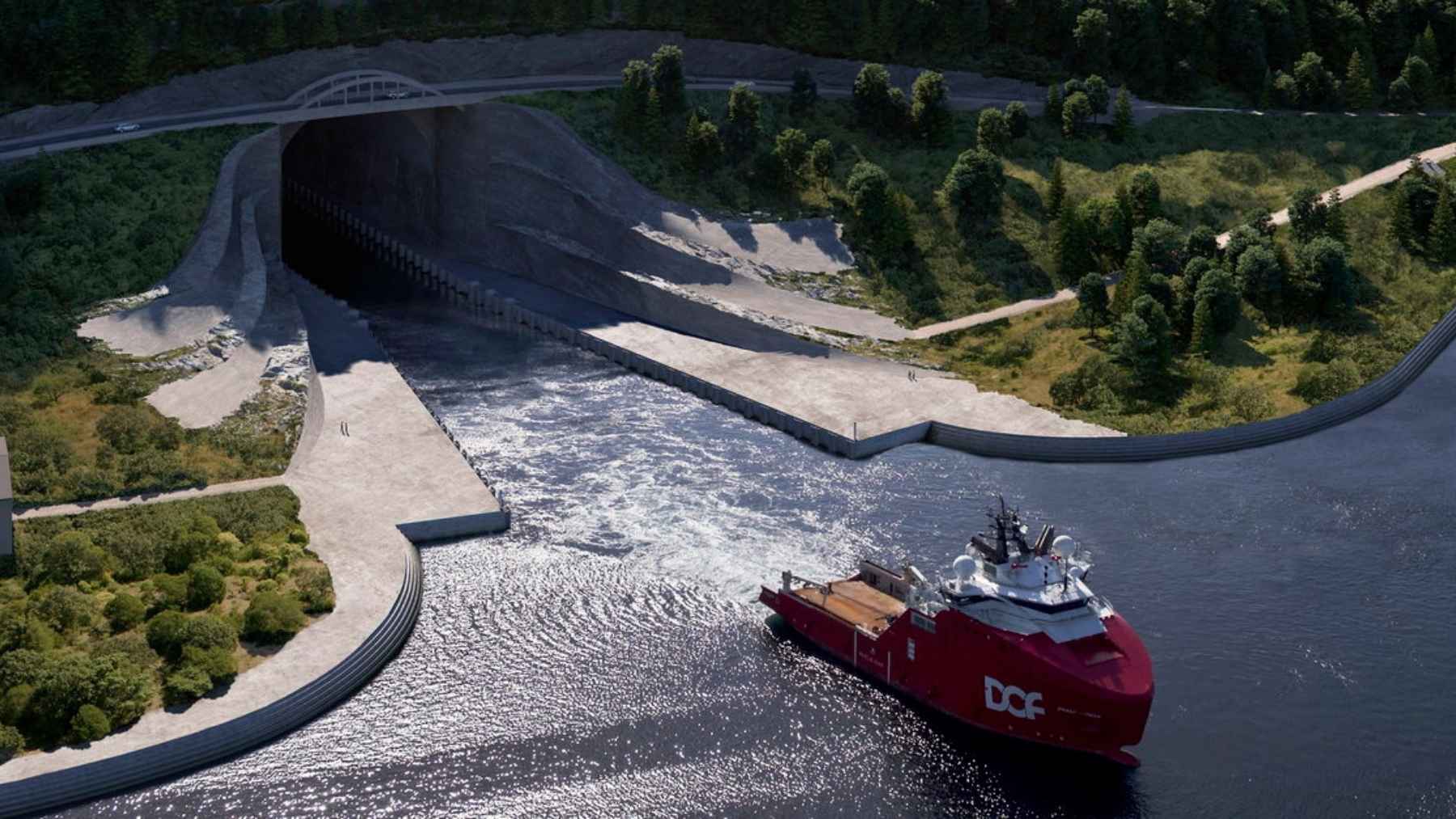
When it’s finished, it’ll be the world’s first full-scale ship tunnel: a 1.7-kilometer (1.06-mile) passage blasted straight through a coastal mountain so cargo ships, ferries and full-size coastal cruise liners can sail through solid rock instead of around the most dangerous piece of water on the Norwegian coast.
This is not “they’re digging it now.” The money clears the way for a contract and for early work, with the actual blasting still a couple of years out. But after a project that has spent the better part of a century being proposed, costed, approved, shelved, and revived, the money showing up is the part that was never guaranteed.
The sea that makes ships wait for days
To understand why anyone would spend close to a billion dollars boring a hole for boats, you have to look at what the boats are trying to avoid. The Stadhavet Sea sits off the Stadlandet Peninsula on Norway’s west coast, and it has a reputation among Norwegian sailors that the engineering is meant to answer.
The Norwegian Coastal Administration, the agency running the project, calls it likely the most weather-exposed and dangerous stretch of sea along the entire Norwegian coast. The numbers back the description up. Storms hit the area roughly 100 days a year. Waves can reach 30 meters, which is about 100 feet, and they don’t politely arrive from one direction either, they converge from several at once, which is the kind of condition that turns a routine passage into a guessing game. According to Interesting Engineering, the waters have been blamed for more than 30 deaths at sea since World War II.
The result, in normal operations, is delay. Fishing boats, cargo carriers, salmon-farm transports and the passenger ships that run the coastal route all end up sitting in port waiting for the weather to behave. That last category is more than an inconvenience. Trøndelag exports a lot of farmed salmon to the continent, and as county mayor Tore Sandvik has pointed out, fish bound for a dinner plate in Europe can’t afford to sit stuck at Stad while a storm blows itself out. A tunnel that lets the boats keep moving in bad weather is, for that cargo, the difference between a market and a loss.
What they’re going to blast through the mountain
The plan is to cut the tunnel through the narrowest point of the Stadlandet Peninsula, connecting the Moldefjord with Kjødepollen in the Vanylvsfjord region. Most coverage measures it at 1.7 kilometers (1.06 miles) of solid rock, or 2.2 kilometers (1.37 miles) once you count the entrance structures built out into the water to funnel ships safely into the portal.
It is not a modest hole. The tunnel will stand 50 meters (164 feet) tall and 36 meters (118 feet) wide, big enough to take vessels up to the size of Norway’s famous Coastal Route ships, the Hurtigruten and Havila fleets, plus large cargo vessels, ferries and cruise ships with drafts up to 12 meters and beams up to 16 meters. Kystverket reckons about 81 percent of today’s ship traffic will be able to use it. Cruise ships will be held to eight knots inside, which still gets them through the mountain in roughly 10 minutes.
Getting there means removing about three million cubic meters of rock, which works out to something like 750,000 truckloads of material. There’s no tunnel boring machine here, none of the massive cutterheads grinding shafts through rock elsewhere. The crews will use conventional drill-and-blast methods to chew through the hard gneiss under the peninsula, the same brute-force approach used on plenty of Norwegian road tunnels, just on a far bigger scale and pointed at the sea.
Roughly 70 to 80 percent of the blasted rock is expected to be reusable as roadbed, rail base or aggregate for asphalt and concrete, so the spoil isn’t entirely waste. The entrances were designed by the Norwegian firm Snøhetta, with the rock walls left deliberately rough so the portals blend into the cliffs rather than announcing themselves.
The project that kept refusing to sink
The reason this is news in June 2026, and not some quiet groundbreaking nobody noticed, is that the tunnel has spent the last year on political life support. Norway’s parliament actually approved it back in 2021, under a cost framework that was supposed to stay around 4.1 billion kroner, later adjusted to 5.4 billion. Then the estimates climbed. By the time the plans were finalized, the Coastal Administration’s number had pushed up toward 9.6 billion kroner, just over a billion dollars, and a project that had looked affordable started looking like a luxury.
In October 2025, Prime Minister Jonas Gahr Støre’s government pulled the plug, telling broadcaster NRK the tunnel was simply too expensive. As recently as May 2026, Finance Minister Jens Stoltenberg, the former NATO chief now running Norway’s budget, drew a line through it again. His revised budget proposal set aside exactly nothing for the tunnel and shifted the 150 million kroner once earmarked for it into road maintenance instead.
He framed it as one of the budget’s most important single cuts: a project that cost too much, delivered too little, and would be used by relatively few. The government’s own cost-benefit math had it running a negative net benefit of 5.9 billion kroner, with the costs landing nearly four times the measured value.
That’s usually where an expensive piece of infrastructure dies. It didn’t, because the math that matters in a Norwegian budget isn’t only cost-benefit, it’s votes. Labour doesn’t hold a majority on its own, so the revised budget had to be negotiated with the Centre Party, the Socialist Left, the Greens and the Red party, and the Centre Party has wanted this tunnel for years. After more than 40 hours of overtime talks, the red-green bloc put the funding back in. Bjørn Arild Gram of the Centre Party announced it flatly at the budget press conference: “Stad Ship Tunnel will be built.” The final package gave the project a total cost framework of 8.6 billion kroner, about $800 million, plus a 150-million-kroner start-up allocation to get moving this year. The parliament’s formal sign-off on the whole budget came on June 19, its last sitting before summer recess.
Not the first tunnel for boats, just the first like this
It’s worth being precise about the “world’s first” label, because tunnels for watercraft are not actually new. As New Atlas notes, they go back to 1679, when the Malpas Tunnel opened on France’s Canal du Midi. The catch is that every one built since then has been an inland affair: canal boats, river links, harbor connections, all in sheltered water. What makes Stad different is the setting. This is an ocean ship tunnel cut through a coastal headland, sized for seagoing traffic that has to deal with open-sea conditions on either end, which is a very different engineering problem from floating a barge through a hillside.
The idea itself is older than most of the people debating it. It was first floated in a local newspaper back in 1874, and during World War II the Germans drew up plans for a similar tunnel to shield shipping from both weather and attack. Neither went anywhere. Now, after a century and a half, the version that survived the budget fight is a genuinely modern megaproject, and not the only one of its kind in Europe right now. It joins a run of enormous undersea and coastal builds, from Denmark’s 73,500-ton concrete tunnel boxes sinking onto the Baltic seabed to Belgium’s artificial energy island being assembled out of caissons in the open North Sea.
A contract, a standstill, and five years of blasting
So what actually happens next. With the funding secured, the Norwegian Coastal Administration says it’s ready to sign. The agency has already finished evaluating the final bids it received in April from three groups competing for the main construction contract: Norway’s AF Gruppen, France’s Eiffage Génie Civil, and a joint venture between Sweden’s Skanska and Norway’s Vassbakk & Stol. Once the award is announced, there’s a standstill period for any complaints before the contract can be signed, with separate contracts for demolition work and new water pipelines near the site ready to be tendered alongside it.
Kystverket Director General Einar Vik Arset says the agency is prepared to start the moment it gets instructions from the Ministry of Trade, Industry and Fisheries, with the goal of breaking ground in early 2027. From there, project manager Harald Inge Johnsen has put construction at about five years. So the earliest a cruise ship sails through that mountain is somewhere around 2032, assuming nothing else goes sideways with a budget that has already proven it can.
And the hedge is earned, because this is a project that has been declared dead more than once and keeps climbing back out of the budget. The hard part was never the rock. A drill-and-blast tunnel through gneiss is well-understood engineering, and Norway builds tunnels in its sleep. The hard part was getting a country to agree that boring a mile-long hole for ships through a mountain is worth the better part of a billion dollars. For now, at least, the answer is yes. Whether it stays yes through five years of construction invoices is the part nobody can blast their way through.