
Boring machines cost so much that most projects buy one and make it do everything. Dig one tube, drag the machine back or cut it into pieces, start the next one. Adelaide bought three, and from next month all three are supposed to be cutting under the city at the same time.
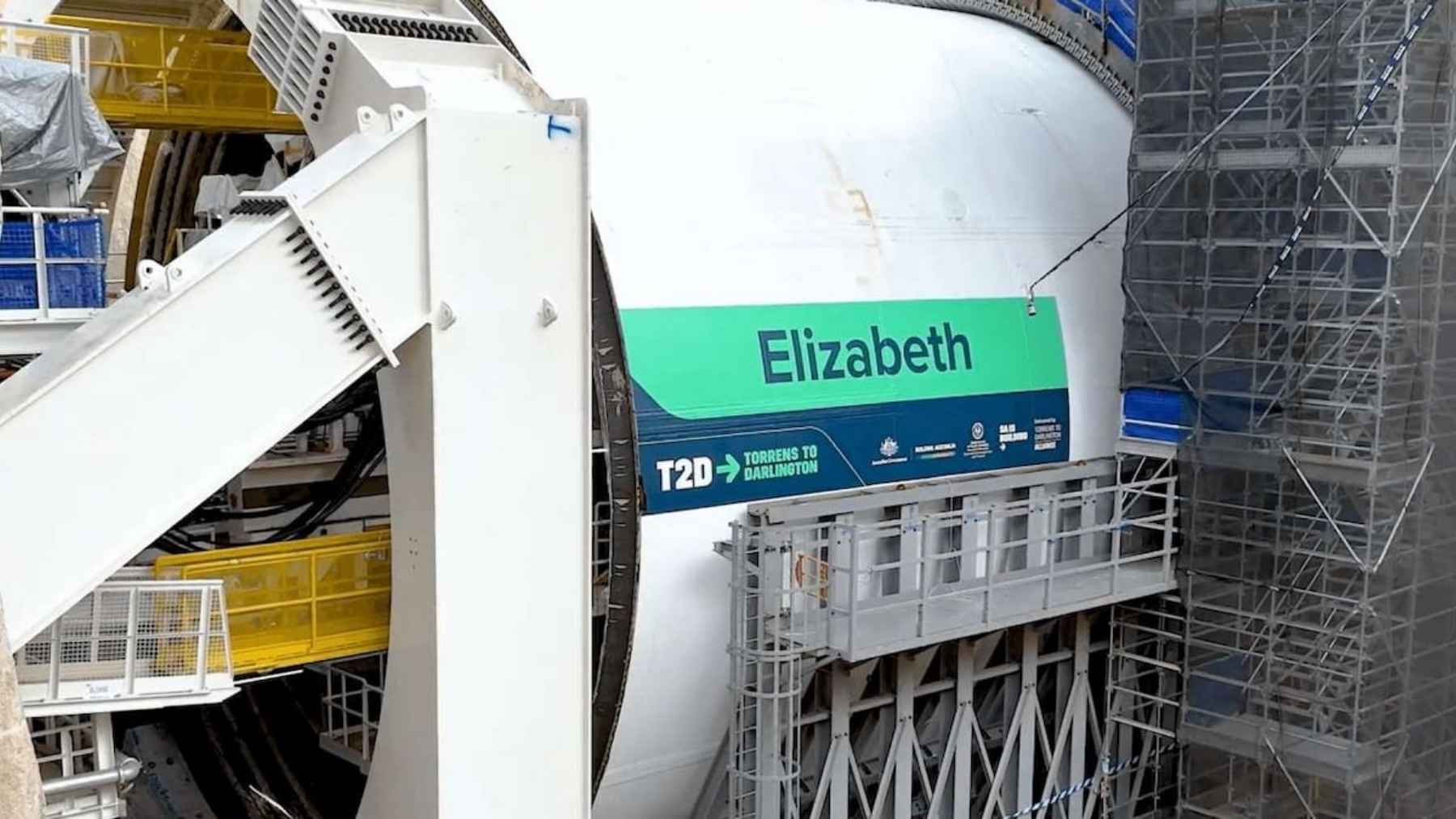
The third one got blessed on Saturday morning at a launch box in Hilton, a suburb about two miles west of the Adelaide CBD. Her name is Elizabeth. She is the last of the trio to go through the ceremony, and her launch is what tips the project into something no Australian road job has done before.
Mary has been grinding under the southern suburbs since July 1. Catherine is sitting in the same pit Mary launched from, waiting her turn. Each machine runs about 328 feet long, 49 feet across at the cutting face, and weighs roughly 3,500 metric tons, or about 3,860 US tons. All three came from Herrenknecht, the German manufacturer in Schwanau that has supplied borers for HS2, the Elizabeth line and Sydney Metro.
The project underneath all this is called River Torrens to Darlington, or T2D. It is the biggest thing South Australia has ever built.
Elizabeth was the last one to get blessed
Tunnel crews have been blessing machines since the 1500s, when miners started asking Saint Barbara for protection underground. The tradition survived into an industry that now runs 22,000-volt substations and laser-guided cutterheads, and nobody has bothered to drop it.
Adelaide has now done it three times. Archbishop Patrick O’Regan handled Mary back in May. Father Joseph Wales Raja George from nearby St Bernadette’s Church did Catherine at the Clovelly Park launch box on July 11. Father Lancy took Elizabeth on Saturday.
The names came out of a public call for nominations that pulled in more than 2,000 submissions. All three honor South Australian suffragists: Mary Lee, Catherine Helen Spence and Elizabeth Webb Nicholls. South Australia was the first place in the world where women could both vote and stand for parliament, which is the sort of thing a state likes to put on the side of a 3,500-ton machine.
Joe Szakacs, the state Infrastructure and Transport Minister, pointed at how fast the site itself came together, saying that a year ago the Hilton precinct was “little more than an empty site.”
Only one of the three is actually digging right now
This is worth being precise about, because the headlines around it have been loose. As of this week, Mary is the only machine of the three with a cutterhead turning.
Catherine was blessed on July 11 and has been described by the project ever since as preparing to launch. Elizabeth was blessed on Saturday and still has to start. The state’s own TBM Tracker currently follows one machine, with the federal infrastructure department noting that updates on Catherine and Elizabeth arrive once they begin tunneling.
The government line is that all three will be turning next month. There is no published date for the day the third one starts, which is the number everyone actually wants.
The closest comparison in the country is Melbourne’s North East Link, which ran two machines under the northern suburbs and is currently down to one. Three at once on a road project has not been done here before, which is why the state keeps repeating the claim.
Elizabeth digs north, then gets taken apart and turned around
Mary and Catherine have the straightforward job. They launch from the same box at Clovelly Park and carve the twin Southern Tunnels, 2.8 miles each, north toward Glandore.
Elizabeth’s assignment is stranger. She launches from Hilton and drives about 1.4 miles north toward the Brickworks at Torrensville. Then she stops, because the northern tunnels are short enough that buying a fourth machine to dig the parallel tube makes no financial sense.
So the crews dismantle her instead. The cutterhead, front shield and main drive stay bolted together as one 2,000-metric-ton block, roughly 2,200 US tons, and that block gets turned around and reassembled to dig the second northern tunnel back toward Hilton.
It is a slow, expensive piece of choreography, and it is still cheaper than a fourth Herrenknecht.
There are five machines down there, not three
The part that got buried under the ceremony coverage is that the fleet is bigger than the trio everyone photographs.
Two smaller borers are joining them, each about 13.5 feet tall, built to dig the cross passages that connect the twin tunnels every 394 feet. The first arrived in Adelaide this month after clearing factory acceptance testing in China. The second is due in the coming weeks.
Cross passages are mandatory. They are the evacuation route if something goes wrong in one tube, and they also carry maintenance access plus the electrical and signaling gear. Most projects cut them by hand or with roadheaders, which is slow and unpleasant work in soft ground.
Doing it with two dedicated machines is an Australian first as well, according to The Tunnelling Journal. Adelaide’s ground is mostly clay, which is what makes the small machines viable in the first place.
Running three at once was an electrical problem first
Machines this size do not plug into the local grid. Each one chews through power continuously, and the state decided early that borrowing it from Adelaide’s distribution network was not going to work.
So SA Power Networks built two substations from scratch, each rated at roughly the equivalent of 5,000 homes and each supplying a dedicated 22,000-volt feed tuned to what the borers need. Tonsley East covers Mary and Catherine. Richmond East, switched on at the end of May, exists purely to run Elizabeth.
The utility has said it normally builds about one substation every three years. It built two for this. Neither gets torn down afterward either, because once the tunnels open the same substations switch over to running ventilation, lighting, traffic management and the safety systems inside.
The digging cycle itself is unglamorous and identical every time. Teeth and discs on the cutterhead shave the face, conveyors haul the spoil out the back, and an erector arm sets 10 precast concrete segments into a ring behind the machine. Hydraulic cylinders then shove off that fresh ring to push the machine forward, and it starts again. The four tunnel drives need more than 50,000 of those segments.
Six and a half miles of road for about $10.7 billion
T2D costs A$15.4 billion, which lands around $10.7 billion at current exchange rates, split evenly between the federal and state governments. What that buys is the final 6.5 miles of Adelaide’s North-South Corridor.
Finish that stretch and the corridor becomes 48 continuous miles of traffic-light-free road between Gawler and Old Noarlunga. South Road currently carries more than 100,000 vehicles a day and the tunnels are projected to swallow about 130,000 weekday trips.
Kyam Maher, the state’s Acting Premier, framed the payoff in the only terms drivers care about, saying the finished road lets South Australians “bypass 21 sets of traffic lights” between the River Torrens and Darlington, with peak-hour savings of up to 40 minutes.
Whether a $10.7 billion road actually delivers 40 minutes back to anyone is a question for 2031, which is the target completion date. Washington is running its own machine named Mary under the Potomac on a similar logic and a similar timeline.
Each of Adelaide’s three moves 26 to 33 feet a day, working around the clock with up to 20 people riding inside. Run all three and the job turns out somewhere near 100 feet of finished tunnel a day.
For the largest thing this state has ever built, that is not exactly a sprint. And the state has not published the date all three start turning together. It says next month, and right now that is as specific as it gets.