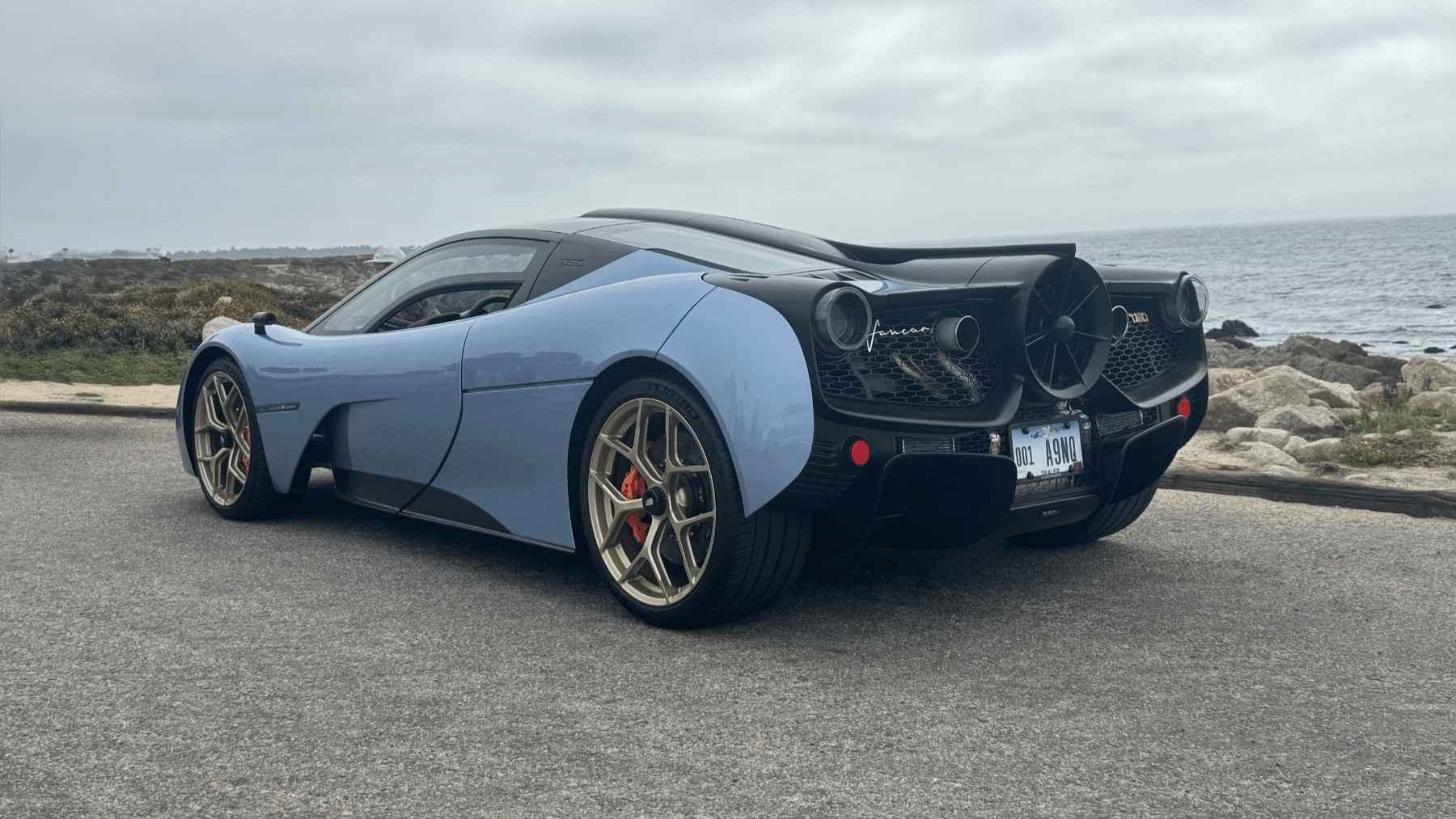

While driving up and down 17-Mile Drive early in the week, my boyfriend and I kept spotting this peculiar blue car with dramatic doors and what looked to be a fan on the back. We chased it down (along with the other car spotters scouting the drive early) and I was able to get some pretty cool shots of it.
At this point, you’ve probably seen pictures of this car making the rounds. It seems to be the most interesting spot before all the chaos of Monterey Car Week really begins later on. But what the heck is it?
What is the Gordon Murray Automotive T.50, and what is that on the back?
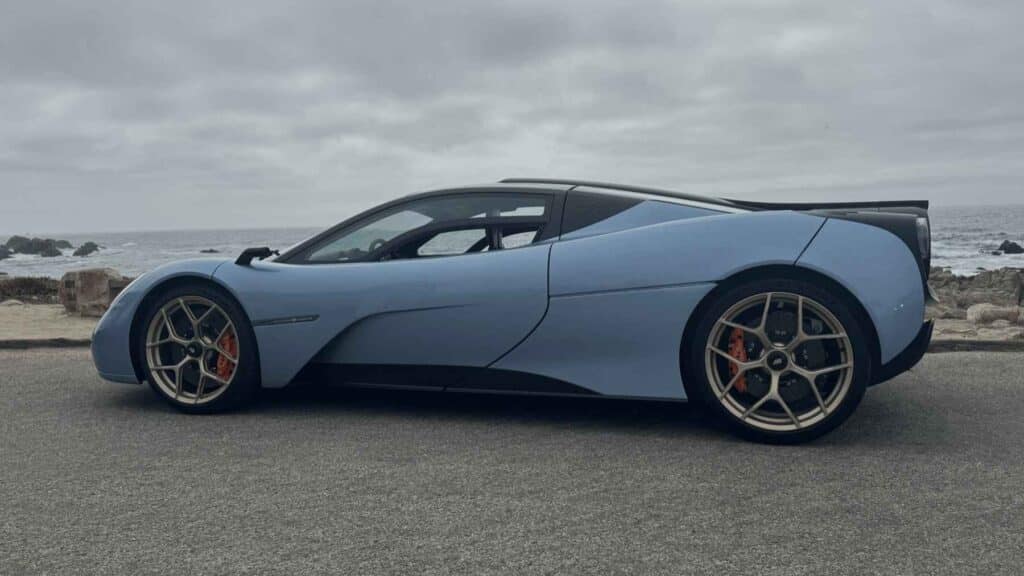
At first, this car looked a little “normal.” Just a flat, angular sports car. Nothing to see here. Although the baby blue set it apart. It definitely had us taking a few glances as we drove by.
Then, the doors swung open. They are something called “dihedral doors,” which swing outward then upward when opened. You’ve probably seen it on the McLaren F1. That was most definitely an attention grabber along the shore.
This is the Gordon Murray Automotive T.50, built by Gordon Murray, the man behind the aforementioned F1 and other record-breaking, stunning vehicles. The T.50 isn’t as groundbreaking as those vehicles. But not everything is about top speeds and 0-60 records.
Car and Driver wrote about the T.50 back in 2025, getting this interesting take from GMA CEO Phillip Lee: “Why are you chasing top speed anyway?” Lee went on to argue that there are only so many times you can make yourself feel sick in a car, that theme parks exist for that sort of thing, and that what actually matters is wanting to get back in.
The T.50 has a bespoke 3.9-liter naturally aspirated V12 engine made specifically for this vehicle, despite only 100 of the car ever being made. It creates 654 horsepower and 344 lb-ft of torque, which is a good amount for something that weighs just 2,198 pounds.
But what probably caught your eye the most is the fan on the back. It’s basically meant to control airflow and create more downforce, making the T.50 even more impressive in its track performance. Murray doesn’t like the look of splitters, wings, and other over-the-top elements that ruin the flow of the T.50’s design. Hence, the fan.
How does the Gordon Murray Automotive T.50’s fan work?
If you’re a more tech-y person, maybe you want a little more than “it’s good for airflow.” If so, here is a brief explainer.
Unlike the infamous fan-equipped Brabham BT46B Formula 1 car that Murray designed in the 1970s, the T.50’s system is not simply a giant suction device. It is a sophisticated active-aerodynamics system designed to make the car faster, more efficient, and more stable without relying on enormous wings or splitters.
The 15.75-inch fan is powered by a lightweight 48-volt electric motor and can spin at up to 7,000 rpm. As I said, its primary job is to control airflow underneath the car. But here’s how it all works: The T.50 uses a steep diffuser and Venturi-style underbody to generate downforce, but that aggressive shape can cause airflow to stall in certain areas. The fan effectively pulls that stalled air through the diffuser, allowing the underbody to generate significantly more downforce.
The system can also reduce drag. In the T.50’s Streamline mode, valves in the diffuser partially close, cutting downforce roughly in half. Meanwhile, the fan continues spinning quickly and extracts air from the upper engine bay, reducing drag by approximately 12.5 percent. At full speed, the fan itself can even generate around 33 pounds of thrust.
The fan becomes particularly useful under heavy braking. In Braking Mode, the diffuser valves open, the fan operates, and the rear spoilers automatically deploy to their maximum 45-degree angle. According to Gordon Murray Automotive, this combination can double the car’s downforce and reduce the braking distance from 150 mph to zero by nearly 33 feet.
The concept has roots in Murray’s earlier work. His Brabham BT46B used a gearbox-driven fan to create enormous downforce, while the McLaren F1 later incorporated two smaller fans beneath its rear bodywork. Those fans improved cooling while also helping extract air from the diffusers, producing more downforce with less drag.
The T.50 represents the most advanced evolution of that idea. Rather than adding increasingly large aerodynamic surfaces, Murray uses airflow itself as an active tool. The result is an extraordinarily effective but complicated system, one Murray believes is unlikely to become common on other road cars.
How much is the GMA T.50?
Remember how I said there are only 100 of these things? Well, they were all sold already, of course. So you don’t have to worry.
But they were worth about $3 million when they arrived. If you were late to the game, you could try to get one at auction when that ever happens. Back in April, chassis 009 sold for $8.035 million with fewer than 30 miles on it, a world record for the model.
The Niki Lauda track edition was sold for even more: $4.36 million. All 25 were sold. I doubt any of them are being used on the track, but I’d love to see it.
 simonrockman DRIVER2 months ago