
Getting your car fixed usually means putting it on a lift. The Navy has the same basic problem, except its cars are 500-foot warships, and there is no lift on earth you can bolt to the seabed under one. So when a destroyer needs its hull scraped, its shafts pulled or its sonar dome opened up, somebody has to get the entire ship out of the water first.
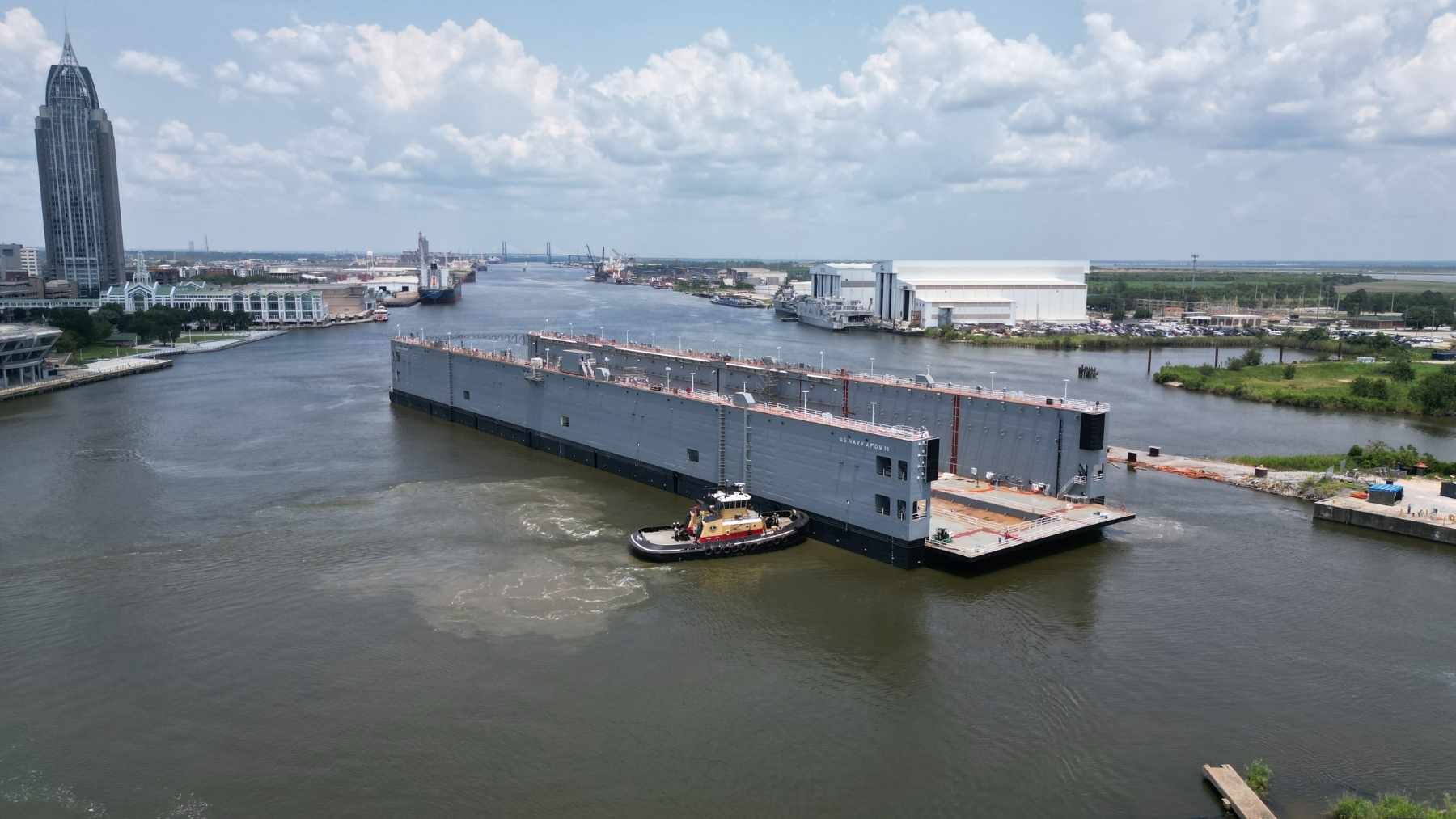
The machine that does that job is a floating dry dock, and on July 28 the Navy got its first brand-new one of this class in more than 40 years. Austal USA and Alabama Shipyard launched AFDM 15 into the Mobile River in Alabama, a 694-foot (212-meter), roughly 12,000-ton steel structure that exists entirely to pick up other ships. It was the largest vessel launch in Austal USA’s 26-year history, and according to Fox10, the largest vessel ever launched from a Mobile-area shipyard, period.
The previous record holder was the 616-foot tanker American Phoenix, back in 2011. That record stood for 15 years and just got beaten by a ship whose entire job description is lifting other ships.
The whole trick is sinking on purpose
A floating dry dock works backwards from every other vessel on the water. Instead of trying very hard not to sink, it floods its own ballast tanks and goes down deliberately, until its deck sits below the keel of whatever ship needs work. The ship is then guided in over the submerged deck, the dock pumps the water back out, and the whole assembly rises until the ship is sitting high and dry on blocks. No cranes, no ramps. Just buoyancy, used in both directions.
AFDM 15 is what the industry calls a “Rennie”-type dock, which means continuous wing walls running down both sides and several sectional pontoons underneath providing the displacement. Per specs reported by trade outlet Baird Maritime, it can take on ballast down to a maximum draft of 54 feet (16 meters), then lift 18,000 long tons clear of the water. The working deck offers 90,800 square feet (8,440 square meters) of clear space, which is a little over a football field and a half of flat steel with a warship parked on it.
That lifting capacity was not picked at random. It covers the ships the Navy actually needs to keep hauling out of the water on the regular: Arleigh Burke-class destroyers, Ticonderoga-class cruisers, both variants of the Littoral Combat Ship, and the Whidbey Island and Harpers Ferry dock landing ships. Austal also says the dock is built to relocate wherever future fleet maintenance requires, so unlike a hole in the ground with a gate on it, this repair yard can be towed to the problem.
Getting it wet took nine days and 1,500 crane mats
Here’s the part that separates this launch from a champagne bottle and a ribbon. AFDM 15 was assembled on land at Alabama Shipyard, next door to Austal’s Mobile facility. To launch a 12,000-ton box that has no engines, you need another dry dock, and the only one in Mobile big enough was Alabama Shipyard’s own Dry Dock Alabama. Crews spent nine days building out the receiving dock, positioning roughly 1,500 crane mats and dock blocks to match the approved docking plan, WorkBoat reports.
Then Berard Transportation showed up from Louisiana with self-propelled modular transporters, the remote-controlled platforms on dozens of wheels that normally haul bridge sections and refinery columns, and drove the entire structure from land onto the waiting dry dock. That transfer happened on Saturday, July 25.
Three days later the dock was flooded and AFDM 15 floated free, with tugs walking it out into the Mobile River. Alabama Shipyard CEO Greg Wagner said the operation took “months of planning, engineering, and collaboration,” which tracks, because for part of it two enormous steel structures sat nested together with barely any clearance between them.
There’s a certain history rhyming here too. Mobile has done this before. One of the Navy’s original medium floating dry docks, later designated AFDM-2, came out of the Alabama Drydock and Shipbuilding Company in the same city during World War II. Eighty-odd years later, the town is back in the floating dry dock business, and if you enjoy watching enormous objects get moved in ways that seem faintly unreasonable, the maneuver sits in the same family as the cutterhead swap crews pulled off under the Chesapeake after a tunneling machine ate a 19th-century anchor.
Why the Navy went 40 years without ordering one
The strange part of this story is not the dock. It’s the gap. The Navy commissioned floating dry docks by the dozen during World War II, and then largely stopped buying new ones. AFDM-3, a dock built in 1943, was designed for the same 18,000-ton lifting capacity as the brand-new AFDM 15, according to specs compiled by GlobalSecurity. Which means for decades, a meaningful chunk of the hardware holding up America’s warships during repairs was older than the sailors’ grandparents.
Meanwhile the fleet kept aging and the repair backlog kept growing. The Congressional Budget Office reported in December 2025 that the Navy has experienced chronic delays and labor overruns on large conventional ship maintenance for more than a decade, and that older destroyers routinely blow past the timelines written into their class plans.
Every day a destroyer waits for dock space is a day the Navy effectively has a smaller fleet. You can build all the new ships you want. If you can’t lift the existing ones out of the water, the math still goes against you. And shore infrastructure falling behind the fleet it serves isn’t a uniquely American condition either, as anyone following Australia’s icebreaker wharf demolition in Hobart already knows.
So in June 2022 the Navy awarded Austal USA a competitively bid design-and-construction contract worth $128 million for one new AFDM, per Defense Daily. It was only the company’s second steel program after two decades of building aluminum ships, and Austal leaned on the experience of owning and operating a similar dock at its own Mobile repair facility. The original contract projected the work wrapping up by August 2025. With delivery now expected in early 2027, the program is running about a year and a half behind that first estimate, and the dock still isn’t finished.
What’s left before a destroyer actually rides it
Launching was the spectacular part, not the last part. Still ahead: installing the wing-wall portal cranes, lighting off the generators, builder’s trials and acceptance trials. WorkBoat reports Austal expects to hand AFDM 15 over to the Navy in the first quarter of 2027. Until then, the biggest thing ever put in the water at Mobile floats there without its cranes, waiting on its own finishing work. A dry dock in need of outfitting is a genuinely awkward object, because the usual place you’d finish a vessel is a dry dock.
The timing around the company is messier than the launch was. On August 11, Naval News reported that Hanwha Defense USA has made a non-binding offer of up to $1.2 billion to acquire Austal USA, and that Austal’s revised market guidance projects a FY2026 EBIT loss of roughly $175 million at the American subsidiary after reassessing contract claims on several programs.
The AFDM is one of the programs named. So the largest vessel Austal USA has ever launched is also, on the books, part of what’s currently losing the company money, right as a South Korean defense giant circles the whole operation with a checkbook. The Navy, for its part, gets its first new floating dry dock in four decades either way. Somebody has to lift the destroyers, whoever ends up owning the yard.