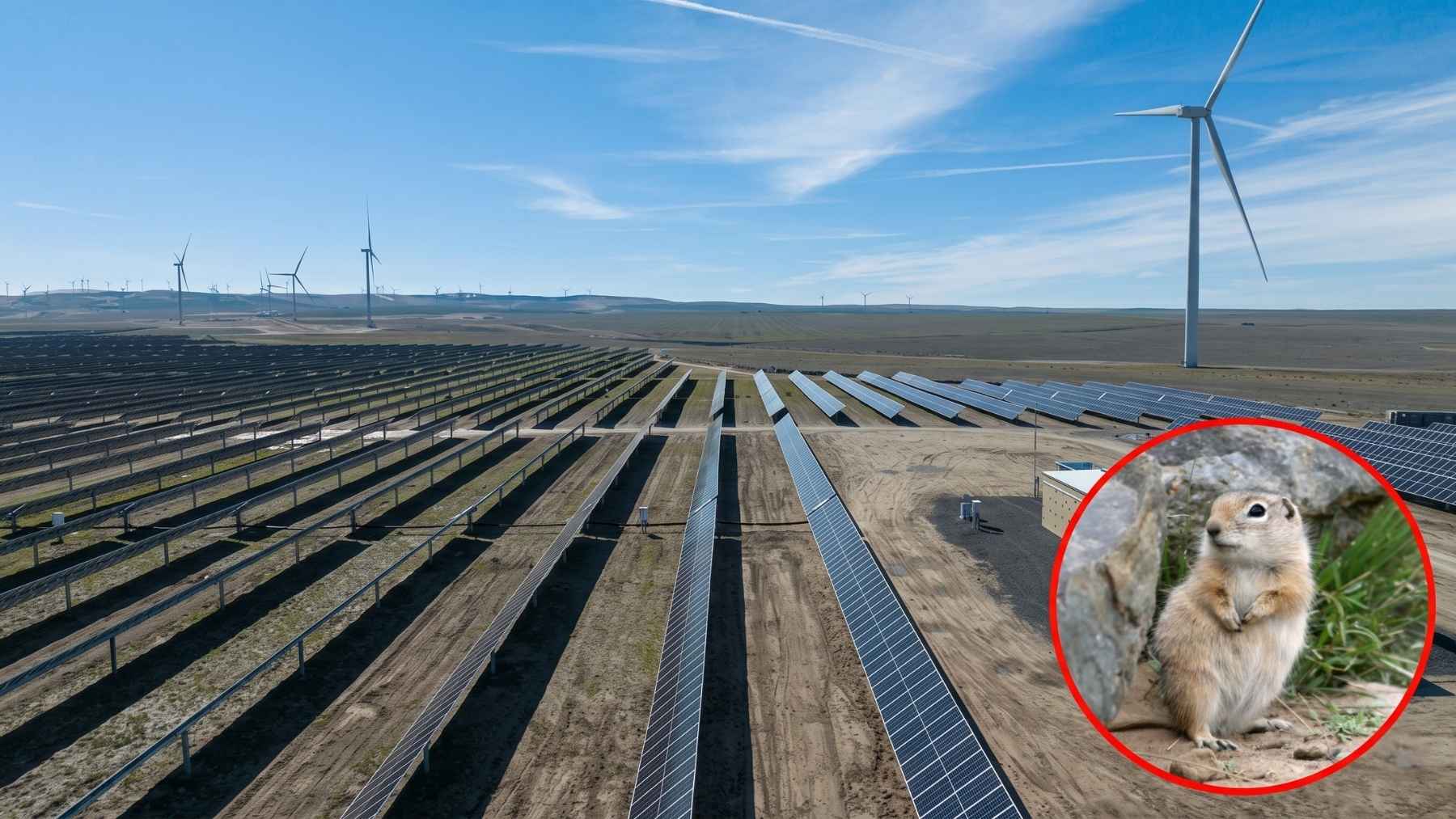

Every power plant answers to somebody. Usually that means a utility commission, a grid operator, and whoever signs off on the maintenance budget. At the Wheatridge Renewable Energy Facility in eastern Oregon, the chain of command runs one link further down, to a grey, white-spotted ground squirrel that weighs less than a decent burrito and spends up to eight months of the year asleep underground.
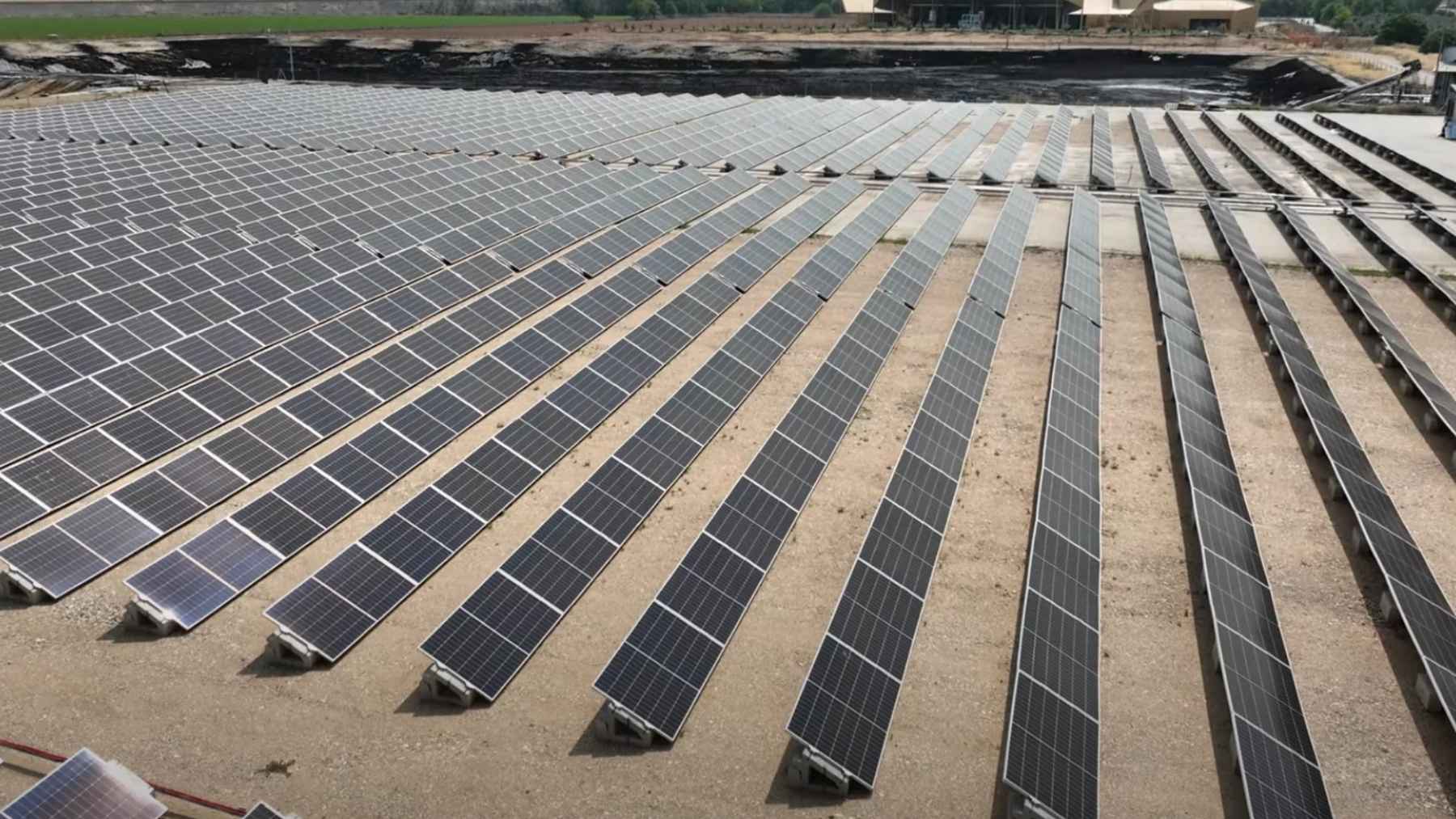
Wheatridge is not a small operation. Portland General Electric and NextEra Energy Resources run 300 megawatts of wind, 50 MW of solar and a 30 MW battery near Lexington, in Morrow County, enough emissions-free power for about 100,000 homes. When the solar and storage came online in spring 2022, PGE billed the site as the first development of its scale in North America to put all three technologies on one property.
The Washington ground squirrel got there first. In Oregon, that turns out to matter a great deal.
The rules live in the license, not a press release
Wheatridge exists because the Oregon Energy Facility Siting Council approved it in April 2017 through a document called a site certificate. A site certificate is a binding agreement between the developer and the State of Oregon. Break its conditions and you are not dealing with bad PR; you are dealing with violations, civil penalties, and in the worst case a revoked license.
One of those conditions, coded GEN-FW-01 in the site certificate, caps traffic on the project’s new and improved private access roads at 20 mph (32 km/h). Not during nesting season. Not when a biologist happens to be watching. During construction and operation, around the clock, for the life of the plant.
Twenty miles per hour sounds gentle until you do the route math. The operating solar site alone runs 3.2 miles (5.1 km) of internal gravel roads, and the certificates covering the wider Wheatridge complex allow up to 20 miles (32 km) of access roads. Every panel wash, every inverter check, every battery inspection happens at school-zone speed.
Detecting this squirrel is literally a job requirement
The certificate’s threatened-and-endangered conditions get more specific. Before anyone breaks ground in suitable habitat, the company must hire a professional biologist with, in the license’s own words, “experience in detection of Washington ground squirrel.” That person surveys every patch of suitable habitat within 1,000 feet (305 m) of any ground disturbance, permanent or temporary.
There is a catch, and it is a big one. The protocol surveys only count if they happen between March 1 and May 31, the stretch when the squirrels are reliably above ground. Miss the window and you wait until next spring. A completed survey stays valid for three years; start construction later than that and you are surveying again.
Where the biologist finds an occupied colony, that ground becomes Category 1 habitat under Oregon’s wildlife mitigation rules, the top tier of a six-level system. Category 1 means avoidance. No panels, no trenches, no laydown yards, nothing, and the exclusion zones get physically flagged on site. The state’s ODFW solar siting guidance wraps every occupied colony in a 785-foot (239 m) buffer of untouchable ground, and treats suitable habitat out to roughly 5,000 feet (1,524 m) as the next protected tier, where impacts have to be offset.
The same guidance carries some of the most specific advice you will find in a state siting document: armor your underground cables, because ground squirrels chew.
Once the plant is running, the obligations keep going. Known colonies get monitored on the same schedule as the site’s raptor nest surveys. If a colony seems to vanish, crews search 500 feet (152 m) beyond the old boundary to check whether it simply moved. New colonies found by accident during other fieldwork get added to the monitoring list.
Eight months underground makes for a brutal schedule
None of this makes sense until you look at how Urocitellus washingtoni actually lives. The US Fish and Wildlife Service species profile puts adults between 4.2 and 10.6 ounces (120 to 300 grams) depending on season, and 7.3 to 9.6 inches (185 to 245 mm) long. Smoky grey coat, whitish spots, a white eye-ring. It may be the least intimidating authority figure in American energy.
The species hibernates or estivates seven to eight months a year. Adults surface in late January or February and breed almost immediately. The year’s juveniles emerge from the natal burrow in March. By June the adults are already heading back underground to sit out the dry season, with juveniles following in June or July. The entire above-ground business of being a Washington ground squirrel fits into roughly four or five months, which is exactly why the state pinned the survey window to spring.
The above-ground months are not exactly relaxing either. An Oregon State University radio-tracking study found that 72 percent of dispersing juvenile males leave in April, traveling anywhere from about 130 feet to 2.2 miles (40 to 3,521 m), with a median trip just over half a mile (880 m). Only 20 to 56 percent of tracked juveniles survived to estivation, with raptors and badgers doing most of the damage. A species this compressed and this hunted has no spare capacity for truck tires.
Oregon lists the animal as endangered under state law. It is not listed under the federal Endangered Species Act, so the muscle here is entirely state-level: the siting council, ODFW, and a license nobody wants to breach.
Oregon re-ran the whole exercise three months ago
This is not dusty 2017 history, either. In February 2026, the solar arm of the complex, formally Wheatridge Renewable Energy Facility III, went back before the siting council. NextEra asked to split the project in two: the operating 50 MW array, with its 155,912 modules, keeps the old name on 359 acres (145 ha), while the unbuilt 100 MW phase becomes a separate facility called Wagon Trail Solar II on 1,935 acres (783 ha), with a request to push its construction deadline from November 2025 to November 22, 2028. State staff recommended approval in the February 2026 proposed order.
The council held its public hearing in March and reached the final-decision stage on May 15, 2026. Along the way, the draft final order added a condition requiring the habitat mitigation plan to run through operations, not just construction, and kept the standing requirement to report incidental wildlife sightings to the state. The squirrel’s paperwork got a fresh signature for the 2020s.
The timing matters for the animal directly. Because protocol surveys expire after three years, a build pushed toward 2027 or 2028 means somebody in a pickup will be creeping across the shrub-steppe some spring soon, counting burrow entrances all over again before a single new post goes in. At 20 mph or less, naturally.
The operator has had stumbles worth noting. In 2025, Oregon’s Department of Environmental Quality issued the solar entity a pre-enforcement notice over erosion and sediment control at the site, and the company is implementing corrective actions, from berm maintenance to reseeding, under a consolidated vegetation and soil plan baked into the 2026 order.
And the complex keeps growing around the colonies. A proposed order for the separate Wheatridge East wind expansion was published for the council’s late-July 2026 meeting, while NextEra pitches the full Wagon Trail Solar concept at up to 500 MW of solar paired with 2,000 MW of battery storage across Morrow and Umatilla counties. Every new acre out here starts with the same question: who is living under it?
It is becoming a running theme in this state. We covered how Oregon approved 406,000 panels on the condition that the developer leave a 600-foot corridor for deer and elk, and earlier this summer we looked at an endangered kit fox that moved into two California solar farms and raised pups, plus the burrowing owls that bred their first summer inside a 10,000-acre Arizona array. The squirrel is the Oregon chapter with the strongest legal teeth.
Somewhere under the Morrow County steppe, the star of all this paperwork is already asleep. It surfaced in late winter, bred, fattened up, and checked out for the year while the panels above it tracked the sun. Trucks will keep rolling past its burrows at 20 mph either way. Not a bad deal for an animal the length of a TV remote that sleeps through two-thirds of its own story.
















It's good the wildlife like the solar farms, farmed animals like them too, and many plants grow better in the mixed shade and wind reduction underneath. Whereas the river dams destroy the salmon and ecosystem that evolved to run on salmon.
Going 20 mph doesn't mean non-productive (original US railroads and the Amish)