
Tunnel boring machines are simple creatures at heart. A rotating cutterhead chews into the rock face, conveyors drag the rubble out the back, and the whole rig creeps forward until a subway, a sewer line, or a highway tunnel pops out the other side. Every one of them, from the machines that dug the Channel Tunnel to the ones threading metro lines under half the planet right now, shares one core design assumption: the hole goes sideways. China just put one to work that goes straight down.
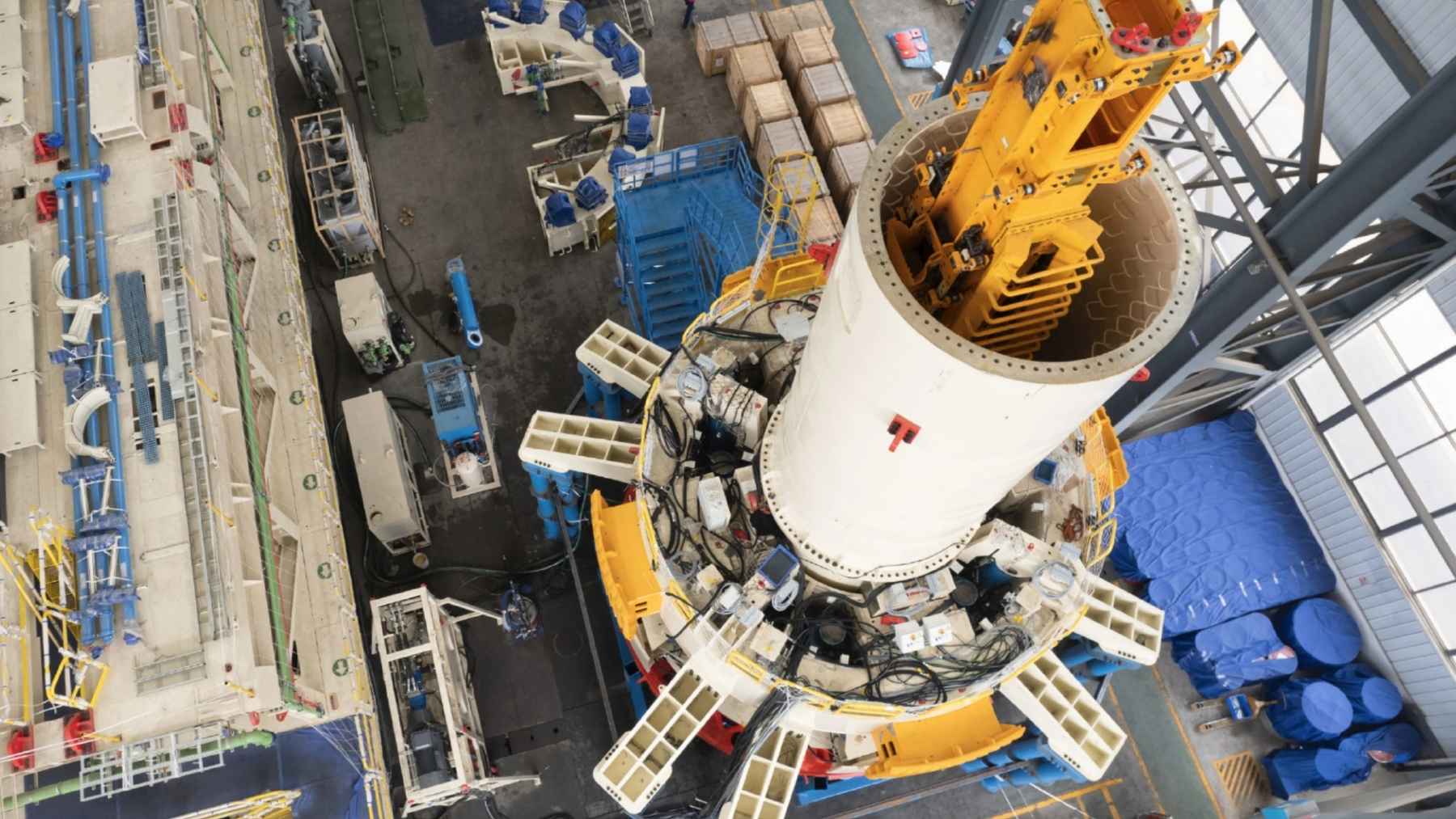
The machine is called Gangtie Jiliang, which translates to Steel Backbone, and the South China Morning Post reports it is billed as the world’s first boring machine able to excavate full-face vertical shafts deeper than 1,000 meters (3,280 feet) in hard rock. It weighs about 500 metric tons, carries a conical cutterhead 8.1 meters (26.6 feet) across, and this spring it began grinding into the ground at an iron ore project run by Ansteel Group in Anshan, in China’s northeastern Liaoning province. State media have taken to calling it an “underground aircraft carrier,” which is the rare official nickname that actually undersells the weirdness of the thing.
That world-first label carries four qualifiers: full-face, vertical, hard rock, kilometer-plus. Strip any one of them away and somebody else got there years ago, and we’ll get to the Germans in a minute. Keep all four together and you have a genuinely new category of machine, pointed at a very specific problem: the minerals everybody wants are getting deeper, and the holes we dig to reach them are still mostly made the way they were a century ago.
The 500-ton rig already digging in Liaoning
Gangtie Jiliang rolled off the line at China Railway Construction Corporation’s industrial park in Changsha in April 2025, according to China’s state asset regulator, as a second-generation design building on CRCC’s earlier Shuchang shaft borer. The engineering sits with China Railway Construction Heavy Industry, or CRCHI, the CRCC subsidiary that builds tunneling equipment, and Science and Technology Daily reports its dedicated R&D team has been on the project since 2021, attacking the three problems that make vertical boring miserable: cutting the rock, getting the rock out, and keeping the freshly cut shaft from squeezing itself shut.
For scale, 500 metric tons is roughly the weight of the reactor pressure vessel the world’s largest crane just lowered into Hinkley Point C. Except nobody lifts this thing into place and walks away. It hangs in its own shaft and ratchets itself downward, day after day, with a kilometer of rock below and an ever-lengthening concrete tube above.
The pitch is to replace conventional shaft sinking, which still mostly means drill-and-blast: crews bore holes into the shaft bottom, pack explosives, retreat, blast, ventilate, muck out the debris, line the walls, and start over, round after round. It works, and it has worked for a century. It is also slow, and every cycle puts people at the bottom of a deep hole with explosives, loose rock, and pressurized water for company. A full-face borer swaps that entire choreography for one continuously rotating cutterhead, and takes most of the humans out of the blast zone, because there is no blast.
Vertical is a completely different physics problem
Pointing a TBM at the center of the Earth sounds like a rotation job. It is closer to a full redesign. Start with gravity: in a horizontal machine, the spoil falls behind the cutterhead, where the conveyors live. Flip the machine vertical and every pound of crushed rock now lands in front of the cutterhead, directly on the surface you are trying to cut. The machine generates its own roadblock, continuously, just by doing its job.
Then there’s the rock itself. CRCHI learned that lesson the hard way when a trial unit working a highway-project shaft in Panzhihua, in Sichuan province, hit a layer that suddenly stiffened to 140 megapascals, roughly 20,000 psi, at around 160 meters down. Advance rates fell from 10 millimeters a minute to 5, cutter rings wore unevenly, and bearings started dying. The fix came from an odd place: pencil sharpeners. Ke Wei, who designed the machine’s excavation system, told Science and Technology Daily that engineers had always mounted cutting tools perpendicular to the rock face, assuming that orientation delivered maximum breaking force, until the way a sharpener blade sits at a shallow angle against the pencil suggested that tilting the cutters might actually break rock more easily. Simulations backed the hunch, the cutters got angled, the wear evened out, and a self-correcting conical cutterhead became the heart of the machine.
It sounds like a cute press-release anecdote until you remember what it cost to learn: a battered cutterhead and dead bearings, 160 meters down a Sichuan highway shaft.
A farm pump from the history books hauls 10 truckloads an hour
Cutting the rock turned out to be the easy half. Ding Zhangfei, the machine’s chief designer, summed up the other half for Science and Technology Daily: hauling spoil out of a 1,000-meter shaft is “like collecting garbage from the roof of a 300-floor building without a lift.”
The team’s first instinct, simply digging the muck out directly, went nowhere. The working answer came from the chain pump, an old Chinese water-lifting rig that raises water step by step on a loop of circulating paddles, in small continuous bites rather than big ones. CRCHI built its vertical muck-removal system around the same logic, with a 25-meter conveying pipe reaching down into the cutterhead, a ring-shaped collector sweeping the shaft bottom through a full 360 degrees, and a skip hoist running the spoil up to the surface. The system moves 120 cubic meters of crushed rock an hour, which Science and Technology Daily pegs at roughly the hourly capacity of 10 municipal dump trucks.
The third problem, keeping a kilometer of fresh shaft from collapsing behind the machine, forced a full support-system redesign. At those depths, ground stress and water pressure are high enough that newly cut walls start deforming almost immediately. CRCHI and its partner institutes tested three lining methods, picked cast-in-place concrete poured behind formwork, watched the first version fail, and rebuilt it with what amounts to independent scaffolding: support arms holding the formwork steady from below on its own suspension system, so the concrete can cure in peace while the machine keeps grinding downward underneath it.
The Germans got to a kilometer first, with an asterisk
If you follow mining tech, you may be itching to object right now, because kilometer-deep mechanical shaft sinking has been done. Between 2011 and 2018, contractor DMC Mining sank two shafts at BHP’s Jansen potash project in Saskatchewan, one to 975 meters and one to 1,005, using a pair of Shaft Boring Roadheaders built by Germany’s Herrenknecht. Per Herrenknecht’s own project notes, it was the first time mine shafts were sunk by mechanical excavation alone, no explosives anywhere, and it was a genuine landmark. It also took seven years, start to finish, and that was the modern way of doing it.
The asterisk is in the method and the rock. The SBR is a partial-face machine, a cutting drum on a telescopic boom that shaves the shaft bottom in passes, closer to a giant milling head than to a true TBM. Herrenknecht builds it for soft to medium-hard ground, its spec sheet caps the tool at rock around 120 megapascals, and Jansen ran it through artificially frozen formations. Even then, a surprise hard layer at about 450 meters wore through cutting picks fast enough that the drum needed a hard-rock upgrade and double the torque. Gangtie Jiliang’s claim is the next rung up: a single full-face cutterhead taking the entire 8.1-meter shaft bottom in one rotating bite, in rock that tested at 140 megapascals, past the kilometer mark. That is the specific gap CRCC says it has filled.
Deeper, faster shafts are the boring half of the mineral race
None of this engineering exists for its own sake. The shallow, easy ore bodies that fed the last century of mining are getting harder to find, and the hunt is heading deeper across the board. Whoever can sink kilometer shafts faster, more cheaply, and with fewer people standing at the bottom gets access to deposits the spreadsheet used to reject. Iron ore in Liaoning is the proving ground, but a machine in this class doesn’t care what’s at the bottom of the hole.
China is not subtle about wanting that position. The country already builds about 70 percent of the world’s tunnel boring machines, more than 4,000 units to date according to Xinhua, and it treats the technology the way it treats high-speed rail: as industrial strategy with a flag planted on it. A vertical hard-rock borer extends that dominance from infrastructure into the supply end of the mineral chain, the same chain the U.S. is scrambling to rebuild with a $1.2 billion rare-earth magnet plant and Japan is attacking from the opposite direction with deep-sea drones built to mine rare-earth mud 6,000 meters under the Pacific.
Notice the pattern. Everyone in this race is building machines to go down. Japan dives through 6,000 meters of water. China now bores through 1,000 meters of rock.
Right now, Gangtie Jiliang is one machine on one iron ore project, and Ding’s team says the plan is to keep developing the technology and push it into more scenarios. Whether it becomes a fleet or stays a very impressive one-off is what actually decides if mining changes. The machine that digs straight down already exists. The open question is how many holes China decides to point it at.