
Almost every nuclear waste story is an argument about where to put the stuff. Finland went with bedrock on an island, the United States has been arguing over Yucca Mountain since the 1980s, and the whole debate assumes the waste is still up here on the surface, waiting for somebody to decide.
Germany answered that question back in 1967 and got it wrong. Around 126,000 drums of low and intermediate-level radioactive waste went down a century-old potash and rock salt mine near Wolfenbüttel, in Lower Saxony, over the following eleven years. The mine is called Asse II. It has been taking on brine since 1988.
So German law now demands the opposite of burial. Every drum comes back up.
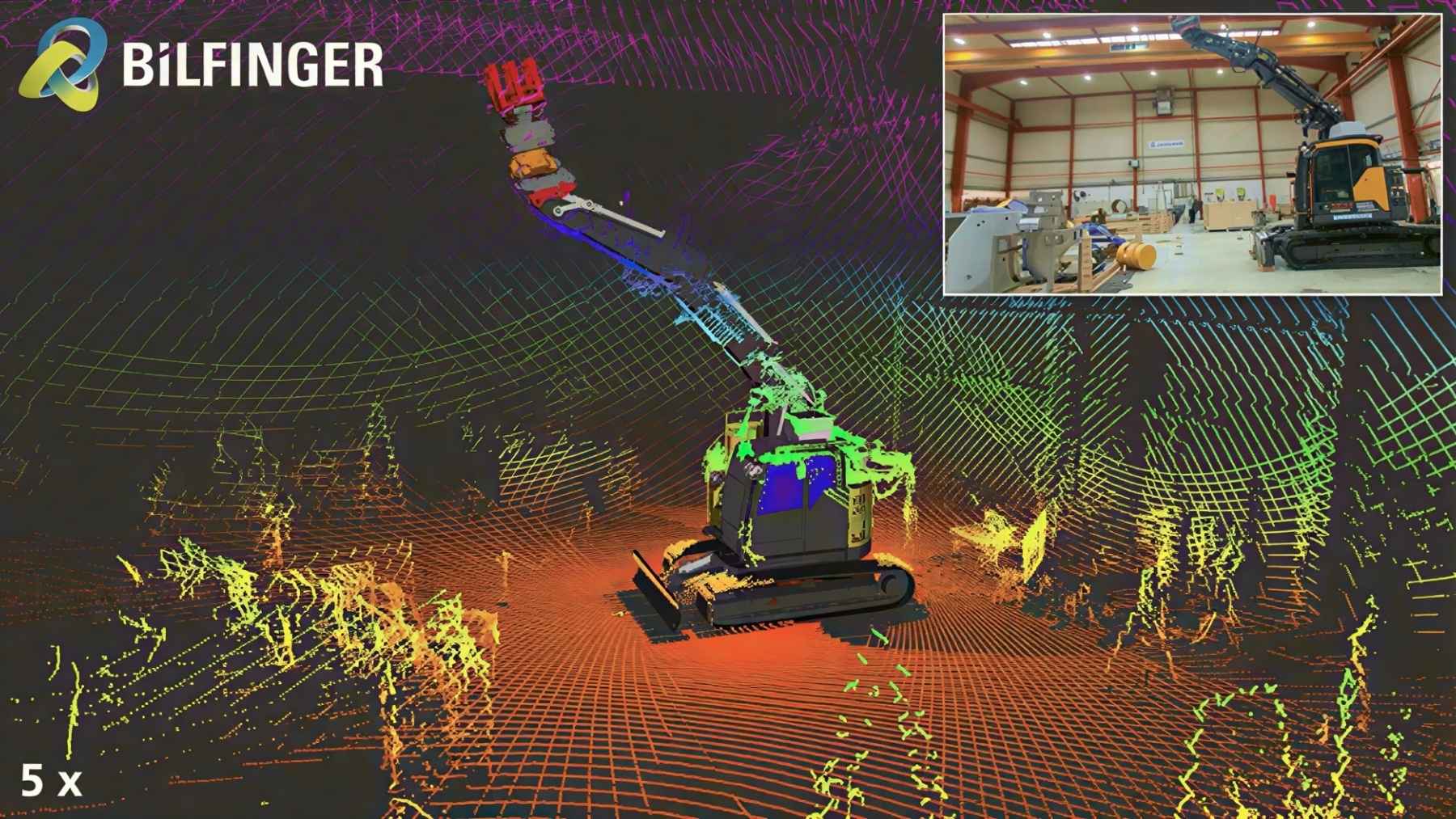
On April 29, the industrial services group Bilfinger and the Fraunhofer Institute of Optronics, System Technologies and Image Exploitation showed what is supposed to do the lifting: a remote-controlled excavator built to pull corroding drums out of collapsed salt chambers with nobody standing anywhere near it. There is a problem with the plan, and it is not the robot.
Salt was the entire reason this was supposed to work
The pitch in the 1960s was geology. Rock salt creeps under pressure, closes its own cracks and stays dry, which is why it got treated as a natural container that would never need maintenance.
The federal government bought Asse II in 1965 to research exactly that, and between 1967 and 1978 it filled 13 former mining chambers. Germany’s federal geoscience agency, the BGR, puts the exact count at 125,787 containers holding roughly 47,000 cubic meters of waste. The deepest chambers sit about 2,461 feet down.
The salt did not stay dry. Brine from the overlying rock has been getting into the mine through its south flank since 1988, and the stability of the mine is compromised by how much salt was cut out of it in the first place. In 2013 the Bundestag settled it with a law: retrieve everything, then close the mine.
That decision is now more than a decade old, and not one drum has come out.
Bilfinger is building an excavator that nobody gets to sit in
The heart of the recovery system is what Bilfinger calls a test excavator: a heavily automated multi-purpose machine fitted with custom grippers, milling heads and buckets. Fraunhofer IOSB, the Karlsruhe institute handling control and automation, is blunt about why it has to be purpose-built. Machines that can do this job in those conditions do not currently exist.
Operators will run it from a protected control room. The assistance package comes out of ROBDEKON, the German competence center for robots that work in contaminated environments, and it leans on sensor fusion, 3D perception of the surroundings and inverse kinematics, which in practice means the operator points at where the tool should end up and the machine works out the arm path on its own.
The repetitive part is meant to become automatic later. Grab a drum, set it in a transport box, repeat.
Bilfinger is also running a digital twin of the entire rig plus a surface test environment that mimics the mine, so movements and load cases get argued out in software before anything touches a real drum. That is the same logic behind the French robot that cut up a 182-ton reactor plug from the bottom upward, working the hottest end first so people could finish the job by hand later.
What makes Asse harder is that the machine has to improvise. Fraunhofer IOSB’s own description of the chambers is that some drums are covered in salt while others are freely accessible, and some were stacked neatly while others are lying in disarray.
Cameras have only been inside two of the chambers
Chamber 12, on the 750-meter level, holds 7,464 packages: 6,747 drums and 717 concrete shielding units. Miners started a targeted borehole at the end of May 2024 and needed until August 2025 to get there, drilling roughly 384 feet at depth. They knew they had arrived when radiation protection readings picked up a radon spike on August 6.
Iris Graffunder, chair of the BGE management board, said the first look came through a hole the size of a tennis ball, and that the visible drums appeared to be in good condition.
Later photographs were less comfortable. At a public meeting that October, BGE radiation protection head Christian Walter presented newer images showing that the drums have shifted out of position in places, and noted that no photographs exist from the period when they were originally put in.
The second chamber is 8a, up at the 511-meter level, which holds Asse’s intermediate-level waste. There are 1,301 drums in it, 1,293 of them intermediate-level, emplaced between August 1972 and January 1977. They were lowered by crane through a hole in the ceiling and unhooked, which built a cone of drums rather than a stack.
A camera went down an old borehole on November 19, 2025, followed by two more runs that same week. BGE reported that most drums still look intact, with some dented and deformed by rock that has come off the ceiling onto them. The highest dose rate measured near the cone was 167 millisieverts an hour, down from about 400 documented above the cone in 1996, and the agency was careful to add that a reading taken above a pile only partly captures the drums underneath it.
The shaft is what everything is actually waiting on
None of this waste can come out through the existing shafts. The plan is a separate retrieval mine east of the current workings, connected to a new shaft called Asse 5 with its own hoisting gear. Drums get moved through the retrieval mine, loaded into overpacks, lifted to the surface and sent to a treatment plant and an interim store, because Germany has nowhere permanent to put them.
Two weeks before that machine was unveiled, on April 14, BGE published the numbers that reorder the entire project.
The agency now calls the shaft the deadline-critical subproject. Current plans assume site clearing inside a protected conservation area starting in 2031, with the hoisting apparatus ready for operation in 2039. Retrieval was supposed to begin in 2033, and BGE says that is no longer realistically feasible, with no replacement date it can name yet.
Which puts the machines in the queue behind a hole in the ground. BGE’s own wording is that an operational Shaft 5 is essential for transporting the machinery and tools, fully developed and approved by then, down into the mine.
The excavator can be finished, tested and licensed years ahead of schedule. It still sits on the surface until there is somewhere to lower it.
The water sets a deadline the operator does not control
Two things have to be true before retrieval starts, and BGE cannot put either of them on a calendar. The emergency planning precautions have to be in place, and the brine has to be under control, because the retrieval only works if the influx stays manageable.
That part has been going sideways in a specific way. For years the operator caught around 12 cubic meters a day, close to 3,170 gallons, at a main collection point 2,159 feet down. In 2024 that collection point went dry and the same water started turning up deeper in the mine.
Graffunder described the search in February as a game of cat and mouse. In July 2025, miners extended a borehole 118 feet on the 658-meter level and hit a strong inflow, catching about 55 cubic meters in the first week. In March they exposed a fissure with brine running through it and rigged a temporary catchment.
None of this water reaches the waste. The reason it matters is that the worst case ends the project outright: BGE has said flooding the mine would only be carried out if the influx became technically unmanageable, which is not currently the case, and that retrieval would have to be abandoned in that scenario.
It is the exact inverse of the problem Finland spent decades solving. Onkalo was designed to need no human attention once it is sealed. Asse needs constant attention and a fleet of machines that have not been built yet.
What the delay actually costs
The figure quoted for years is €4.7 billion, about $5.5 billion by World Nuclear News’s conversion, and it covers everything up to the start of retrieval. Not the retrieval itself. Not the interim storage. Not the final disposal, which has no site. And not the extra years April’s schedule added at the front end.
Sinking a shaft through bad ground is its own multi-year project even when nothing radioactive is involved. BHP needed 89 freeze and monitoring holes and six years of excavation to get two shafts down through waterlogged Saskatchewan sand, and that was a greenfield potash mine with no drums at the bottom and no conservation area on top.
The first drums went into Asse in 1967. On the current schedule, the earliest anything mechanical reaches in to lift one back out is the 2040s. That would put the oldest of them underground for more than seventy years, in a mine that was only ever supposed to hold them while somebody researched whether the idea worked.