
Fusion power has been “thirty years away” for the better part of seventy years, which is the kind of running joke that makes the people building it wince. The pitch never really changes. Harness the reaction that powers the Sun, get clean energy with no carbon and no meltdown risk, and quietly solve one of the biggest problems on the planet. So when an actual fusion machine makes news, the instinct is to brace for either a miracle or a letdown.
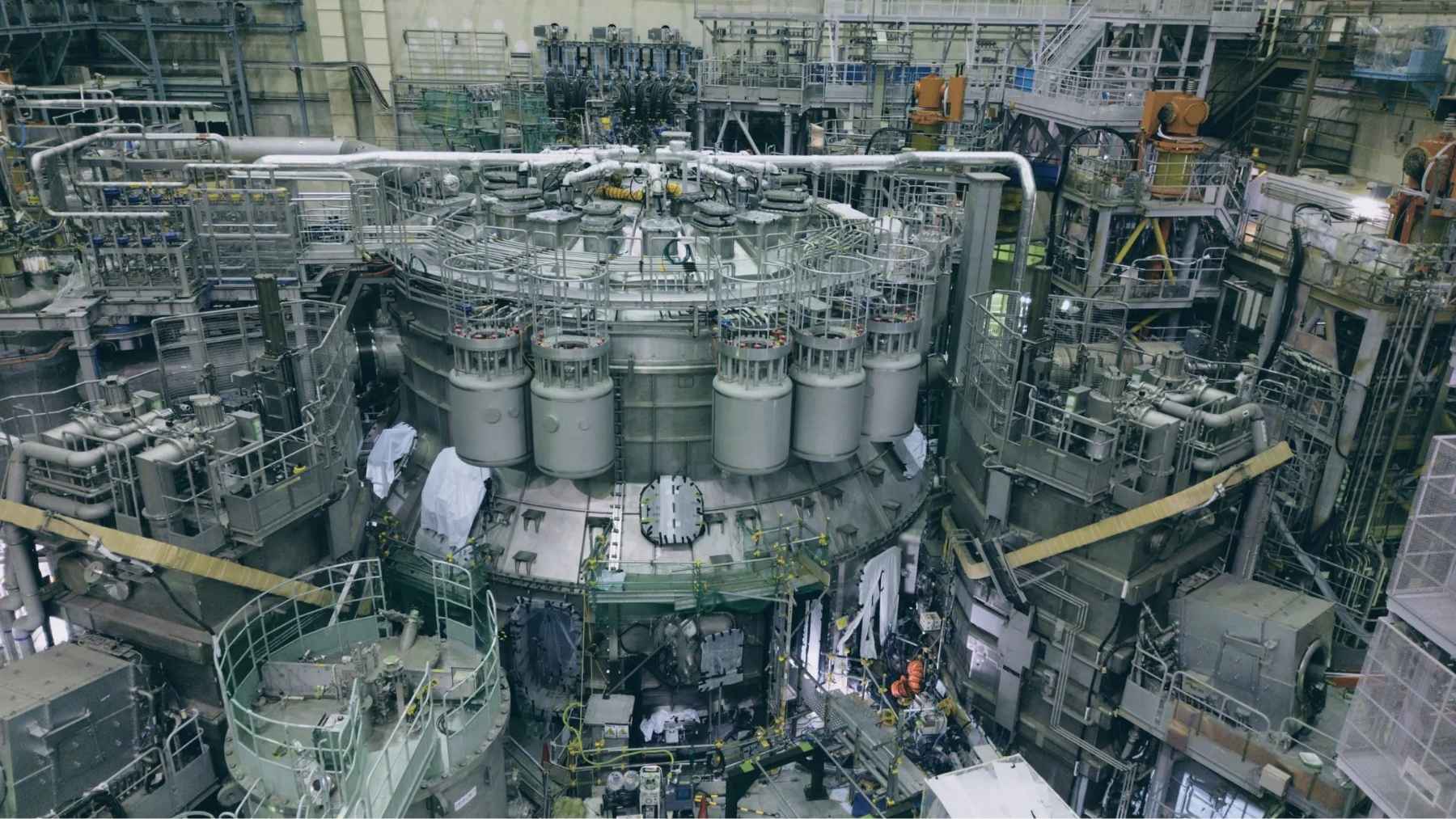
What happened in Naka, Japan, on February 27 is neither. The world’s largest operating tokamak, a doughnut-shaped device called JT-60SA, switched on the first of its newly upgraded systems and began a slow, methodical checkout that engineers call integrated commissioning. No record-breaking plasma. No power flowing anywhere. Just the unglamorous business of confirming that an eight-meter copper coil, wound by hand inside a vacuum chamber, behaves exactly the way the math says it should before anyone dares to heat hydrogen to a hundred million degrees right next to it.
The 8-Meter Coil Is the Part That Took Two Years
JT-60SA first flickered to life in late 2023, producing a low-power plasma just long enough to prove the basic machine worked, and then it got switched off. The two years since were not a pause. They were a rebuild. Crews from Japan and Europe spent that window pulling the inside of the machine apart and installing a long list of new hardware, and the headline piece is a pair of ring-shaped control coils built to keep the plasma from wandering into the walls.
Each coil is eight meters across, wide enough to park a couple of cars inside the ring. The unnerving part is how they got there. They were wound directly inside the vacuum vessel, by hand, rather than built elsewhere and lowered in. Japan’s National Institutes for Quantum Science and Technology (QST) says the fast plasma positioning coil was fabricated to a tolerance of about two millimeters, roughly the thickness of a coin, across a structure the size of a small room. The work was done with Mitsubishi, and QST describes installing in-vessel control coils like these as a first for any large superconducting tokamak.
These coils are also first in line for commissioning, because they can be tested at room temperature without pulling a vacuum, and they run off European-supplied power systems. They do one specific job: nudge the plasma’s position fast enough to catch it before it drifts. In a machine where the fuel is a cloud of charged particles hotter than the core of the Sun, keeping that cloud centered for even a fraction of a second is most of the engineering problem.
Carbon Armor and a Magnet Colder Than Deep Space
The coils were not the only thing that changed. The inside of JT-60SA now has a new first wall and a new divertor, the component that takes the worst of the heat where exhaust plasma slams into the bottom of the chamber, and both are built with carbon-based armor. Carbon is an old, slightly unfashionable choice in fusion. It handles heat well and is forgiving during early experiments, even if it carries tradeoffs that a machine like ITER is designed to avoid. For a research device whose whole point is to learn, forgiving is a feature.
Europe also shipped in new diagnostics, the sensors that let physicists see what the plasma is doing, along with cryopumps and extra heating systems. “We included diagnostics and cryopumps from Europe, as well as additional heating systems, key to achieving hotter, more powerful plasmas,” says Jerónimo García, the JT-60SA Project Leader, in a restart announcement from Fusion for Energy.
The temperatures involved are absurd in both directions. The superconducting magnets that cage the plasma run at around minus 269 degrees Celsius, about four degrees above absolute zero and colder than the empty space between stars. A few feet away, those same magnets are meant to hold a plasma that can reach a hundred million degrees Celsius, several times hotter than the center of the Sun. That gap, from near absolute zero to a hundred million degrees across a span you could measure with a tape, is the engineering miracle nobody bothers to put on a poster.
It is also why commissioning is so deliberate. Teams start with the systems that work cold and dry, then pump the cryostat and vacuum vessel down to high vacuum, and only at the end do they cool the big magnets and power them up to confirm everything integrates. Skip a step and you find out the expensive way.
The AI Tools Are There to Save Machine Time
One line in the commissioning plan stands out, and it is the one about artificial intelligence. QST and Fusion for Energy say the restart will lean on new AI and high-performance computing tools meant to improve plasma simulations and speed up day-to-day operations. The goal is blunt: shorten the stretch between switching the machine on and getting it into useful, full-scale plasma experiments.
That sounds like buzzword bingo until you understand how scarce time is on a machine like this. Every day JT-60SA runs costs real money and burns a slot that hundreds of scientists are competing for. If software can predict how the plasma will behave and trim even a handful of redundant test shots, that is days of machine time back in the bank. It is the same logic pushing fusion programs to add AI to plasma control in the first place, where the payoff is catching an instability before it wrecks a run.
The experiments themselves are scheduled for the end of 2026 and are expected to run for about six months. The plan is to push the machine to current levels it has never reached, chasing the long-pulse, steady-state plasmas that a real power plant would eventually need. The experiment team is already sorting through more than 150 research proposals from scientists across Europe, Japan, and the ITER Organization, and physicists from EUROfusion labs and ITER will work on-site in Naka during the campaign.
Biggest Tokamak Running, With an Asterisk
The “world’s largest operating tokamak” label is accurate, and it is worth being precise about what it means. JT-60SA has a plasma radius of about three meters and a plasma volume of roughly 130 cubic meters, which according to the ITER Organization makes it the biggest tokamak actually running anywhere right now. The asterisk is ITER itself.
ITER, the enormous international reactor under construction in southern France, will dwarf JT-60SA once it comes online. But “once” is the operative word. ITER is still being assembled and is not expected to begin its research operations until the 2030s, with experiments using its full deuterium-tritium fuel later still. Its design target is to produce roughly ten times more fusion energy than the heating power pumped in. Until ITER actually fires, JT-60SA is the largest machine of its kind that exists in working form, which is precisely why ITER’s own scientists are flying to Japan to use it.
That relationship is the entire point of JT-60SA. It was built under a Japan-Europe pact called the Broader Approach specifically to run high-temperature, high-pressure plasma experiments ahead of ITER, and to feed lessons into DEMO, the demonstration plant that is supposed to come after ITER and prove fusion can generate electricity at a useful scale. DEMO so far exists mostly as design studies in various countries. The order of operations is JT-60SA, then ITER, then DEMO, then maybe a power plant you would recognize as one.
None of This Puts a Watt on Your Grid Yet
For all the “artificial sun” headlines, it is worth being blunt about what JT-60SA is not. It is a science instrument, not a power station. It has no turbine. It is not wired to send electricity to a single home, and it never will be. Its entire job is to generate data so that the machines after it might one day do that. Anyone telling you fusion is about to lower your power bill this decade is selling something.
The contrast with fission, the nuclear we already use, is stark. While JT-60SA was warming up its coils, Britain finished lowering a 500-ton fission reactor into place at Hinkley Point C using the largest crane on Earth, sliding the steel cylinder onto its mount with about 40 millimeters of clearance on each side. That is a real fission reactor that will put real power on a real grid in the early 2030s. Fusion is not at that stage and will not be for a long time.
What is driving the urgency is demand. AI data centers are devouring electricity faster than anyone planned for, which is why China is testing a truck-mounted “nuclear power bank” pitched at exactly those data centers, and why private outfits are racing to skip the giant-government-lab route entirely. One American-Israeli alliance has even floated a plan to bolt a container-sized fusion reactor onto a barge by the early 2030s. Most of those ventures are still feasibility studies and press releases.
JT-60SA is the opposite of a press release. It is a hundred-million-degree machine, two years of rebuilding, an eight-meter coil wound by hand, and a carbon-armored chamber, all being switched on one careful subsystem at a time so that the boring, decades-long work of making fusion real has something solid to stand on. It will not heat your house. It might help figure out what eventually does.