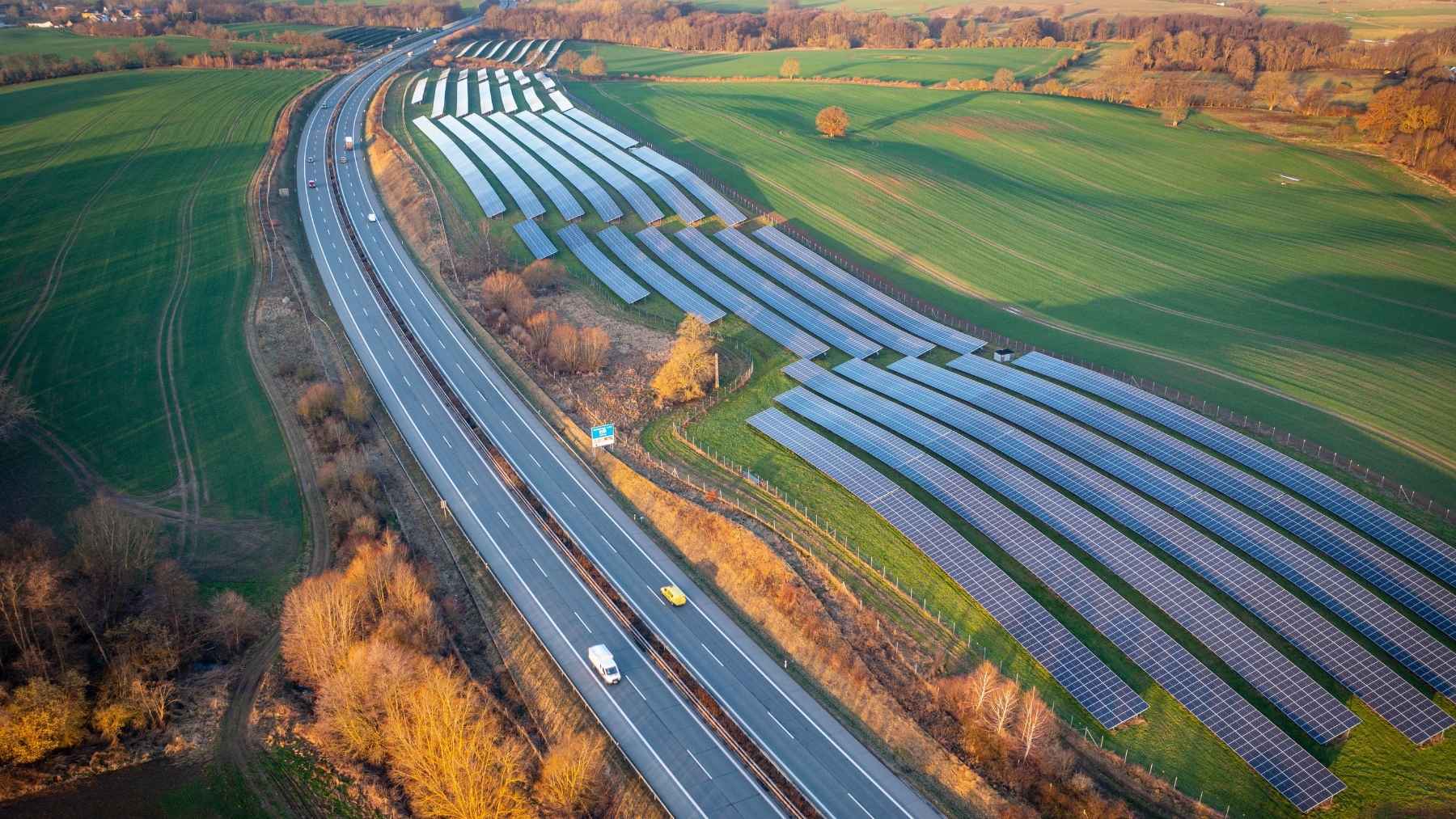

If you drive an interstate anywhere near a decent-sized American city, you pass a wall you have never once thought about. Twelve to twenty feet of gray concrete, running for miles, doing one job: keeping traffic noise off the subdivision behind it.
There are 3,866 linear miles of that wall in the United States. It covers 300,101,207 square feet, it cost roughly $10.8 billion in 2022 dollars, and every inch of it is already engineered, already permitted, and already standing in the sun.
Europe has been trying to give walls like that a second job since 1989. Germany just spent €4.2 million testing the far more ambitious version of the same idea, and then did the thing almost nobody does with a green-energy pilot project. It told everyone what the thing cost.
Bavaria roofed 35 meters of road and then published the invoice
The road is the St 2584, the four-lane feeder that runs west of Munich Airport near Hallbergmoos, where the B 301, the A 92 and the Zentralallee all meet. The state building authority in Freising put a steel canopy across it and hung glass on top.
Minister-President Markus Söder and Bavarian transport minister Christian Bernreiter switched it on last August 25. The Bavarian transport ministry put out the specs the same day, and they are unusually complete.
The canopy is 35 meters long and spans every lane. It carries 1,235 square meters of module, 1,100 on the roof and another 135 on the south face, for a peak rating just under 210 kilowatts. The glass is transparent so drivers underneath don’t feel like they’ve been dropped into a tunnel.
Target output is around 210,000 kilowatt-hours a year, which the ministry puts at more than 115 tonnes of CO2 avoided and the annual consumption of 70 households. The power feeds into the Stadtwerke Freising grid, and some of it runs the road’s own emergency call boxes, traffic counters and control gear.
Then there’s the last line of the release. Construction started in September 2024, and the thing cost about €4.2 million.
Divide that by 210 kilowatts and you get roughly €20,000 per kilowatt of installed capacity.
Twenty thousand euros a kilowatt is the number nobody publishes
Fraunhofer ISE, the German lab that does the country’s reference work on solar economics, models ground-mounted solar farms using build costs between €900 and €1,600 per kilowatt. Bavaria’s road canopy came in somewhere between twelve and twenty-two times that.
The American benchmark isn’t kinder. Lawrence Berkeley National Laboratory’s 2025 utility-scale solar report put the capacity-weighted installed cost of US projects that came online in 2024 at $1.22 per watt DC. That’s $1,220 a kilowatt, for panels bolted to trackers in a field.
The exchange rate does not rescue this. Whatever the euro is doing this week, a road canopy is more than an order of magnitude more expensive per kilowatt than the same silicon lying in a field, and Bavaria knew that going in.
The reason is structural, not electrical. A canopy is a bridge you have to build from scratch, tall enough to clear trucks, stiff enough to survive wind uplift, and corrosion-resistant enough to sit in exhaust for thirty years, all while traffic runs underneath it during construction. The panels are the cheap part.
The walls are the part that pencils
Which is why the serious version of this idea was never the canopy. It’s the barrier, because the barrier was getting built regardless.
It’s the same logic that put panels over California’s irrigation canals and between the rails of a live Swiss train line. Don’t buy the land. Don’t buy the structure. Find something already built, already inspected, already pointed at the sun, and hang glass on it.
Germany’s reference case sits on the A3 between the Aschaffenburg and Aschaffenburg-Ost junctions. In October 2019 a crew closed a gap between two existing barriers with a new one, 890 meters long and three meters high, with photovoltaic elements built into it.
The federal transport ministry ordered monitoring, and Autobahn GmbH published the interim results in March 2021. The local utility, Aschaffenburger Versorgungs-GmbH, measured about 112,000 kilowatt-hours off the wall in 2020, which it pegged at the annual electricity use of 25 four-person households. After a year and a half, the wall showed no operational downside against a conventional one.
So the panels survive the roadside. That question is answered.
Except the arithmetic complicates the whole argument. The Aschaffenburg wall needed 890 meters of highway to produce 112,000 kilowatt-hours, or about 126 kilowatt-hours per meter of road per year. Bavaria’s canopy is designed to do roughly 6,000 per meter, because it has the entire width of the roadway to work with instead of a three-meter strip.
That’s a target against a meter reading, so treat it loosely, but the gap is around 48 to one. The canopy is a vastly better use of a meter of highway. It’s also more than ten times the price per kilowatt.
That trade is the entire debate, and it’s why the walls keep winning. Nobody has to justify the structure, because somebody else already paid for it.
America already owns 3,866 miles of the raw material
Federal noise regulation makes every state DOT keep a running count of the barriers it has built, and the Federal Highway Administration compiles the lot. The FHWA inventory runs from 1963 through 2022, and it’s the thing to reach for whenever somebody tells you the roads could power the country.
Forty-eight states and Puerto Rico have built 300,101,207 square feet of it. Alabama, Rhode Island and the District of Columbia have never put up a single one.
The same agency has already done the math on what you’d get by wiring it all up, and this is the number the press releases skip. In a 2017 report on photovoltaic noise barriers, US DOT researchers put the national prize at “at least 400 Gigawatt hours annually,” which they worked out to the yearly electricity use of about 37,000 homes. They left the door open to a good deal more.
Thirty-seven thousand homes. From every noise barrier in America. That’s a floor rather than a ceiling, and the authors deliberately left room above it, but it’s still a rounding error against a country with more than 130 million households.
The same report notes that the business case for these things usually depends on whatever subsidy happens to be available at the time. It also points out that the first one went up in Switzerland in 1989, which makes the technology exactly as old as the Mazda Miata.
The first American solar sound wall has been almost-built since 2022
On January 25, 2022, MassDOT signed a letter of intent to retrofit an existing barrier on I-95 in Lexington, on the stretch locals call Route 128. The agency called it the first of its kind in the Western Hemisphere.
The wall is 3,000 feet long, 20 feet tall, reinforced concrete, sitting on the north side of the highway. The plan puts metal grids on 160 concrete panels facing the southbound lanes, with modules angled out toward the traffic.
Expected capacity is 637.5 kilowatts DC. Expected output is 802,000 kilowatt-hours a year, or 120 homes. Solect Energy would own and maintain the array, and MassDOT would buy the power a few cents per kilowatt-hour under the basic utility rate, which Canary Media reported as roughly $560,000 in savings for the state across 20 years.
MassDOT ran two dozen candidate sites before picking this one, then held a referendum in which every abutting household had to approve. Every one of them did. Noise monitoring got written into the pilot as a condition.
That was four and a half years ago. There has been no announcement that the panels are up, and every figure in the last three paragraphs is still a projection rather than a meter reading.
The supplier side, meanwhile, is moving. On Thursday, Ko-Solar of Natick, Massachusetts, the outfit that brought MassDOT the Lexington concept back in 2015, announced an exclusive North American partnership with R. Kohlhauer, a manufacturer out of Gaggenau, Germany. Kohlhauer has been doing this a while. Its solar barrier work spans Germany, Switzerland, Austria and Poland, according to pv magazine. Neither company’s announcement mentions a finished American installation.
None of this is Bavaria’s fault
The canopy was never supposed to be a good deal. Bavaria didn’t build it to sell electricity, it built it to find out what breaks, what it costs to maintain, and whether drivers hate it. It’s one of the few pilots anywhere that put the price in the press release instead of burying it, and €20,000 a kilowatt is a useful answer even when it’s an ugly one.
It’s also the honest counterweight to the recurring fantasy that highways are a hidden power plant, the same fantasy that produced the drivable solar road France just finished digging up. Roads aren’t a power plant. They’re a place to put panels without starting a fight over farmland, which is a real and worthwhile thing, and a completely different claim.
The walls are the cheap version. America has 300 million square feet of them, already standing, already paid for, already pointed at the sun. The one in Lexington has been the country’s first solar sound wall for four and a half years running.
Whatever is holding it up, it isn’t the physics, and it definitely isn’t a shortage of wall.
 @craigbrunetti ROOKIE2 months ago