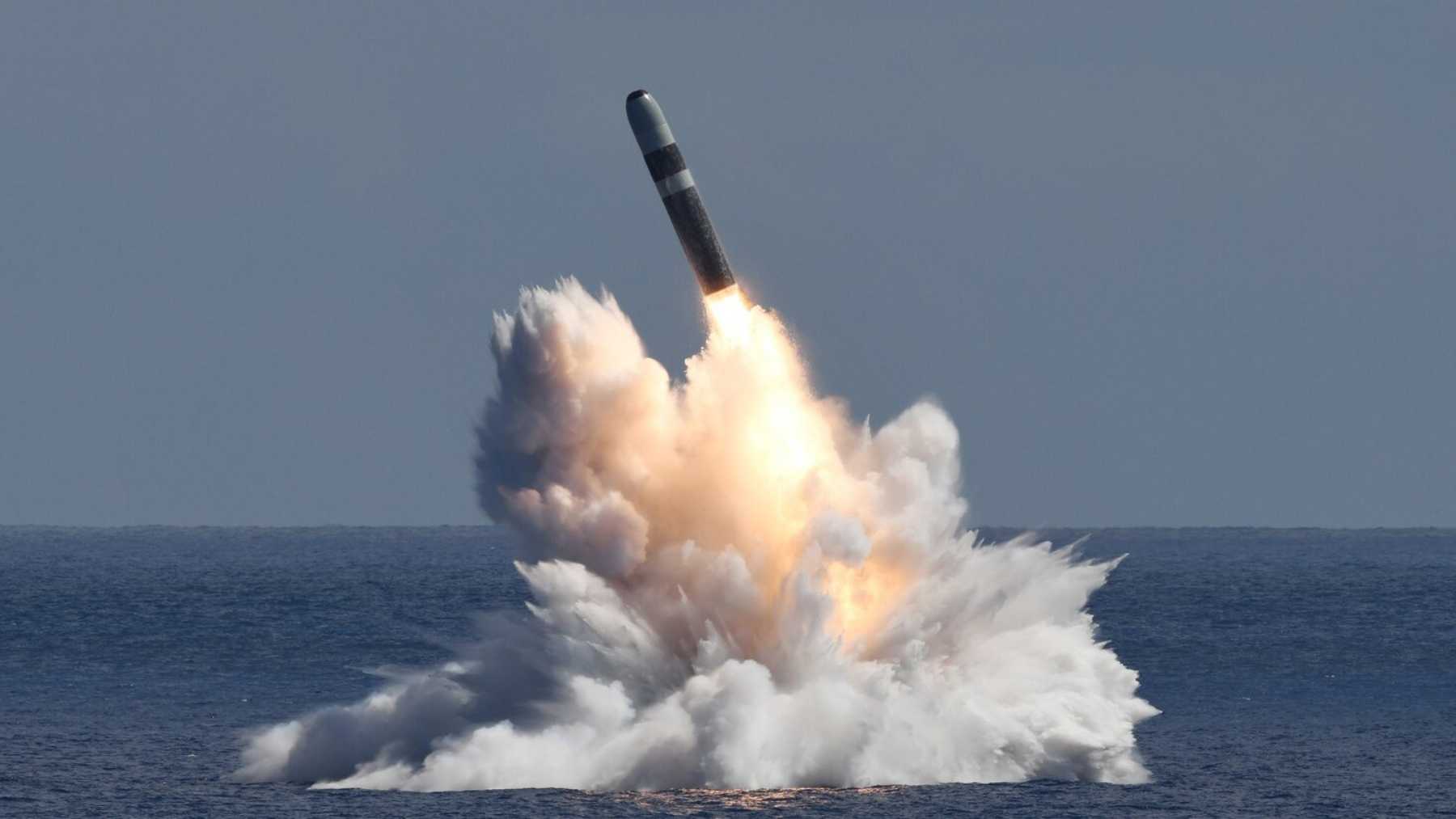

You have probably seen the photograph without registering what it shows. A missile standing on a column of white water off Florida or California, ocean sheeting off the nose, sky going orange behind it. It runs on every wire service the morning after a Trident test and it has become the stock image for America’s nuclear deterrent.
It is not a picture of a rocket launch. At the moment that shutter opens, the Trident II D5’s first-stage motor has not fired yet. The missile is coasting on momentum it was handed a few seconds earlier, inside the submarine, by something much closer to a gas piston than to a rocket.
The Navy puts the sequence in writing in the least glamorous document it produces about this weapon. In the final environmental assessment for the Trident II testing program, published by Strategic Systems Programs in September 2025, the description runs to one sentence: the system is fired from a launch tube on the submarine at depth, and after broaching the surface, the first stage motor ignites.
Everything interesting is packed into that word “after.”
The rocket motor is the last thing that happens
Start with the object. A Trident II D5 is 44 feet long, 83 inches across at the base and weighs 130,000 pounds, according to the Federation of American Scientists. Federal rules cap most loaded semi trucks at 80,000 pounds. The missile is heavier than one and a half of them, standing on end.
It sits in a tube 87 inches wide. That leaves roughly two inches of clearance on each side, and the tube is dry. Not damp, not partially flooded. Dry, with air in it at a pressure the crew controls.
The dryness is the whole trick. A flexible closure sits across the tube underneath the muzzle hatch, so when the hatch swings open to the sea, the water rests on top of that closure rather than pouring down onto 65 tons of solid propellant.
Then the launch charge fires, and it fires outside the tube. Navy patent filings on missile ejection systems lay out the standard approach: an ordnance gas generator burns a solid charge to produce hot gas, water cools that gas so it does not damage the missile or its own rocket motor, and the water flashing to steam adds to the push. The mixture is fed into the base of the tube and lifts the missile off its support ring.
From there the missile breaks through the closure, out through the hatch and up through the water inside the expanding gas it brought with it. It reaches the surface, keeps climbing, and only once it is clear of the sea does the first stage light. FAS describes what follows in the same breath: the motor ignites, the aerospike extends and the boost phase begins.
The aerospike deserves its own sentence. It is a telescoping needle that pops out of the nose cap and cuts frontal drag by about half, which is a peculiar thing to bolt onto a weapon that spent its first seconds being thrown like a shot put.
The Navy publishes a launch depth, just not the one you want
This is where most of the internet gets loose. Search the subject and you will find confident figures for how deep an Ohio-class boat sits when it shoots. Those figures do not come from the Navy, because the Navy does not publish operational launch depth.
What it does publish is a test floor, and it appears in the environmental assessment only because federal law required somebody to write it down. Sea-based flight tests, the document states, are launched from a depth greater than 100 feet below the sea surface and from at least 50 nautical miles offshore of the U.S. mainland. Test components have to come down at least 200 nautical miles from any landmass or island.
That is a real, sourced, official number. It is also a minimum for a scheduled test on an instrumented range with up to four support ships sweeping the water ahead of it, which is not the same situation as a boat on deterrent patrol. Anyone handing you a precise operational depth is handing you somebody’s guess.
Fire the same missile off a beach and the sequence runs backwards
The Navy intends to launch Tridents from dry land, and that plan turns out to be the cleanest proof that the cold launch exists for the submarine’s benefit rather than the missile’s.
Under the same testing program, up to 10 land-based test flights are scheduled between 2032 and 2036 from Space Launch Complex 46 at Cape Canaveral Space Force Station, with every component falling into the same Atlantic ocean area used for the sea tests.
The document flags the single difference, and it is the one that matters: for a land-based test launch, first-stage ignition would occur at ground level.
Same missile. Same three stages. Put it on a pad and it behaves like every rocket you have ever watched, lighting where it stands. Put it inside a submarine and the motor stays cold until the weapon is somewhere the submarine no longer has to care about.
The rest of the boat’s arsenal splits along similar lines. Torpedo tubes push weapons out on pressurized water, which is how the Mk 48 heavyweight torpedo leaves an American submarine, and it is also the route France uses for cruise missiles aboard its Barracuda-class attack boats instead of vertical cells. Gas ejection is what you reach for when the object is 44 feet long and has to end up pointing at the sky.
The Navy told five newspapers it wanted 122 launches and nobody wrote back
The paperwork is far more specific than any Navy press release. The proposed program runs through 2039: up to six sea-based tests a year from 2025 through 2028, up to eight a year from 2029 through 2039, plus those 10 land-based flights. The ceiling adds up to 122 launches.
It also concedes what a launch costs the ocean underneath it. Trident emissions had never been fully quantified, so the Navy took Minuteman III data and doubled it, on the reasoning that a Trident weighs roughly twice as much. The resulting estimate per launch is 3.67 tons of particulate matter under 10 microns, 2.87 tons of hydrogen chloride and about 37 tons of carbon dioxide.
Spent motor casings and the equipment section are not recovered. They sink thousands of feet and stay down there. Commercial and recreational fishing is shut out of the affected area for somewhere between 90 minutes and four hours per location.
The draft went out for 30 days between May 25 and June 24, 2025, advertised in the Honolulu Star-Advertiser, the San Diego Union-Tribune, the Florida Times-Union, Florida Today and a Brevard County weekly. The Navy received no comments at all. The Air Force signed its own finding of no significant impact on December 15, 2025.
For a sense of what those tests actually deliver, the four D5LE launches conducted off the Florida coast from September 17 to 21, 2025 brought the system to 197 successful flight tests, and one of the night shots was visible from Puerto Rico. The Navy’s standard line, printed in the release, is that the tests were not conducted in response to any ongoing world events.
All of it now points at a submarine that is not finished
The launch mechanism is the settled part. Nearly everything around it is moving.
On July 10, Lockheed Martin announced an $850 million contract modification to keep developing D5 Life Extension 2, the version meant to carry the sea-based deterrent past the 2040s. The Pentagon announced the award back in April. Work is spread across Colorado, Florida, Utah, Washington, Georgia and the Washington area, and the company says it is hiring against it.
D5LE2 cleared its Milestone B decision in mid-2025 and sits in engineering and manufacturing development, with initial fleet introduction planned for fiscal 2039. The Navy broke ground in February on a 130,000-square-foot engineering test facility at Cape Canaveral to support it, due for completion in January 2028.
The boats are the harder problem. Ohio-class submarines begin retiring at a rate of one per year in 2028, and the Columbia-class replacement is not there yet. General Dynamics told investors in April that the lead boat, District of Columbia, is on a path to deliver by the end of 2028 for a first deterrent patrol in 2030, after years of slipped schedules.
Columbia carries 16 tubes instead of Ohio’s 24, at the same 87 inches across, built into a missile compartment the United States designed jointly with Britain for the Royal Navy’s Dreadnought boats. Which means the ejection sequence described above has to work identically inside a hull nobody has taken to sea yet.
Then there is the treaty side. New START expired on February 5, 2026, and under its terms each Ohio had four of its 24 tubes sealed off, carrying 20 missiles rather than 24, according to the Congressional Research Service. Those four tubes per boat are no longer capped by anything.
Read the whole file and the striking thing is how little of it touches the launch itself. The guidance gets new computers. The warhead gets a new designation. The submarine gets a new hull, a reactor core built to last its entire service life and an electric drive. The part where a solid charge burns, boils some water and throws 65 tons of missile out of a dry tube has not needed rethinking since the Polaris boats. It is the oldest idea in the system and the only one nobody is spending $850 million to replace.