
Power purchase agreements are the least interesting paperwork in the energy business. A buyer promises to take the electricity, a generator promises to make it, both sides argue about price for a while, and somebody signs. The machine doing the generating usually exists by then, or is at least halfway welded together.
The one covering a stretch of ocean off Oregon works the other way around. The Bonneville Power Administration, the federal agency that markets electricity from the Northwest’s dams and moves more of it around the region than anyone else, agreed to buy everything a test site seven miles off Newport produces between 2026 and 2030. The electricity is supposed to come out of ocean waves, which nobody in the continental United States has ever sold under a commercial contract before.
It is now late July of the first contract year. The site has four places to plug a machine in, roughly 47 miles of buried cable waiting to carry the current ashore, and not one wave energy converter in the water.
The cable went in first, and it is still the only thing out there
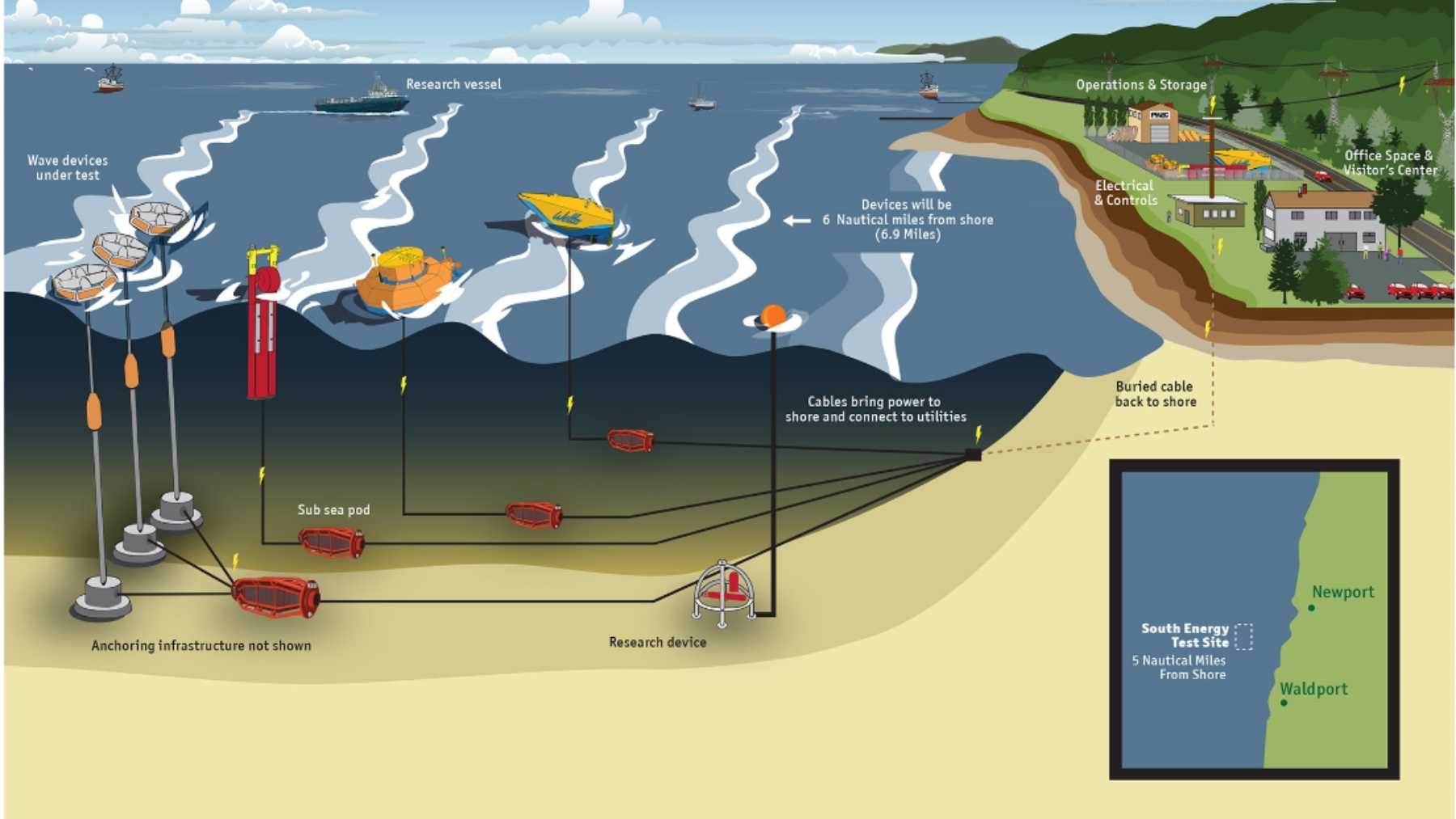
PacWave South is run by Oregon State University, and it is the piece of this story that actually got built. The site sits about seven miles offshore, west of Newport, across two square nautical miles of the Pacific.
Inside that box are four test berths. OSU’s own site description puts the arrangement plainly: each berth gets its own dedicated power and data cable rated at 5 megawatts, running roughly 12 miles back to a shoreside building called the Utility Connection and Monitoring Facility, between Seal Rock and Waldport. Add the four cables together and you get about 47 miles of line, buried up to a meter down in the seafloor sediment and drilled to land under Driftwood Beach.
The Federal Energy Regulatory Commission licensed the site in March 2021, after a permitting process OSU describes as spanning nearly a decade. Construction started that June. The cables went in during 2024, and OSU says the build was finished by early 2025.
What has not happened is the part everyone was waiting for. As of May 2026, according to KLCC in Eugene, the only hardware out there was the buried line and the buoys marking where the machines are supposed to go. A boat full of Oregon Coast Community College biology students visited the site this spring, and the most conspicuous man-made object in sight was a buoy.
CalWave’s generator survives storms by not being where they happen
The machine first in line for the northern berth comes from CalWave Power Technologies, an Oakland company that came out of a fluid dynamics lab at UC Berkeley. Its device is called the xWave, and the unit headed for Oregon is the x200, which the company rates at 200 kilowatts.
Almost every wave machine you have seen a photo of floats. Buoys bob, hinged rafts flex, paddles slap against a harbor wall. Floating is where the energy is, and it is also where the weather is, which is why the sector’s history is littered with devices that worked beautifully right up until the weather found them.
CalWave’s answer is to put the whole thing underwater and leave it there. The x200 hangs submerged, tethered to the seabed, pulling on winches as the water above it moves. When the sea gets ugly, it can change how it responds, brake its own machinery and shut down entirely rather than fight. The company told the American Society of Civil Engineers the units are designed to ride out 100-year storms and last 20 years at sea.
That claim has one real-world test behind it. In September 2021 CalWave dropped a smaller version, the x1, into about 75 feet of water roughly 1,800 feet off the Scripps Institution of Oceanography pier in San Diego. The prototype measured about 14 feet by 14 feet, and the Department of Energy contract called for six months.
It stayed 10, after DOE granted an extension, and came out in July 2022 with 99% system uptime and no operator interventions. The catch is what the power did next: it went to a local microgrid at Scripps, not to a utility. Getting to a real grid is the entire point of Oregon.
Worth noting how much the plan has grown. When DOE announced the $25 million PacWave funding round in January 2022, CalWave’s project was described as a 50-kilowatt device, and its $7.5 million was the largest of the eight awards. The company now lists the Oregon unit at four times that rating.
The money showed up in January. The machines did not.
The funding story here is the opposite of what you would guess from the empty berths. H.R. 6938 became law on January 23, 2026, and the DOE office that pays for this work walked away with $220 million, an 18% raise and, by the department’s own account, the biggest annual budget it has ever had. Marine energy got $141 million of it.
Congress also attached instructions. The office’s budget page lists what it was told to spend the money on, and PacWave appears there by name, with a directive to get the site up and running.
Six months later the berths were still empty. Dan Hellin, PacWave’s director, told KLCC that the delay is federal money not reaching the developers, and tied it to the churn of a change in administration and DOE’s own reorganization, which folded the Water Power Technologies Office into a renamed Hydropower and Hydrokinetic Office in late 2025. Reorganizations move faster on org charts than they do on invoices.
None of that is a technology problem, which is an unusual position for wave energy to be in. The sector has spent decades failing on hardware. This particular hold-up is accounting.
Hawaii did the grid-connected part back in 2015
Every careful description of the Oregon deal contains the word “continental,” and that word is doing real work.
The Navy has run a Wave Energy Test Site off Marine Corps Base Hawaii at Kaneohe Bay for years, and it was the first place in the country where a wave machine could plug into a live grid. Northwest Energy Innovations moored a 20-kilowatt prototype called Azura on a 30-meter berth there, and in 2015 it began pushing power onto the base grid, which feeds into Oahu’s.
What Oregon adds is the commercial layer. Hawaii was a research hookup. Oregon is a contract, at a market price set through the Western Energy Imbalance Market, with a federal buyer taking whatever comes ashore. CalWave put the distinction well in its post on the agreement, writing that for the first time in the continental U.S., “the electrons covered by a PPA will come from wave energy technologies.”
One correction worth making, because the wire coverage got it muddled: CalWave did not sign this contract. The PPA is between BPA and Oregon State University, and the federal environmental paperwork clearing it, a DOE categorical exclusion dated August 22, 2025, names those two parties. CalWave is the expected first tenant, which is a different thing.
The deployment window closes at the end of September
Wave energy has a season, and the Oregon coast is not subtle about it. Hellin told KLCC that “your window of actually doing stuff is really mid-May through the end of September,” and that missing it costs you six months rather than a few weeks.
Today is July 24. That leaves roughly ten weeks of workable water before the North Pacific starts handing out the kind of conditions the x200 was designed to hide from rather than be installed in.
It also helps to be honest about the ceiling. The 20 megawatt-hours per hour in the contract is the site’s licensed maximum, not a forecast, and Hellin has said outright it is unlikely PacWave gets anywhere near it while companies are still testing early hardware. A 200-kilowatt machine is one percent of that number. The point of the PPA was never the volume. It was proving that a federal power buyer will write a wave energy device into an ordinary commercial contract at all.
That still puts Oregon ahead of most of the field. The other machines drawing attention this year are doing it elsewhere: CorPower Ocean’s Swedish buoy has been feeding the Portuguese grid since 2023 by going limp in heavy seas instead of hiding under them, and Ocean Power Technologies has spent its energy on buoys that charge robots rather than customers.
The expensive part of the Oregon project is buried and paid for. The hard part, a federal agency agreeing to buy the output, was settled last fall. What is missing is a 200-kilowatt machine and a boat to carry it out there, which after a decade of permitting and four years of construction is a genuinely strange thing to be short of.