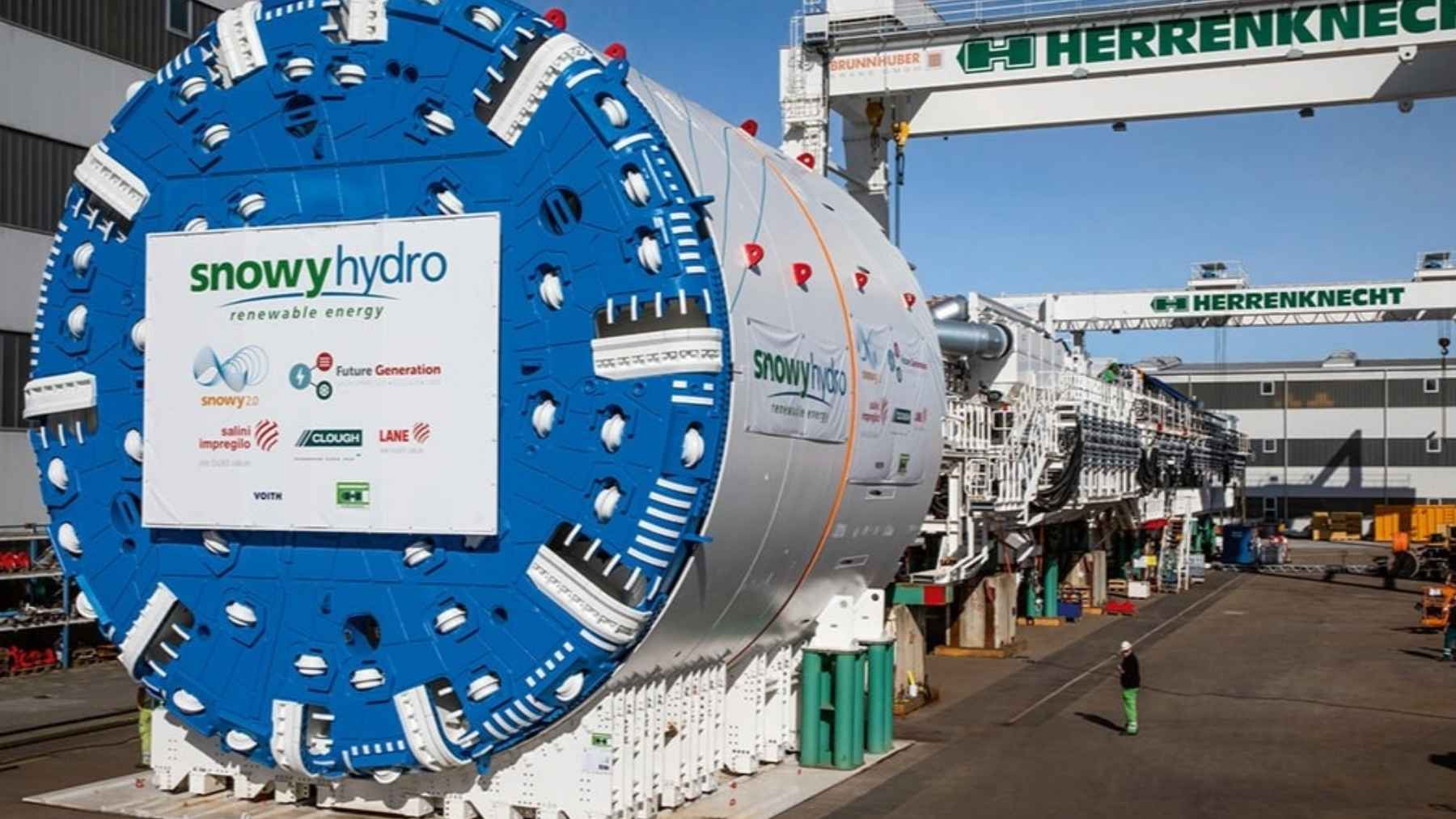

Tunnel boring machines usually earn their headlines by being enormous. The 54-foot borer Germany built for San Jose’s subway is wider than a semi trailer is long, and the 1,500-ton Virginie had to be walked across Charles de Gaulle airport on 34 axle lines because no crane was allowed to lift her.
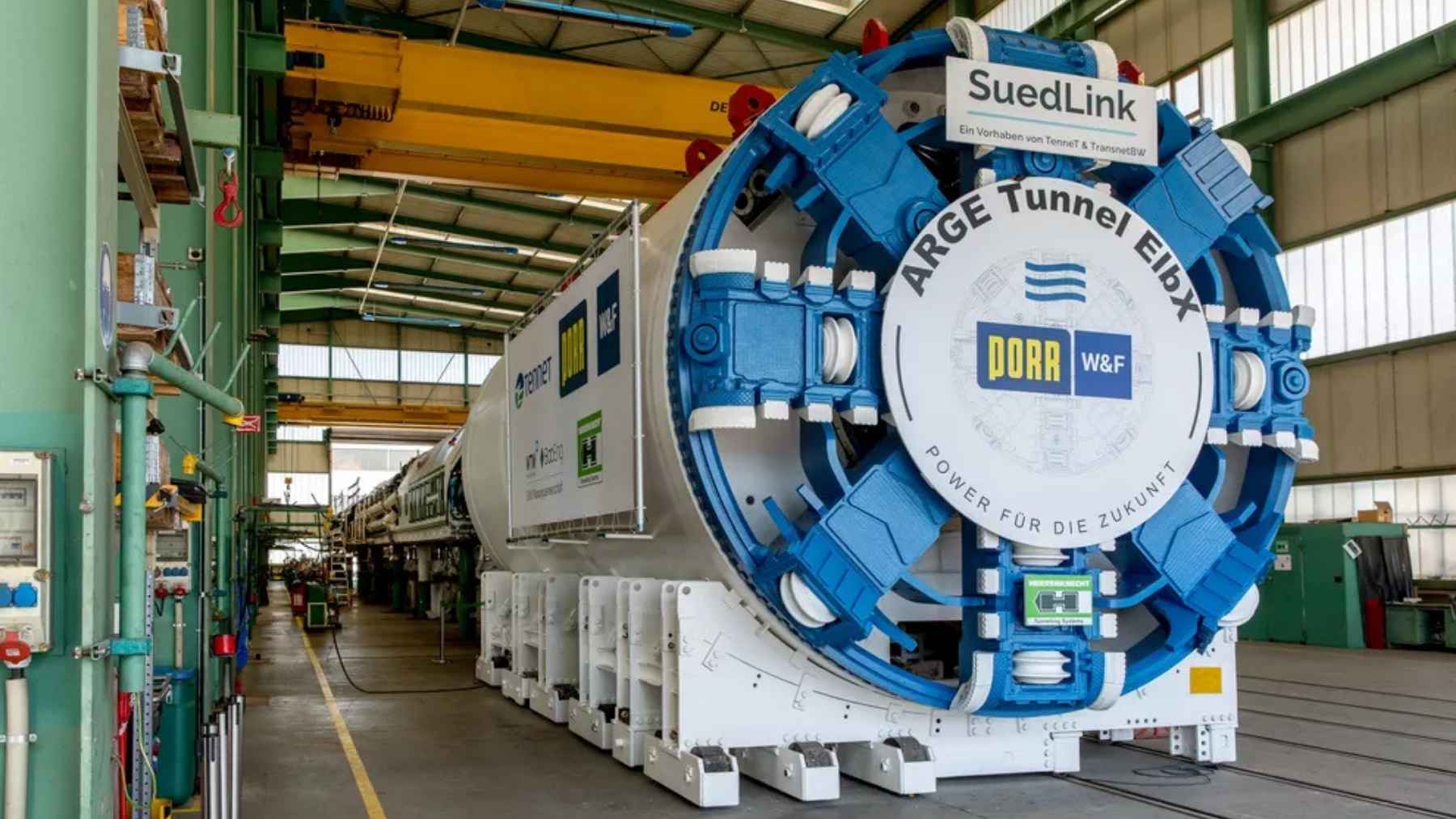
Elsa went the other way. She weighs 700 metric tons, about the same as the borer headed for New York’s Second Avenue subway, but she stretches that weight along 623 feet (190 meters) of machinery squeezed into a tube barely 16 feet across.
On June 22, she broke through into the target shaft at Wischhafen, on the south bank of the Elbe River in northern Germany, 5,224 meters (3.2 miles) from where she started digging in February 2025. Herrenknecht, the company that built her, confirmed the final numbers in early July: the entire drive took less than 18 months.
The hole she left behind is a cable tunnel. Once it gets its fit-out, six high-voltage lines will run through it as part of SuedLink, the roughly €10 billion (about $11 billion) transmission project meant to carry wind power from Germany’s north coast down to its factories in the south.
The hard part was the packaging
A Mixshield is Herrenknecht’s machine for the ground nobody wants: mixed soils, high water pressure, geology that changes every few hundred feet. It holds the tunnel face up with pressurized bentonite slurry while the cutterhead grinds away, so the river above never notices anything is happening.
The catch is that all of that plumbing takes space. Herrenknecht’s own catalog lists the Mixshield range as running from 4.8 to 19 meters in diameter, and Elsa, at 4.9 meters, sits about as close to the bottom of that range as the concept allows.
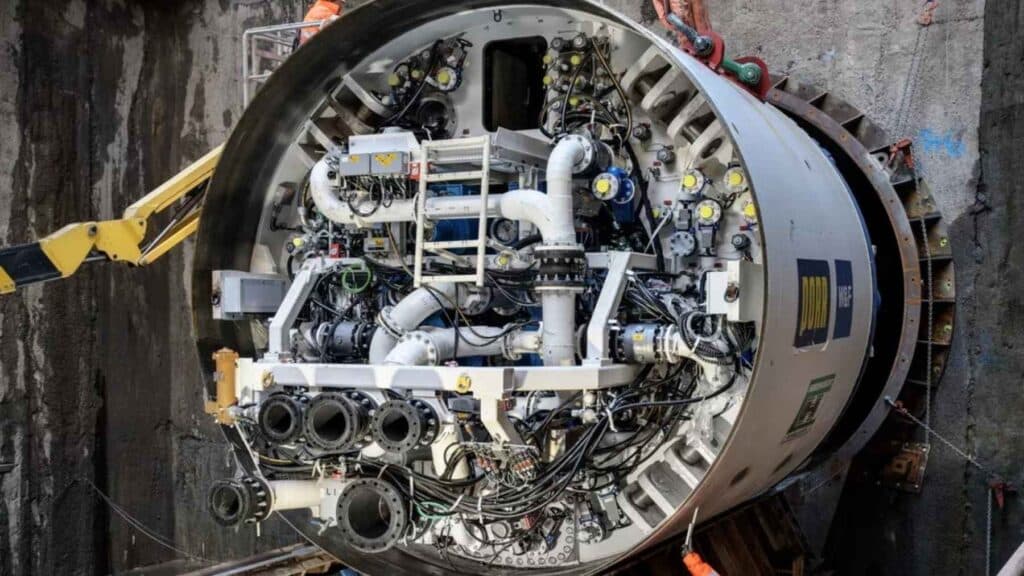
Herrenknecht project manager Johannes Faißt said the engineering challenge was to “incorporate the technology of a highly complex Mixshield” into a hull just under five meters wide. The conveyor, the electrical systems, the hydraulics, the ventilation, the segment transport and the crew walkways all had to fit somewhere, so they got spread across twelve trailing gantries. That is why a machine 16 feet wide ends up 623 feet long. Herrenknecht handed her over to the construction consortium on July 19, 2024, and she launched the following February.
The cutterhead runs on 720 kW, roughly 965 horsepower, and turns with 2,369 kNm of torque. In American units that works out to about 1.75 million lb-ft. Your F-450’s diesel makes 1,200.
Lauenburg clay does not want to leave
The route under the Elbe reads like a geology final exam: clay, silt, peat, sand, gravel, stones and boulders, in no particular order. The ground is also highly permeable, which under a river is exactly the property you would rather it didn’t have.
The specific villain was Lauenburg clay, a sticky glacial deposit with a talent for gumming up cutterheads. Herrenknecht’s answer was a center flushing system that blasts 500 cubic meters of slurry per hour, around 2,200 gallons a minute, straight through the middle of the cutterhead to keep the clay moving instead of clinging. In total, 1,200 cubic meters of bentonite slurry circulated through the machine every hour.
Then there’s the pressure. Twenty meters, call it 66 feet, below the riverbed, the water pushes at up to 3.8 bar, about 55 psi on every seal, all day, every day, for nearly 17 months. A multi-layer sealing system kept the river where it belonged while cargo ships kept passing overhead, because the Elbe never closed for the occasion.
Elsa lined the tunnel as she went, placing rings of six precast concrete segments, each ring 1,300 mm (about 4.3 feet) wide. She averaged 233 rings a month, which comes out to 303 meters, roughly 994 feet, of finished tunnel every month. By the end she had placed about 4,000 rings, or 24,000 individual segments, each one cast to fit within survey tolerances measured in millimeters.
The alignment wasn’t a straight shot either. The route includes curves, descents and climbs, so a navigation system from Herrenknecht subsidiary VMT kept her on line the whole way down and back up.
Six cables and a 435-mile extension cord
So why bore a three-mile tunnel to carry no cars, no trains and no people? Because Germany has a geography problem. Its wind blows in the north, and its factories sit in the south, in Bavaria and Baden-Württemberg. SuedLink is the roughly 700-kilometer (435-mile) answer: a 525-kilovolt direct-current line running from Brunsbüttel near the North Sea down to Großgartach, with a transmission capacity of 4 gigawatts.
The project was originally supposed to be running in 2022. Local opposition to overhead pylons pushed the entire route underground, which added years and turned river crossings like this one into full-scale tunneling jobs. Grid operator TenneT, which runs the northern half of SuedLink while TransnetBW handles the south, points out that this cable tunnel is now about two kilometers longer than the A7 highway tunnel under the Elbe in Hamburg.
Inside the finished tube, which has a clear inner diameter of 4 meters (around 13 feet), crews will pull six 525 kV cables: two per transmission system, plus one spare for each. The spares go in on day one, because nobody wants to re-enter a three-mile tunnel under a shipping channel to thread a replacement later. The tunnel also gets rails for maintenance vehicles, so future inspections happen from a cart instead of a hike.
Cable tunnels are quietly becoming their own category of megaproject. Herrenknecht machines are boring high-voltage tunnels under London and Berlin right now, and London is drawing up utility bores of its own, including two 8-foot tunnels meant to carry nothing but hot water across the city.
Elsa retires before the first electron shows up
Breakthrough is the photogenic part. What comes next is not. Per TenneT, the machine gets lifted out of the target shaft and taken apart, and the tunnel moves into fit-out: safety systems, controls, monitoring gear and eventually the cable pull itself.
TenneT says SuedLink remains on schedule for commissioning at the end of 2028, and the rest of the route is moving. In July, the operator finished its first fully completed underground cable section, a 37-kilometer stretch in the Rotenburg district of Lower Saxony where all four cables are already in the ground.
There is also a market angle hiding in this story. Herrenknecht estimates that Germany’s grid expansion will require around 4,500 crossings of rivers, roads and existing infrastructure. Most won’t need a 190-meter Mixshield, but plenty will need something, and every one of them is a machine order for somebody.
Elsa herself is done. She went into the ground in February 2025, chewed through what TenneT ranks among the toughest sections of the entire 435-mile project at about 994 feet a month, and came out the other side in under 18 months. The cables she dug for won’t carry an electron until 2028. The machine, as usual, was the reliable part.