
Fusion has spent seventy years being thirty years away, and the usual explanation is the hardware. Superconducting magnets chilled to within a few degrees of absolute zero. Laser halls the length of a football field. Machines that will cost more than any electricity they ever sell.
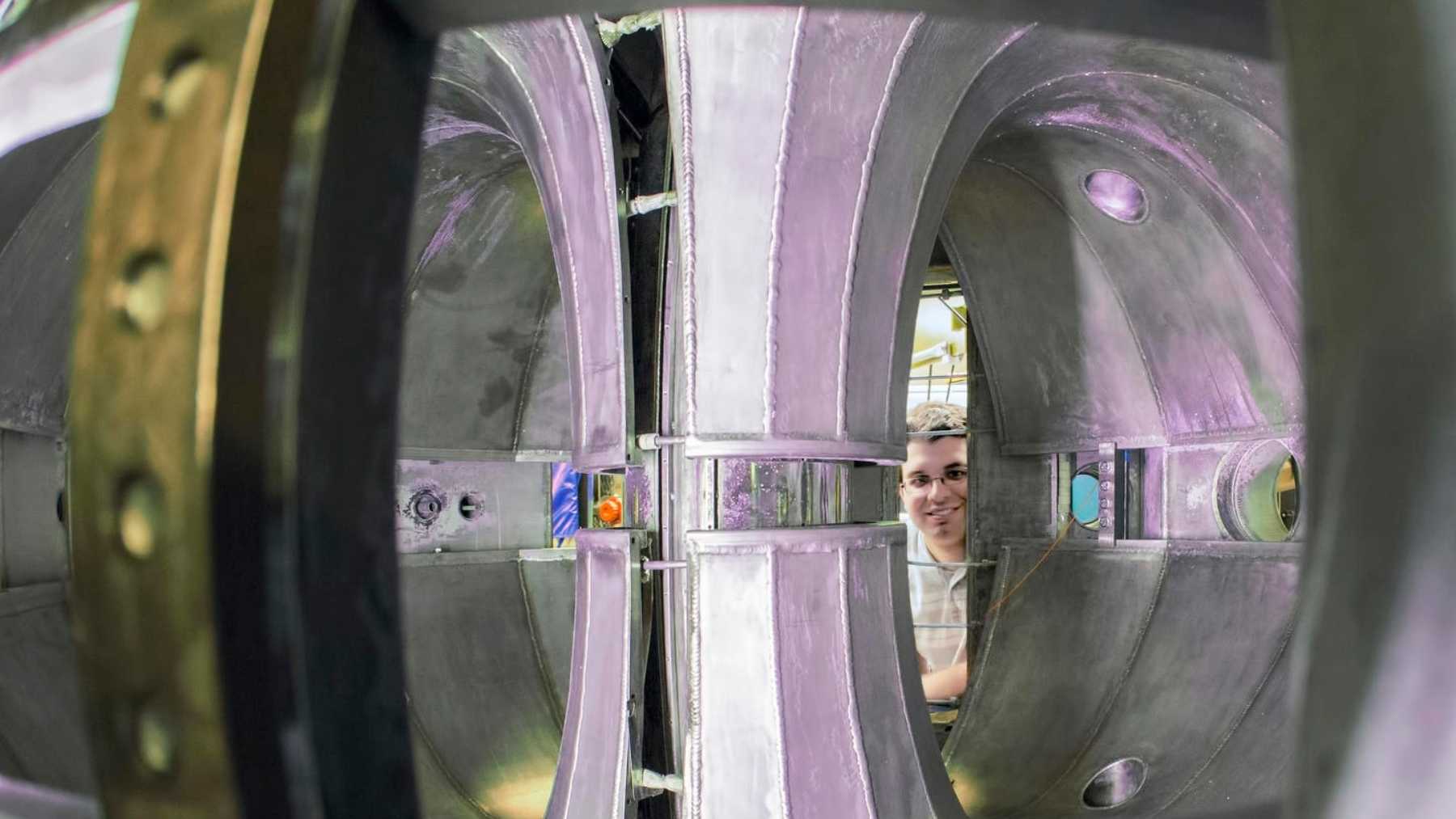
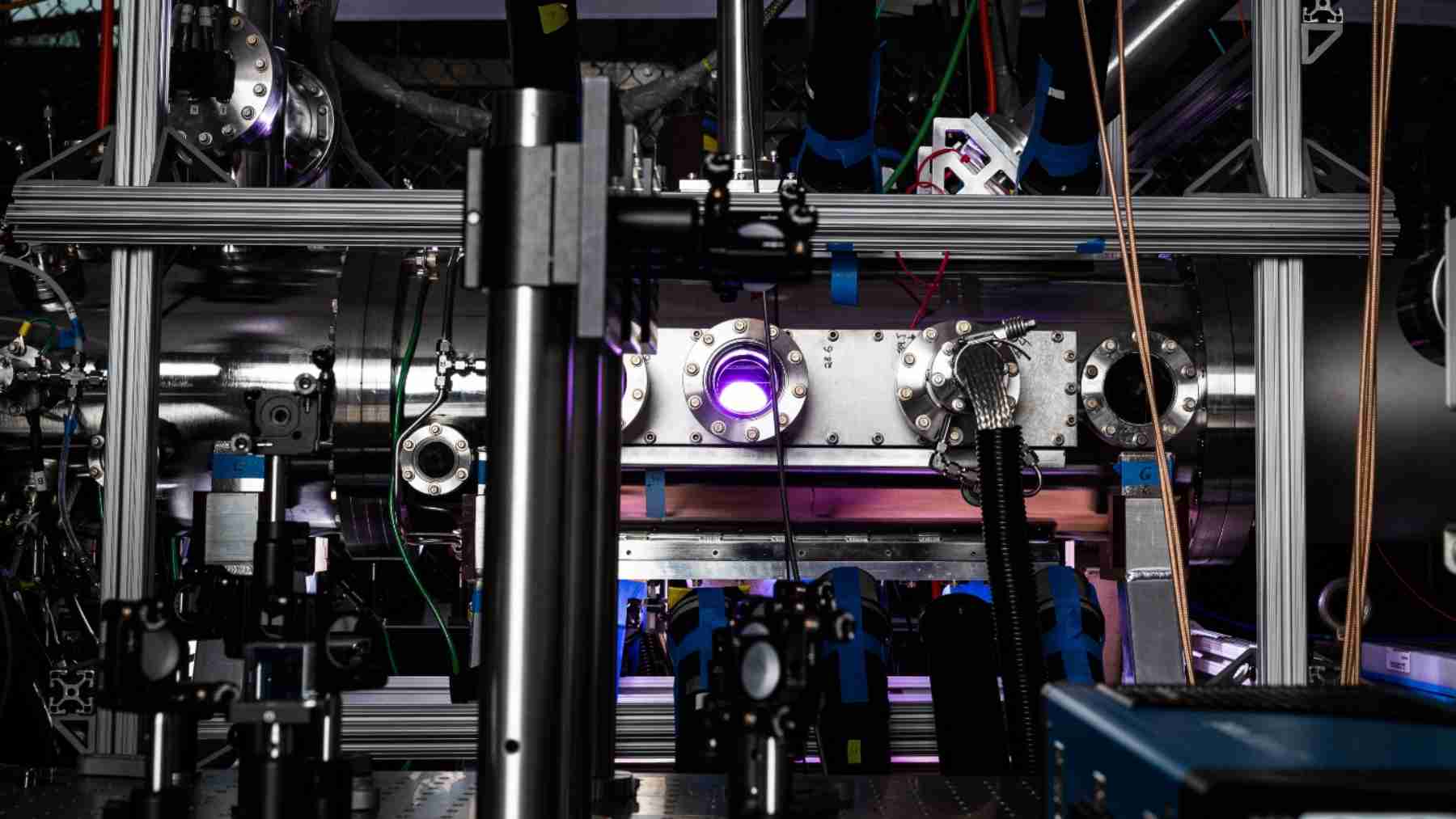
Zap Energy, in Everett, Washington, built the exception. Its fusion device has no magnets, no lasers and no cryogenics. It pinches a plasma with nothing but a pulse of electric current shoved down a column of gas, and the current does all three jobs at once: confine, compress, heat.
On April 29, Zap announced it is also going to build a nuclear fission reactor. Ten megawatts, cooled by liquid sodium, based on a Japanese design from the last century that nobody ever finished. On July 2, GeekWire toured the Everett labs and filed a report that called the move a surprise detour.
Zap’s president disagrees with that reading. So the simplest machine in fusion is now bolted to the oldest machine in nuclear, and it is worth understanding both before deciding who is right.
Fusion’s first big idea was also its first big failure
The Z-pinch is old. Run a strong current down a conductive column and the magnetic field that current generates squeezes the column inward. Zap’s own telling of the origin story involves a lightning rod at an Australian kerosene refinery, crushed flat by a strike in 1905, before anyone had a name for the effect.
Be precise here, because “no magnets” gets misread constantly. This is still magnetic confinement. The magnetic field simply comes from the plasma itself instead of from a coil wrapped around it, which is the entire reason the hardware bill collapses.
By the late 1950s, on the strength of Britain’s ZETA device, the Z-pinch was the front-runner in fusion research. Then physics happened. A static pinch is violently unstable. The column kinks, wrinkles, sausages up and tears itself apart, and by the 1960s most of the field had abandoned it, as Zap’s engineers lay out in the Century design paper published last September in Fusion Science and Technology.
The repair arrived in the 1990s at the University of Washington, where Uri Shumlak and collaborators from Lawrence Livermore National Laboratory proposed stabilizing the pinch with sheared flow. Make the outer layers of the column travel faster than the core, and the shear between them smothers a kink before it can grow into a failure. Shumlak co-founded Zap in 2017 to sell the idea, and he is still its chief scientist.
Century fires twelve lightning bolts a minute into a bath of liquid metal
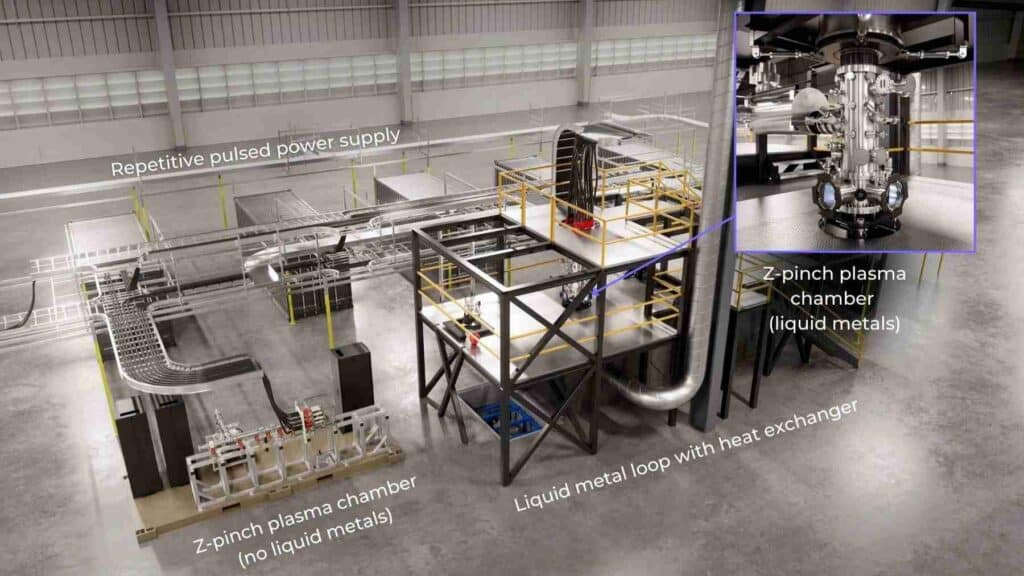
Century is not a reactor, and Zap has never called it one. It is a rig built to find out whether the plumbing around a Z-pinch power plant can survive being a Z-pinch power plant. It runs on plain hydrogen or helium instead of deuterium-tritium fuel, which means no fusion reactions and no neutrons. Nothing to capture.
What it has is current. Each shot drives up to 500,000 amps down the column, roughly twenty times what a bolt of lightning carries, by the company’s reckoning. The plasma chamber is about the size of a hot water heater, mounted vertically, pulsed power injected at the top, liquid metal circulating at the base.
The liquid metal is the clever part. Around 2,500 pounds (1,100 kilograms) of molten bismuth flows through the vessel doing three jobs at once. It conducts, it shields the solid metal underneath from the plasma, and it hauls heat out to a custom 200-kilowatt air-cooled heat exchanger.
Century was commissioned in June 2024 at roughly 1.4 kilowatts of average power, one shot every ten seconds. In February 2025 the Department of Energy certified a three-hour run of 1,080 consecutive shots at that cadence, each carrying at least 100 kiloamps.
By last September, per Zap’s own announcement, it was firing every five seconds for more than a hundred shots in a row. Total input power 57 kilowatts, with 39 kilowatts reaching the cables into the chamber, which Zap describes as about 30 kilowatts of sustained average power. A twentyfold jump in fifteen months.
Matthew Thompson, who ran Zap’s systems engineering at the time, told World Nuclear News the pulsed design will eventually work like an internal combustion engine, cylinders firing all day to produce a steady output. That is a better mental picture than a star in a jar, and it explains why Century exists at all. Benj Conway, then chief executive and now president, framed it this way: “Fusion is not just a plasma problem. It’s a systems integration problem.”
Century’s design target is 100 kilowatts of average input power, which Zap likens to concentrating the average draw of 75 American homes into that water-heater-sized chamber. Its central stack is about the size of a double-decker bus, close to the footprint of a single commercial module the company expects would produce 50 megawatts of electricity.
The billion-pascal number comes from a different machine
Century never fuses anything, so the physics headlines belong to Zap’s FuZE line. On November 18, at the American Physical Society’s plasma physics meeting in Long Beach, the company reported that its newest device, FuZE-3, had reached electron pressures of 830 megapascals.
Plasma is electrons plus much heavier ions. If both species sit at roughly the same temperature, which is what Zap expects, total pressure runs about double the electron figure: 1.6 gigapascals. One gigapascal is on the order of 10,000 atmospheres, or roughly ten times the pressure at the bottom of the Mariana Trench.
Those pressures held for about a microsecond and were measured with optical Thomson scattering, the gold standard for the job. The claim is narrower than the number sounds, and Zap states it carefully: highest pressure ever recorded in a sheared-flow-stabilized Z pinch. Not in fusion. No Z-pinch anywhere has reached scientific energy gain, and the company has not suggested one has.
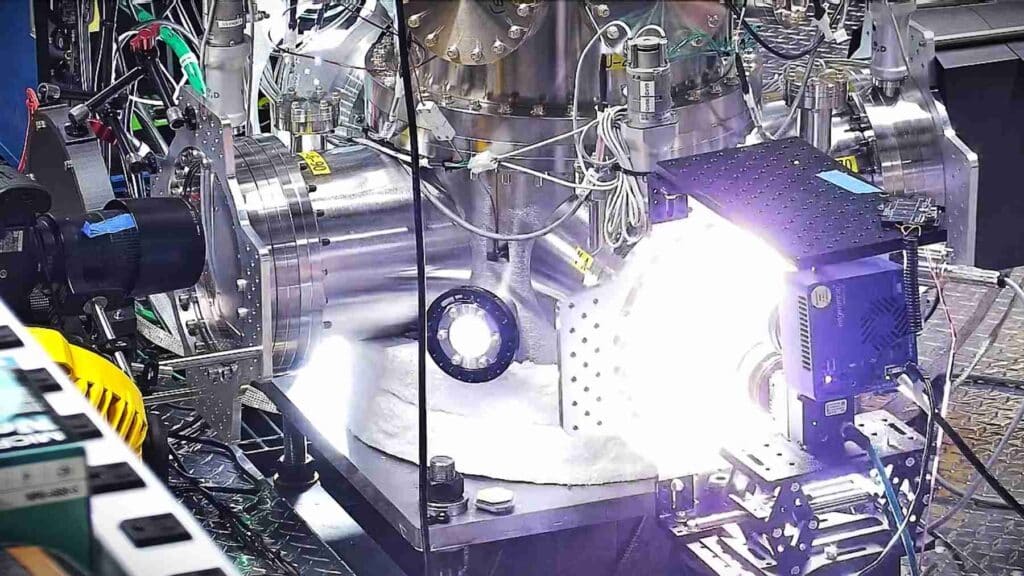
FuZE-3’s advantage is a third electrode and a second capacitor bank, which let Zap accelerate the plasma and compress it independently instead of asking one pulse to do both. The chamber is about twelve feet long. The plasma filament inside is a few millimeters wide. The original FuZE has been retired, FuZE-Q still leads the fleet on neutron yield, and a further device, FuZE-A, came online this year.
Zap says the fission reactor is not a pivot
Which brings us back to April 29, when the company announced two things in one breath. Zabrina Johal became chief executive, arriving from AtkinsRéalis after nearly two decades at General Atomics and a stint as an officer in the U.S. Navy’s nuclear power program. Conway moved to president. And Zap said it would develop conventional nuclear fission alongside fusion, which it says makes it the first fusion company to do so.
The reactor is a 10-megawatt microreactor cooled by liquid sodium, per GeekWire’s July 2 report. It is based on the 4S, a design Toshiba developed with a Japanese research institute and never built, which Johal told TechCrunch comes free of intellectual property entanglements.
The overlap Zap points to is the liquid metal itself. Sodium behaves a lot like the bismuth sloshing around Century and the lithium a commercial Zap core would eventually use. Same pumps, same corrosion problems, same heat extraction headaches.
“Fission and fusion are two sides of the same coin,” Johal told TechCrunch. “They have so many challenges that are congruent with each other.” Conway is blunter about how he wants the move read. “This isn’t a pivot,” he told GeekWire.
Read the numbers however your mood suggests. Zap has raised $330 million, holds a seat in the Department of Energy’s Milestone-Based Fusion Development Program, and owns a pressure record inside its own class of machine. It also expects fission revenue within a year and a commercial fission product in the early 2030s, which is a long time before anybody expects to buy a fusion plant from anyone.
Zap is not the only fusion company with a side hustle
More than fifty companies are chasing fusion power, and a surprising number of them have found something else to sell in the meantime. Commonwealth Fusion Systems and Tokamak Energy sell their high-temperature superconducting magnets to other fusion outfits. TAE Technologies and Shine Technologies went into nuclear medicine. Zap picked fission, which is by some distance the boldest of those detours.
A four-minute drive from Zap’s labs, Helion is racing a 2028 deadline to sell fusion electricity to Microsoft from a plant in central Washington. Outside Boston, Commonwealth just craned the second half of a steel donut into its magnet hall. In British Columbia, General Fusion heats its plasma by collapsing a lithium can around it.
Every one of those machines is more complicated than a column of gas with a current running through it. None of them has put fusion electricity on a grid either. Laura Berzak Hopkins, deputy chief research officer at the Princeton Plasma Physics Laboratory, told GeekWire the field has closed real distance while major scientific and technological hurdles remain, which is about as honest a summary as the sector currently supports.
There is something clarifying about the simplest machine in fusion needing the oldest machine in nuclear to pay its rent. Zap’s whole argument is that the Z-pinch skips the parts that make fusion unaffordable. Century’s shot counter and FuZE-3’s pressure readings suggest the physics is cooperating. The sodium-cooled reactor suggests the calendar is not.