
The pitch on an uncrewed submarine is always the same, and it is a good pitch. Take the people out and you no longer need air, food, escape hatches or any of the plumbing that keeps a crew breathing, so the hull gets to spend its volume on batteries, sensors and weapons instead.
Then you send it somewhere you would never send a person.
Taiwan has one. It is called the Huilong, or Smart Dragon, it runs about 30 meters (98 feet) long, and it has two torpedo tubes in the bow. It has also, so far, been towed out to sea behind a support boat.
On June 25, Taiwan’s state weapons lab briefed reporters on a new purchase: an American drone submarine roughly one-thirtieth the weight of the Huilong. Buried in the briefing was the reason. Officials at the National Chung-Shan Institute of Science and Technology told the Liberty Times they want to learn how the Americans do autonomous navigation, sensor integration and modular design, because those are the areas where the Huilong program left them short.
Two days earlier, a Taiwanese defense consultant had laid out the other half of the problem in the Taipei Times. Taiwan’s rules still assume a human is standing there when an unmanned boat goes to sea.
The machine is real, and so was the torpedo
The Huilong is a joint job between NCSIST and Lungteh Shipbuilding, the Yilan yard that also builds Taiwan’s Tuo Chiang corvettes and its Black Tide attack boat. Local reporting dates the start of construction work to 2020. Taiwan’s Up Media has put the budget at NT$3.67 billion, somewhere around $116 million.
Nobody official has published a displacement figure. Estimates circulating in Taiwanese media and picked up by The War Zone land at roughly 100 tons. Taiwan’s China Times reported in October 2024 that the real number is north of 200 tons, citing people familiar with the program. Take your pick, because the ministry has not settled it.
What is not in dispute is the front end. Photos from a dry dock in late 2024 showed two square torpedo tube openings side by side at the bow, one hatch swung open, with a pair of yellow U-shaped cradles parked in front of them for loading.
They work, too. Both China Times and Up Media reported that in late September 2024 the Huilong fired a German-made SUT heavyweight torpedo from one of those tubes. It was an exercise round, meaning the warhead is replaced with ballast of the same mass so the run behaves like the real thing, and the torpedo floats up afterward to be fished out and used again.
So: a hull with a five-bladed propeller, an X-shaped stern, working torpedo tubes and a verified shot. Taiwan’s defense minister, Wellington Koo, then told reporters it was a test craft for trialing sonar and mines, that it had no propulsion system of its own, and that support vessels would tow it during sea trials. The War Zone and The Maritime Executive both flagged how strange that combination is at the time.
It gets stranger. Reporting in Taiwan has never been able to settle whether the thing is properly uncrewed at all, with some accounts describing space aboard for two to four people.
NCSIST is buying an American drone to learn what its own drone never taught it
The Huilong project has been closed for a while. Taiwan’s United Daily News, writing in April 2025 about the already-wrapped program, described the vessel plainly: a small submarine that has to be plugged into a fiber-optic line to be operated, with no AI guidance at all.
NCSIST’s June briefing does not contradict that. The institute’s line is that Huilong built up domestic know-how in propulsion, lithium batteries, control systems and vehicle integration, and that on autonomous navigation accuracy, sensor integration and modularity, mature foreign products still have plenty to teach.
That is a state weapons lab saying, on the record, that its 100-ton drone submarine is not the autonomous part of its own drone submarine program.
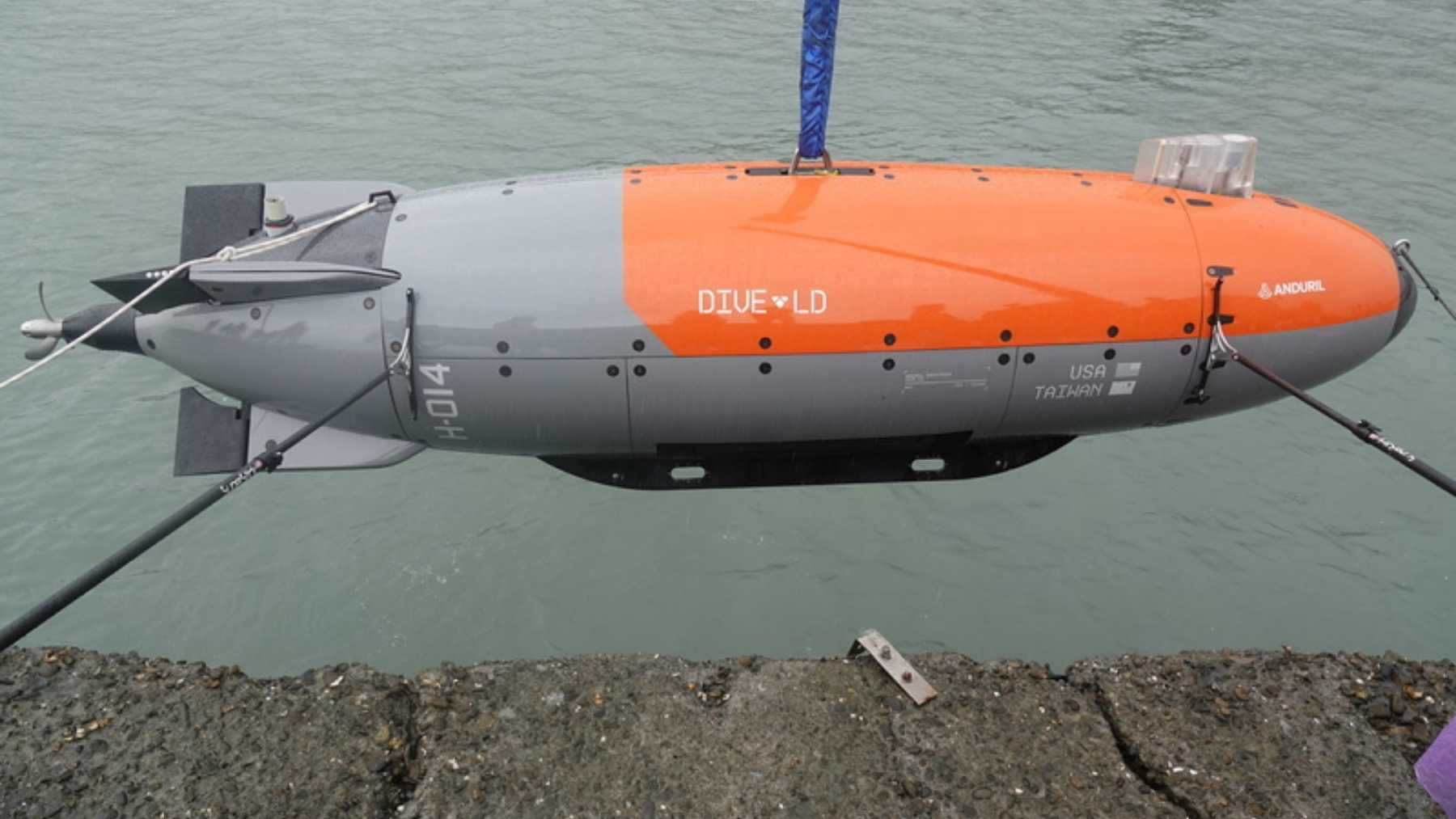
The fix it has bought is Anduril’s Dive-LD. NCSIST signed for it alongside the Copperhead mine at Taipei’s defense expo in September 2025, crews are already in acceptance training, and the vehicle lands in August.
Three tons, ten days, and it does not need anyone to tell it where it is
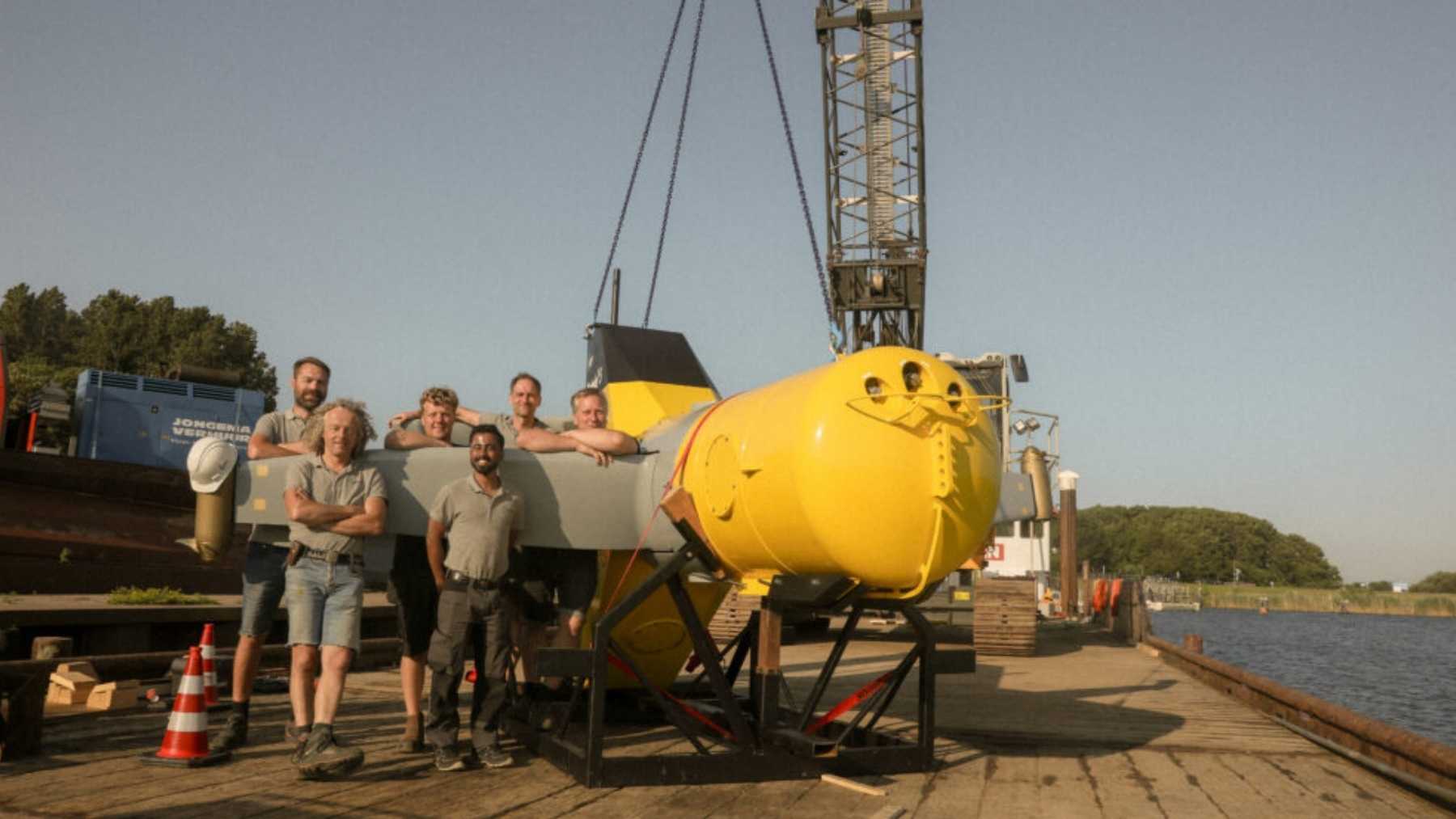
Anduril describes the Dive-LD as a large-diameter autonomous undersea vehicle with modular payloads, 10-day endurance and a 6,000-meter depth rating. It is 5.8 meters long, 1.2 meters across, and weighs about 2,700 kilograms dry. Call it three tons against the Huilong’s hundred-plus.
The numbers NCSIST handed the Liberty Times are the interesting bit. At 2.5 knots the Dive-LD runs submerged for about 10 days. Push it to 4 knots and you still get four.
GPS does not reach down there, so it does not use any. Inertial navigation, a Doppler velocity log and seabed tracking get fused together instead, and NCSIST says the resulting error stays inside 0.02 percent of total distance traveled. Over 100 miles of swimming, that is being wrong by about 100 yards.
The payload bay swaps out fast, and NCSIST says the open software architecture lets it adapt a sensor that did not come from Anduril in roughly two weeks. Taiwan’s units are fitted with synthetic aperture sonar, a multibeam echosounder, a magnetometer and high-resolution cameras.
Then comes the punchline. Between the Anduril contract and US export control rules, Taiwan’s Dive-LD is designated for commercial and civilian work only: seabed mapping, marine surveys, search and rescue, and inspecting the undersea cables that carry the island’s internet. NCSIST is pairing with Chunghwa Telecom for that last one.
The only underwater vehicle Taiwan will own that reliably steers itself is American, arrives in August, and is contractually barred from being a weapon.
Unmanned at sea means somebody has to follow you, or it is illegal
Richard Chou, an information security consultant, spelled out the regulatory side in a June 23 op-ed for the Taipei Times. Rules for aerial drones in Taiwan have loosened over the years. The underwater rules have not.
By his account, offshore sea trials are still written around a human operator being physically present, which is not a thing an autonomous vehicle can accommodate. So private developers test in reservoirs and inside harbors, which is not where the ocean is.
He was blunter at a defense event in April, talking to Storm Media: current unmanned-boat rules confine you to the harbor, and if it goes to sea unmanned, somebody has to follow it or you are breaking the law.
Which matters more than it used to, because the private hardware has gotten good and cheap. Chou’s op-ed points at the Taihe No. 1, an ROV from New Taipei firm Awareocean Technology built for mine countermeasures. It dives to about 300 meters on a one-kilometer fiber-optic tether and takes a side-scan sonar module.
The base vehicle runs about NT$3 million, or roughly $95,000. Load it up with high-end commercial sonar and an underwater positioning system and you are still around NT$5 million.
Awareocean general manager Chan Hsiang-chih told Storm Media the design started in 2022 under an economics ministry program and was aimed at the navy’s mine-hunting problem from day one. There are three variants: one to find the mine, one that carries the explosive charge to kill it, and a flagship with the side-scan sonar for wider searching. He says the military has been to see it work.
So Taiwan can now build a mine-hunting robot for the price of a mid-spec Ford F-150 Raptor. What it cannot easily do is take that robot offshore and let it hunt anything by itself.
The British firm building Taiwan’s next one already drives one from Australia
Lungteh, the Huilong’s builder, has not stopped. At Taipei’s defense show in September 2025 the yard showed a large UUV developed with two British companies, MSubs and Marine AI, and told Asian Military Review it hoped to have the thing finished in 2026. There has been no public word since that it has been.
MSubs is worth knowing here, because we have covered the same Plymouth outfit from the other end. It built Excalibur, the Royal Navy’s 19-ton drone submarine, which just started a two-year trials program the Navy handed straight to MSubs without a competition. During an exercise last August, British operators drove Excalibur while it was submerged off Plymouth, from a control room in Australia, 10,000 miles away.
That is the same company, one hemisphere apart, working on the same class of machine. One of them has already been driven across the planet. The other is a hull with two torpedo tubes on the end of a fiber-optic cable.
None of this happens in a quiet neighborhood, either. China is testing uncrewed submarines around 45 meters long, bigger than anything anyone else has built, and wiring a sensor network across the Pacific seabed designed to find the boats that are supposed to be invisible.
What actually changes next
Chou’s asks are unglamorous and specific: rewrite the sea-trial rules, designate underwater test zones inside suitable ports, and give offshore testing a legal framework. He also wants a marine version of the “Drone National Team,” the commercial program Taiwan used to stand up its aerial drone industry.
None of that requires a breakthrough. It requires somebody to change a sentence.
Taiwan’s first indigenous submarine, the Hai Kun, is the reason the Huilong exists in the first place, and it is still not delivered either. CSBC has been paying daily late fees since it blew the November deadline, and as of a shareholders meeting in late June the company was still saying second half of this year.
The rest of the industry has an appointment already booked. The first Taiwan Marine Technology and Unmanned Vehicle Expo runs November 3 to 5 in Tainan, with the Ocean Affairs Council behind it and 125-plus exhibitors expected. Awareocean is bringing the Taihe. Everyone will have something on a stand that can find a mine on its own.
Then they will all take it back to the reservoir.