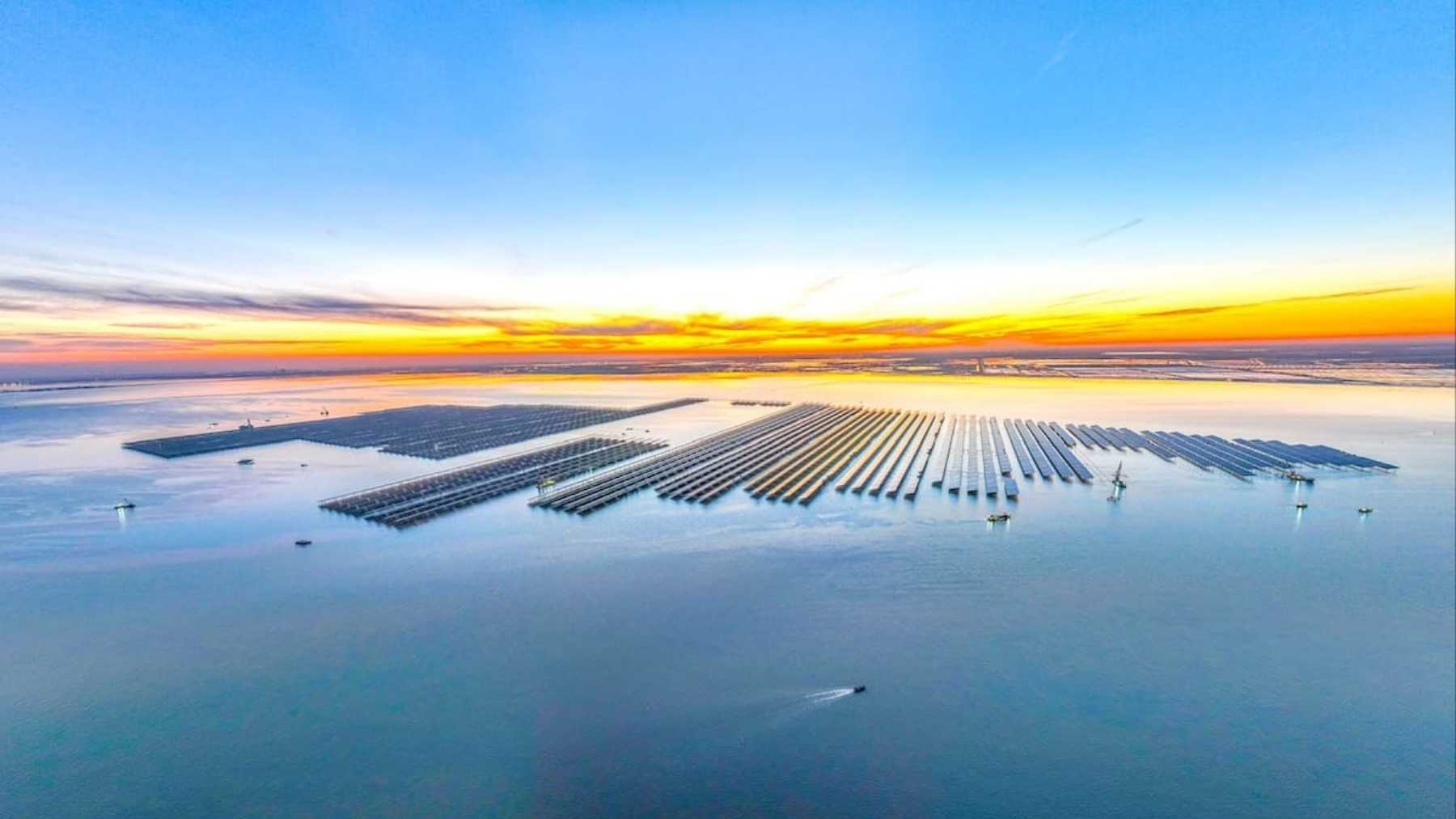

Solar farms go where the land is cheap and the sun is reliable. Most of the time that means a desert, a stretch of scrubland nobody is farming, or the roof of a distribution center. China has spent the last decade pushing that idea about as far as it will go on dry land, from a 250-mile “great wall” of panels strung across the Kubuqi desert to a Tibetan-plateau array so productive that the operator had to bring in thousands of sheep to keep the grass from shading the modules. The newest one skips the land question entirely. It sits about five miles off the coast of Dongying, in Shandong province, bolted to the seabed on nearly 3,000 steel platforms, with fish farming going on in the water underneath.
That project is called HG14, and as of late December 2025 it is fully wired into the grid. Built by Guohua Energy Investment, a subsidiary of state-owned China Energy Investment Corporation (CHN Energy), it is a 1-gigawatt photovoltaic plant that the company bills as the world’s first gigawatt-scale offshore solar farm, and the largest sitting in open sea anywhere. The “offshore” part is doing real work, because almost every big floating solar project you have read about lives on a calm reservoir or an inland lake. This one is out in the actual ocean, in a bay that ices over in winter.
This one is bolted down, not floating
Worth getting the engineering straight first, because “floating solar farm” is the label that keeps getting stuck on HG14 and it is not quite right. The plant does not float. It is a fixed-pile system: steel piles are driven into the seabed, and the platforms holding the panels sit rigidly on top of them. That approach works here because the water is shockingly shallow, between roughly 3 and 13 feet (one to four meters) deep across the entire 1,223-hectare site, which works out to about 4.7 square miles, or close to a fifth of Manhattan. At that depth you can anchor straight to the bottom instead of building expensive floating pontoons, and you end up with a far sturdier structure.
Sturdiness is the whole game out there, because the waters off Kenli district turn genuinely hostile in winter. Air temperatures drop below 14°F (-10°C), Siberian winds push saline spray that can freeze on contact, and the shallow bay forms sheets of sea ice. CHN Energy says the fixed-pile design was engineered specifically to take waves, tides, strong winds and seasonal ice without buckling. There are 2,934 of those platforms by the developer’s count, each one about 197 by 115 feet (60 by 35 meters), held down by a combined 11,736 steel piles. To put them in fast enough, the construction crews used a setup that drives four piles into the seabed at once with automated leveling, which is the kind of unglamorous detail that decides whether a project like this finishes this decade or next.
Shallow water is most of the trick
Building solar at sea sounds like an answer to a problem nobody has, given how much empty land is lying around. But eastern coastal China is not empty. It is where the people and the factories are, and flat, cheap, sun-soaked land near those load centers is genuinely scarce. Parking a gigawatt of panels just offshore puts the electricity right next to where it gets consumed, without bulldozing farmland or picking a fight over a desert.
The catch is that this exact approach only works in a narrow set of places. Fixed-pile offshore solar needs a shallow coastal shelf with a stable seabed that can hold the piles and ride out the local wave climate, and most coastlines simply do not offer that. So while the topline makes HG14 sound like a blueprint the rest of the world can photocopy, the conditions behind it (a broad, shallow, ice-prone bay sitting right next to a major demand center) are fairly specific. It is less a universal template than a very good use of one unusual stretch of sea.
The cable and the permits were both firsts
The record here is not just about size. HG14 is the first time China has paired a 66-kilovolt offshore cable with an onshore cable to move solar power that far at high capacity, with the current stepped up to 220 kilovolts once it reaches land. It is also, according to pv magazine, the first offshore solar facility approved under China’s national three-dimensional sea-use rights framework, which is the bureaucratic machinery for letting more than one industry legally share the same patch of water. Pairing the panels with on-site storage and that transmission setup lifts the plant’s effective capacity by around 20% and trims unit costs by roughly 15%, per CHN Energy’s figures.
“The project provides valuable experience for future offshore solar farm construction,” Zhang Bo, deputy manager of the Kenli project at Guohua Energy Investment, told state broadcaster CGTN, as Electrek relayed. Which is corporate-speak for “we are going to build more of these.”
There are fish farms under the panels
The detail that tends to stop people is the second business running in the same water. HG14 uses what CHN Energy calls an integrated fishing-and-PV model: power generation up on the platforms, aquaculture in the sea below. The company expects the fish farming alone to bring in more than 27 million yuan a year, roughly $3.8 million, on top of whatever the electricity earns. The panels throw shade and the structure offers shelter, which in theory makes the water beneath friendlier to farmed fish than open sea.
On the power side, the developer’s own numbers are the ones to weigh, since this is a state operator reporting on its own project. CHN Energy says HG14 will generate around 1.78 terawatt-hours a year at full output, enough by its math to cover about 2.67 million urban residents and roughly 60% of Kenli district’s total electricity demand. It puts the annual savings at 503,800 tons of coal and 1.34 million tons of CO2 avoided. A 100-megawatt, 200-megawatt-hour battery sits alongside the array to soak up midday generation and push it back onto the grid at full power for about two hours when it is needed most.
One farm does not flip the grid
It is tempting to read a gigawatt of offshore panels as China running away with the energy transition, and the national numbers do look like that from a distance. By the end of 2025 the country’s installed solar capacity reached about 1,200 gigawatts, up roughly 35% in a single year, according to its National Energy Administration. Wind and solar combined first passed China’s thermal (mostly coal) capacity back in early 2025, and Carbon Brief reports that the China Electricity Council expects solar capacity alone to overtake coal for the first time during 2026.
Capacity is not the same as electricity, though, and that is where the tidy version falls apart. Solar plants in China run at an average capacity factor of around 14%, against roughly 50% for coal, so a coal station still puts out several times more actual power per gigawatt installed. China also kept building coal hard last year: developers put forward about 161 gigawatts of new coal-fired capacity in 2025, per the Centre for Research on Energy and Clean Air and Global Energy Monitor, even as coal-fired generation itself slipped around 2%, its first drop in six years. Coal is not being switched off. It is being nudged toward backup and grid-balancing while the renewables get built out around it.
So HG14 is a real, working gigawatt sitting in the open ocean, which is a new thing and a hard one to pull off in a bay that freezes solid every winter. It is also a single project, in shallow water that happens to suit it, owned by a utility that controls exactly how the numbers get reported. Both of those are true at once. The real test is the next one: whether a fixed-pile plant like this turns up somewhere the water is deeper and the permitting is messier, or whether five miles out to sea stays a Shandong specialty.
Image credits: cscec.com