
Yellowstone is the supervolcano everyone keeps half an eye on. Park rangers field the eruption questions, documentaries run the doomsday arithmetic, and the magma chamber under Wyoming has spawned its own little genre of internet dread.
A magma reservoir of roughly the same size has been parked under the rolling hills of Tuscany this whole time. It isn’t threatening anyone. It’s been quietly running a power plant since before World War I.
Researchers from the University of Geneva, working with two Italian institutes, mapped it using a technique that turns the planet’s background hum into a scan of the deep crust. Their estimate, published in April in Communications Earth & Environment, is about 6,000 cubic kilometers of magma and partly molten rock, sitting 8 to 15 kilometers down beneath central Tuscany.
That’s roughly 1,440 cubic miles, a volume the authors put in the same league as the crustal reservoirs under recognized supervolcanoes like Yellowstone, Indonesia’s Toba and New Zealand’s Taupo. The difference is that Tuscany shows almost none of the usual warning signs, and the heat has been doing useful work for over a century.
The hills don’t look like they’re hiding anything
Most big magma systems announce themselves. You get craters, steam, swollen ground, fields of old volcanic deposits. Yellowstone has the geysers. Toba left a lake you can see from space.
Tuscany has gentle hills and vineyards. No major eruption has been recorded there in the entire Holocene, the roughly 11,700 years since the last ice age, which is exactly why a reservoir this size could sit undetected for so long.
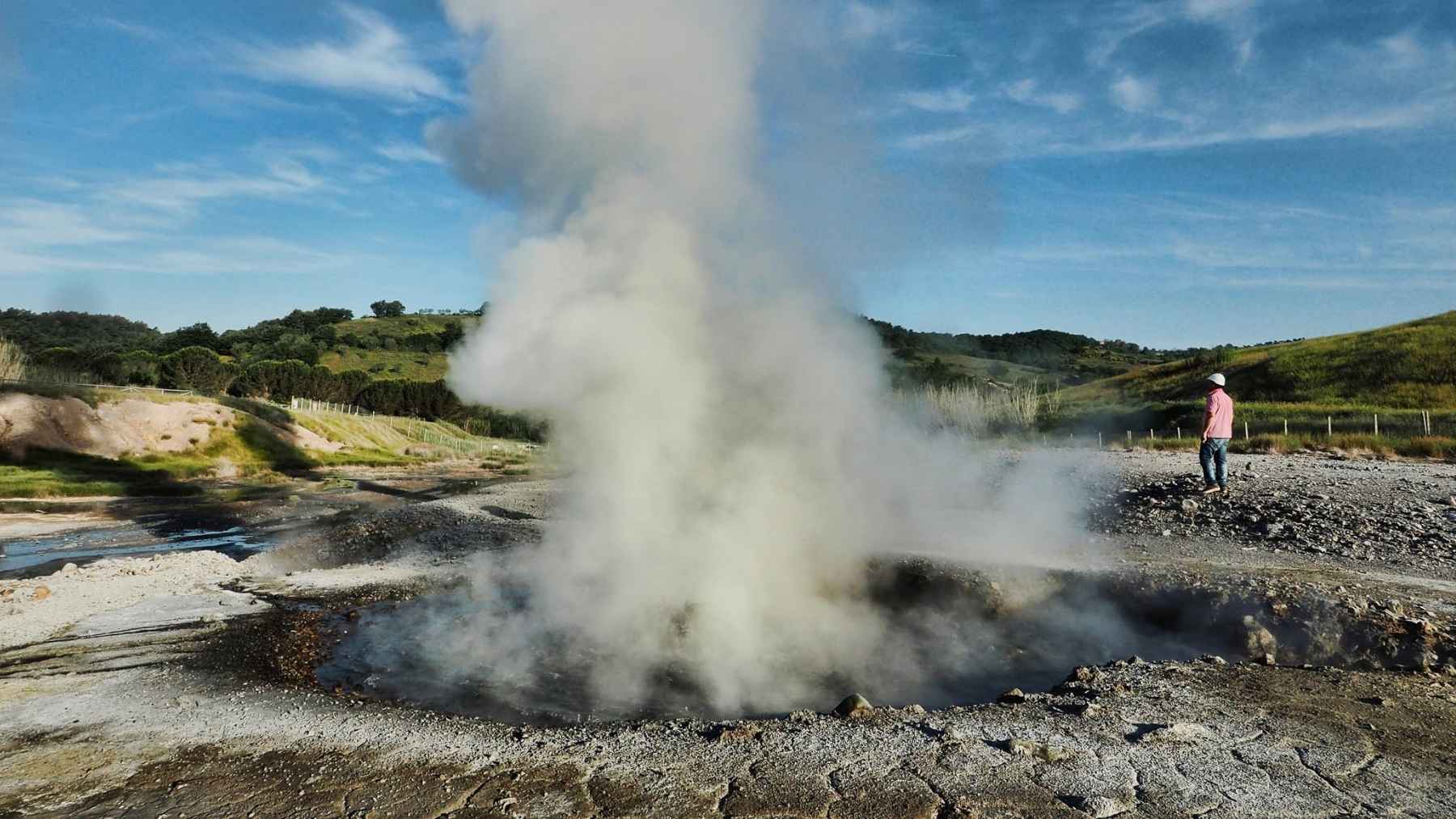
What the region does have is heat. The area around Larderello, in the center of Tuscany, picked up the nickname “Devil’s Valley” long ago for the steam venting out of the ground. The source of all that heat was never pinned down, because there was no obvious volcano to blame.
A borehole project that wrapped up in 2018 had already turned up sudden temperature spikes a few kilometers down, hinting that something was off. The new map gives that something a shape: a body of magma about 20 kilometers across, centered around 10 kilometers deep.
You find it by listening to the planet’s background noise
The technique is called ambient noise tomography, and it’s about as strange as it sounds. The ground is never truly still. Ocean waves, wind, and the general churn of human activity keep it humming at frequencies too low to feel.
Those vibrations travel through rock as surface waves, and they slow down when they pass through anything hot or partly melted. Spread enough sensors across a region, cross-reference how long the waves take to get from point to point, and you can build a three-dimensional picture of what’s down there. No drilling required.
The Geneva-led team used more than 60 seismometers scattered across Tuscany and the islands just offshore. Brandon Schmandt, a Rice University geophysicist who wasn’t part of the study, told Eos that surface waves are sensitive to how rock resists shearing, and that introducing even a little melt makes it “a good way to find a big magma reservoir.”
The payoff is speed and cost. Mapping magma this way is far cheaper than drilling exploratory holes and hoping you hit something, which matters well beyond one Italian valley.
The heat that has run Larderello since 1913
The history is what makes Tuscany more than a geology curiosity. The magma the team mapped is the engine behind the oldest geothermal operation on Earth.
In 1904, Prince Piero Ginori Conti rigged up a small generator at Larderello and used geothermal steam to light five bulbs in his boric acid factory. It was the first time anyone had turned the Earth’s heat into electricity.
By 1913, Larderello had the world’s first commercial geothermal power plant, a 250-kilowatt unit feeding the local railway and the surrounding towns. Italy stayed the only industrial producer of geothermal electricity on the planet until New Zealand caught up in 1958.
More than a century later, it’s still going. Italy’s geothermal fleet, all of it in Tuscany and anchored by Larderello, adds up to around 770 megawatts, now operated by Enel Green Power.
For all that history, nobody could fully explain where the heat came from. Matteo Lupi, the study’s lead author and an associate professor of earth sciences at the University of Geneva, said the team knew the region was geothermally active but “did not realize it contained such a large volume of magma,” according to the writeup on Phys.org. The reservoir they imaged is the missing answer.
Tuscany has the magma for a supervolcano, minus the supervolcano
Here’s the obvious question. If there’s enough magma down there to rival Yellowstone, why has Tuscany never produced a Yellowstone-style eruption?
The honest answer is that nobody is completely sure, and the researchers lay out a few possibilities. The Tuscan magma is highly viscous, formed by melting the surrounding crust rather than rising straight from the mantle, which makes it sluggish and far less prone to blowing its top.
It may also be drier than the magmas under classic supervolcanoes, or it may have crept into the crust slowly over a very long stretch of time. Federico Farina, a University of Milan geochemist and co-author, has pointed out that the structure of the crust itself could be trapping the melt and keeping it put.
Then there’s the texture of the stuff. A reservoir like this isn’t an underground lake of clean liquid rock. It’s closer to a “magma mush,” a stiff mix of melt and crystals that’s hard to mobilize in a hurry, which helps explain how such a large volume can sit there without erupting.
The team’s read is that the system poses no threat on any timescale humans need to care about. Lupi’s own framing is almost wistful: give it a few hundred thousand years, he’s suggested, and the region could grow a supervolcano of its own.
The same map points at lithium and rare earths
The reason a study about Italian magma turns up in conversations about cars and batteries comes down to what forms alongside deep magmatic systems.
Reservoirs like the one under Tuscany are exactly the kind of setting where lithium and rare earth elements concentrate, the materials that go into electric-vehicle batteries and a long list of other modern hardware. Map the magma cheaply, and you’ve got a head start on finding the resources tied to it.
Lupi has made that link himself, flagging lithium and rare-earth deposits as one of the practical reasons the method matters for the energy transition.
It’s the same logic driving a wave of other “heat and minerals from the rock” projects. Across parts of Australia, the pitch is granite that warms itself through radioactive decay. In the Utah desert, Fervo Energy is fracking heat out of hot dry rock toward the largest enhanced geothermal field on the planet. And in Iceland, one nonprofit wants to drill straight into magma on purpose to see how much power a single hole can produce.
Tuscany sits at the gentler end of that spectrum. The magma is already doing the work. The new part is that we can finally see it.
The quietly useful part
None of this changes daily life in Tuscany. The hills are still hills, the wine is still wine, and the steam vents that spooked medieval travelers are still venting.
What changed is the map. For more than a century, Larderello produced clean power from a heat source nobody could fully account for. Now it has a number on it: roughly 6,000 cubic kilometers of magma, a few miles down, hiding in plain sight under some of the calmest scenery in Europe.
The same trick that found it works anywhere the ground hums, which is everywhere. That’s the quietly useful result here, more than the Yellowstone comparison. Tuscany already knew it was sitting on heat. Now it knows how much.