
An aircraft carrier is about the heaviest thing people build that still moves under its own power. A hundred thousand tons of steel, and no crane on the planet is going to pick one up.
So the line General Atomics uses about its biggest magnet reads like a fish story: it is strong enough to lift an aircraft carrier two meters, or six feet, straight up out of the water. Nobody is ever going to try that. But the number behind the boast is real, and on June 23 the last piece of that magnet was lowered into place at the ITER fusion site in southern France.
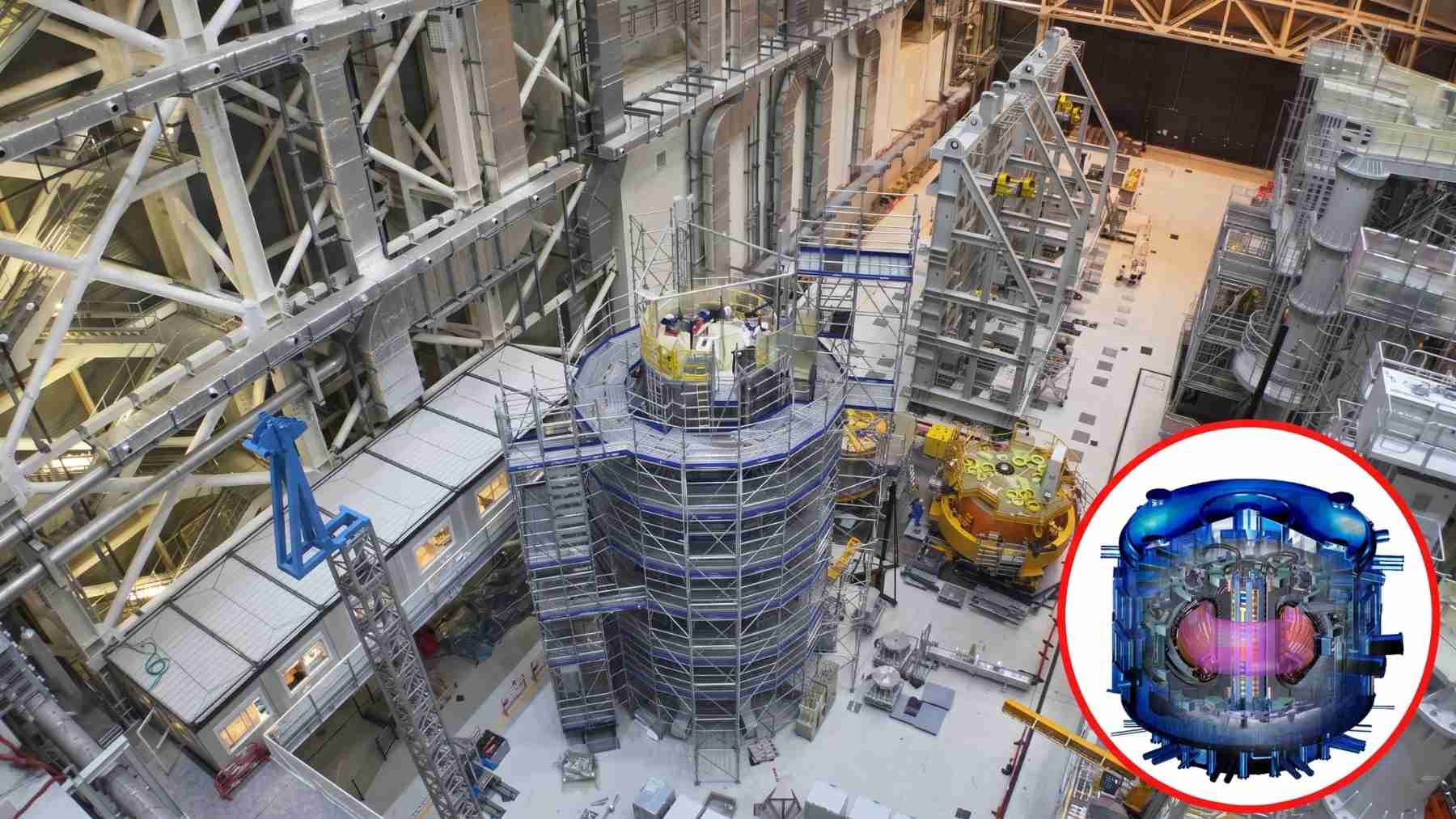
The magnet is called the central solenoid, and it is the largest and most powerful pulsed superconducting electromagnet ever built. It weighs 1,000 tons, stands 18 meters tall, about the height of a five-story building, and it was made in Poway, California, just north of San Diego, over roughly 15 years.
It reached its full height last month, six stacked coils finally sitting one on top of another inside the biggest fusion machine humans have ever attempted to build.
The aircraft carrier is not a metaphor
Here is where the carrier line comes from. At its core the central solenoid reaches a magnetic field of 13 tesla, which General Atomics puts at roughly 280,000 times the strength of Earth’s own magnetic field. Your hospital MRI runs somewhere between 1.5 and 3 tesla.
Bottled up inside that field is about 6.4 gigajoules of stored energy. That is the “lift a carrier two meters” figure. It is not something the magnet will ever do, just a way to picture how much force is packed into it.
The word “pulsed” is the key difference. ITER actually needs three sets of magnets. The big D-shaped toroidal coils and the ring-shaped poloidal coils hold steady fields to cage and shape the plasma. The central solenoid is the one that pulses, dumping its stored energy to kick the plasma current into life and keep driving it. Think of it as the machine’s ignition and its accelerator at once.
Its actual job is stranger than moving ships. Sitting in the dead center of the ITER tokamak, the solenoid fires a pulse that induces a current of 15 million amperes in a cloud of hydrogen plasma, and holds that current for 300 to 500 seconds at a time.
That current heats and helps confine the plasma until it reaches 150 million degrees Celsius, about ten times hotter than the core of the Sun. Fusion happens somewhere in there. The solenoid is what gets the whole reaction moving, which is why the people who work on ITER call it the machine’s beating heart.
Six coils, more than two years each
You do not build something like this in one piece. The central solenoid is six separate coils, called modules, stacked into a tower. Each one is about 4.25 meters across, weighs 110 tons, or 250,000 pounds, and takes more than two years of precision work to wind and finish.
The raw material is odd stuff. Each module is wound from roughly 6 kilometers, nearly four miles, of niobium-tin superconducting cable jacketed in steel. That cable was manufactured in Japan and shipped to California, where General Atomics wound it into flat, layered “pancakes” and spliced them together like rope.
Then it goes in an oven. To turn the cable superconducting, each module bakes in a furnace that General Atomics compares to a very large kitchen convection oven, spending about ten days at 570°C and another four at 650°C.
Six of these were needed for the stack. General Atomics built a seventh as a spare, which World Nuclear News reports will only be used if a problem ever turns up in one of the six already in France.
The forces are the real engineering problem
Winding the coils is only half the challenge. The other half is stopping the finished magnet from tearing itself apart.
When the central solenoid runs, the six modules shove against each other with enormous force. US ITER’s engineering technical director, Kevin Freudenberg, put the vertical load on the stack at up to 60 meganewtons, which he described as more than twice the force of a space rocket at blast-off.
To hold that in place, the magnet is wrapped in what the team calls an exoskeleton: a support cage of more than 9,000 individual parts, built by eight US suppliers across six states. It includes 18-meter steel tie plates running the full height of the tower and massive key blocks at the top and bottom.
The bolts are not ordinary bolts either. The team turned to a US company’s Superbolt technology to fasten the structure tightly enough to survive the loads the magnet generates.
Getting the last coil into that cage was its own white-knuckle job. The 110-ton module had to be lowered into a gap with just 50 millimeters of clearance on one side and 65 on the other. For a component that heavy, that is threading a needle.
Made in San Diego, stacked in France
ITER is backed by seven members: the European Union, the United States, China, India, Japan, Korea and Russia. Together they represent 35 countries, and the US built one of the project’s single largest pieces.
The arrangement is unusual. Instead of writing a check, most ITER members contribute hardware they build at home. The US is covering about nine percent of ITER’s construction cost but gets access to 100 percent of the science that comes out of it. American investment has passed $1.1 billion, more than 80 percent of it spent inside the US, and over 600 US companies have had a hand in ITER hardware.
General Atomics is not a newcomer to this. The company runs the DIII-D National Fusion Facility, the largest operating fusion research reactor in the US, for the Department of Energy, and it built its Poway magnet plant specifically to make the central solenoid.
The solenoid work was run by US ITER, managed out of Oak Ridge National Laboratory. When the modules were finished in August 2025, the company held a celebration at its San Diego magnet plant with Congressman Scott Peters and San Diego Mayor Todd Gloria on hand, and a clear message: turn San Diego into a fusion hub.
General Atomics has a second connection to aircraft carriers, and this one is literal. The company builds the electromagnetic catapults, known as EMALS, that launch jets off the Navy’s Ford-class carriers. So the outfit whose magnet is described as strong enough to lift a carrier also builds the electromagnets that fling aircraft off the real ones.
It reached full height. Now it waits.
The June 23 lift finished the stack, but not the magnet. Next comes the support cage and a pre-compression step that squeezes the whole tower together. After that, the completed solenoid sits on its platform in the assembly hall and waits. It cannot move to the center of the reactor until all nine sections of the vacuum vessel are installed around it.
ITER itself is running years behind. The revised schedule that its director-general, Pietro Barabaschi, unveiled in 2024 pushes serious research operations to 2034, and the machine will not run on its real deuterium-tritium fusion fuel until 2039. Barabaschi has been blunt that fusion “cannot arrive in time to solve the problems our planet faces today.”
The delay is not only about slipping dates. Under the new plan, ITER skips the old “first plasma” milestone, a quick low-power test on a barely finished machine, in favor of starting with a more complete reactor and going straight to real research. Barabaschi has called the old milestone mostly symbolic, “a machine test” rather than science.
The magnet is at least the part that is done, and it is not the only giant fusion magnet in the news lately. Days after ITER topped out its solenoid, China announced it had tested the largest fusion magnet ever built, a 582-ton coil made entirely at home. A separate American machine just got a school-bus-sized replacement magnet built in Spain. And the largest fusion machine actually running, Japan’s JT-60SA, still holds that title only because ITER has not switched on yet.
That is the strange status of the most powerful magnet ever built: finished, stacked, and waiting on the rest of a machine that will not start real experiments until 2034. The hard part, winding six superconducting coils in California without ruining a single one, is over. The rest is mostly patience, and a lot of it.