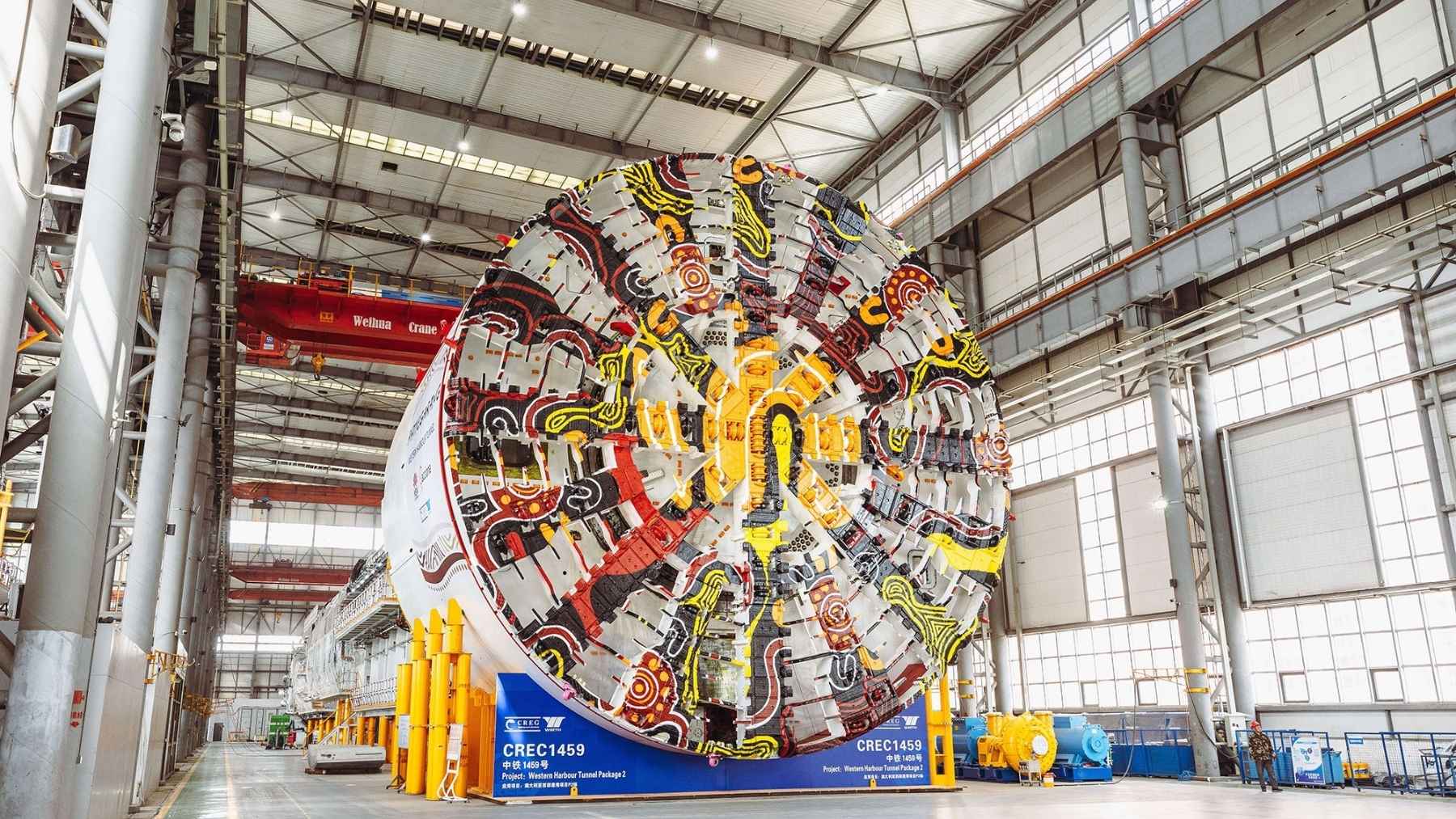

The biggest tunnel boring machine in the Southern Hemisphere arrived in Sydney roughly the way a cheap bookshelf arrives at your door: flat-packed, with some assembly required. The scale is a little different. This one shipped from China in 263 major parts plus 125 containers of loose components, according to the New South Wales Government.
And there was nowhere sensible to put it together. A machine 15.7 meters (51.5 feet) across doesn’t fit on any road in Australia, or anywhere else. So crews hauled the parts underground at night and assembled the whole thing inside a purpose-built cavern 44.7 meters (about 147 feet) below Birchgrove Oval, a suburban cricket ground on Sydney’s inner west.
That machine is called Patyegarang, and she is now digging. Trade outlet Ground Engineering confirmed on July 2 that the borer has begun her drive toward Waverton. Ahead of her cutterhead sit the final 1.5 kilometers (0.9 miles) of the Western Harbour Tunnel, the stretch that runs directly under Sydney Harbour itself.
The last 1.5 kilometers run under the harbour floor
The Western Harbour Tunnel is Sydney’s third road crossing of the harbour and its first new one in about three decades. When it opens in 2028, the 6.5-kilometer (4-mile) link will connect the Warringah Freeway near North Sydney to the Rozelle Interchange and WestConnex, with three lanes in each direction. The NSW Government says it will stay in public hands.
Most of the route has already been carved out by electric roadheaders, the smaller grinding machines better suited to the dry land sections. Overall excavation sits at 81.35 percent, per the state government. The boring machines exist for the one part roadheaders can’t touch: the underwater crossing, up to 50 meters (164 feet) below sea level.
It is not a straight shot down there either. CREG, the machine’s Chinese manufacturer, describes an S-shaped alignment with a minimum turning radius of 960 meters (3,150 feet), through sandstone, silt and silty clay that averages 30 MPa in compressive strength and hits 80 MPa in places. Patyegarang has to steer through all of that while roughly the length of a city block.
How long, exactly, depends on who’s measuring. CREG lists the machine at about 113 meters without its trailing platform. The NSW Government’s fuller figure, back-up gantries included, is 137 meters, which is longer than a football field with both end zones attached.
The drive runs 24/7 with about 40 people aboard at any one time, and the state expects the underwater section to take around a year. As she advances, Patyegarang lines the bore behind her with some of the roughly 13,000 precast concrete segments cast at a facility in Emu Plains, Western Sydney, then trucked in via the M4 and WestConnex. NSW Roads Minister Jenny Aitchison called the launch a milestone “marking the beginning of the final stage of excavation under Sydney Harbour.”
They built it in a cavern with hallway clearance
Normally you dig a big open pit, lower the borer down in sections, and bolt it together in daylight. Sydney didn’t get that option. The launch site sits under a residential neighborhood, so the project excavated twin caverns 28 meters (92 feet) tall, among the largest ever dug in Australia, just 230 meters from the water’s edge.
Inside, a 500-tonne gantry crane spent months stacking the machine piece by piece, including a 462-tonne cutterhead, just over a million pounds of spinning steel, lifted into position back in February. Once assembled, the NSW Government says there was only 1 to 2 meters of clearance between each machine and the cavern walls. That’s a five-story building parked with about the margin of a hallway.
“Both TBMs will be assembled and launched from underground chambers, a first for Australia,” construction manager Christian D’Hondt said in an ACCIONA statement. The state government goes further: at 4,350 metric tons apiece, about the weight of 88 double-decker buses, these are the largest boring machines ever assembled underground anywhere.
The slurry factory is buried down there too
Patyegarang is a slurry machine, which matters under a harbour. Instead of cutting a dry face, she presses a pressurized mix of water and clay against the ground in front of her. That fluid holds back the soft marine sediments and keeps the face from collapsing while the cutterhead grinds away 50 meters under the seabed.
All that slurry has to come from somewhere, and this is the project’s second record. The treatment plant that feeds it stretches more than 100 meters (328 feet) long and stands up to 15 meters tall, and the NSW Government says it’s the first plant of this size ever built underground anywhere in the world. It can pump up to 3 million liters an hour, roughly 793,000 gallons, to each machine’s face.
These plants normally sprawl across the surface next to the launch site. Sydney buried this one specifically so the neighborhood above wouldn’t spend years living next to an industrial facility. The plant filters the returning slurry, sends the liquid back to the machines for reuse, and the separated rock gets trucked out through WestConnex for recycling on other projects.
So the machine was built underground, launches underground, and even its supply chain lives underground. The residents of Birchgrove get a cricket oval. Everything else happens 147 feet beneath it.
The original plan involved digging up the harbour
None of this was the first idea. The earlier concept for the crossing was an immersed tube tunnel, the kind where you dredge a trench in the seabed and sink prefabricated sections into it. ACCIONA project director Andrew Marsonet has said that approach would have disturbed marine ecosystems and heritage areas, so the contractor pitched a deeper alignment bored entirely beneath the harbour floor instead.
That redesign is why the machines exist. No dredging, no barges over the harbour, and a planned construction site at Berrys Bay in Waverton got handed back for foreshore parkland instead. Transport for NSW awarded ACCIONA the A$4.24 billion Stage 2 contract in December 2022 to deliver it, covering the harbour crossing, the northern connections and the full tunnel fit-out.
Stage 1, the 1.7-kilometer southern approach from Rozelle to Birchgrove, was finished by a John Holland and CPB Contractors joint venture in February 2025. Then they handed the tunnels over, and the big machines took the baton.
It’s also the biggest borer China has ever exported
Patyegarang holds one more record, this one for her builder. CREG, the Chinese state-owned manufacturer, says the 15.7-meter cutting diameter makes her the largest-diameter tunnel boring machine the country has ever shipped overseas. The design was a joint effort: CREG engineers embedded with ACCIONA in Australia, ACCIONA staff embedded in China during fabrication, per the contractor.
China builds bigger at home. The 5,000-ton machine grinding under the Yangtze carries a 16.64-meter head, and the same industry produced a 500-ton rig that drills straight down. But exports are the growth story. The South China Morning Post reports China is now the world’s largest TBM manufacturer, and after Patyegarang shipped, the state of Victoria ordered four more Chinese machines for Melbourne’s Suburban Rail Loop.
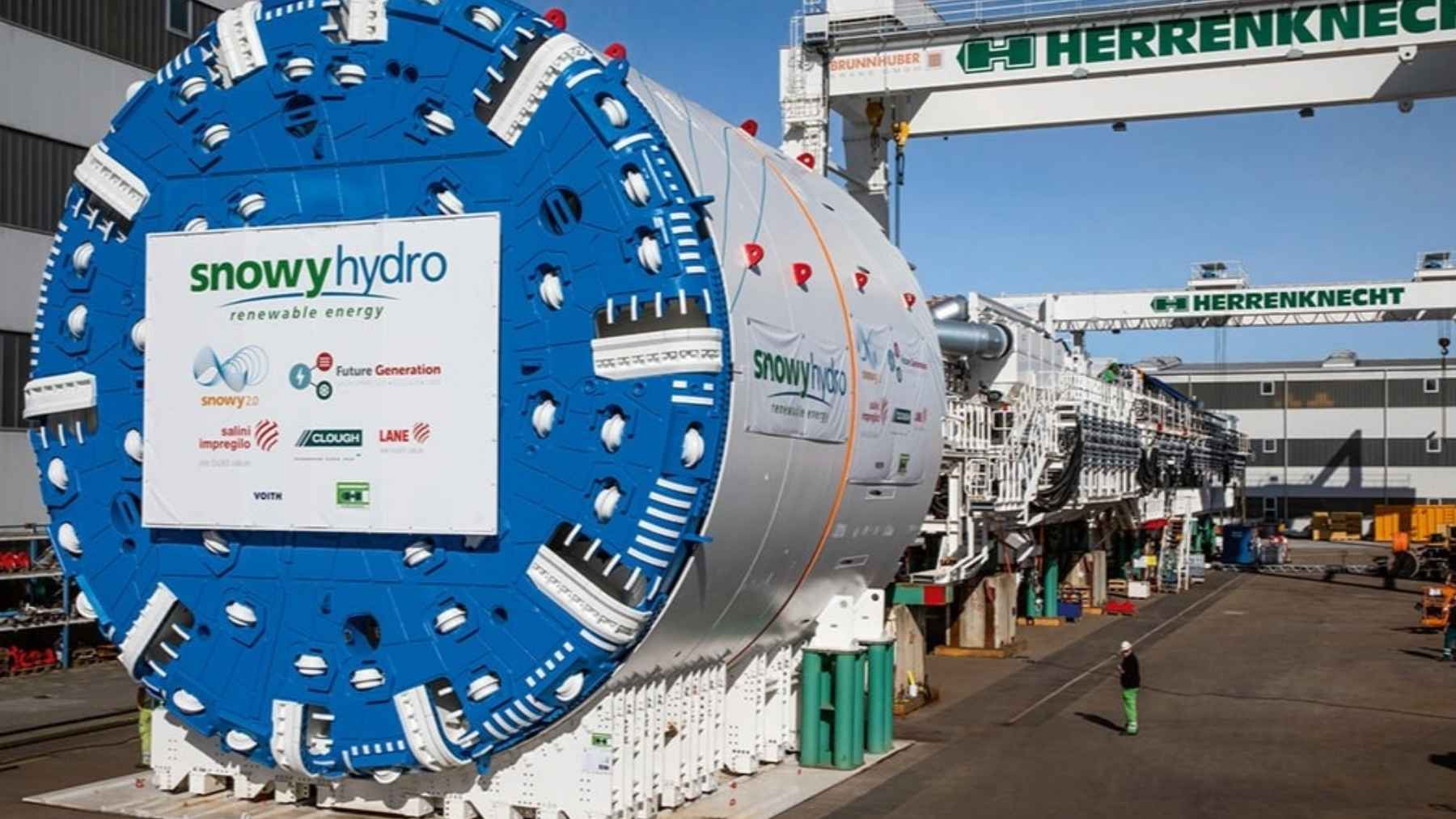
Australia has form here anyway. A 2,300-ton borer just finished its work nearly a kilometer under the Snowy Mountains. And the underground-assembly trick puts Sydney at one extreme of a spectrum the whole industry is exploring: Washington lowered its Potomac borer down a shaft in sections, Montreal did roughly the same for its metro extension, while The Boring Company’s Prufrock machines in Nashville skip the pit entirely and tilt themselves into the dirt from a truck. Sydney’s answer to the launch problem was the most extreme of all: build the factory where the work is.
Her sister is four weeks behind
Barangaroo, the second machine, was 94 percent assembled when the state published its last update and is expected to start digging about four weeks after Patyegarang. Both are named for Aboriginal women from Sydney’s early colonial history, and both cutterheads carry artwork honoring them.
Once the two borers reach the receival chambers at Waverton, the machines’ work is done and the fit-out crews take over for the 2028 opening. The state projects the finished tunnel will pull 35 percent of traffic off the Western Distributor, 20 percent out of the existing Sydney Harbour Tunnel and 17 percent off the Harbour Bridge.
Until then, there’s a public tracker where you can follow both machines’ progress under the harbour in something close to real time. Sydney spent years engineering this project so that nobody on the surface would notice it happening. The tracker exists for the people who want to notice anyway.