
Everyone loves talking about wind and solar until the conversation reaches February. Northern Europe builds gigawatts of offshore turbines that flood the grid with surplus power when it’s blowing a gale in July. Then the wind drops for a week in midwinter and everyone remembers why gas plants still exist.
The missing piece has always been seasonal storage. Somewhere to park the summer surplus until you actually need it six months later. Lithium can’t do it, and pumped hydro is locked to the few places with the right mountains.
The Netherlands just put serious public money behind a different answer: a hole in the ground filled with hydrogen.
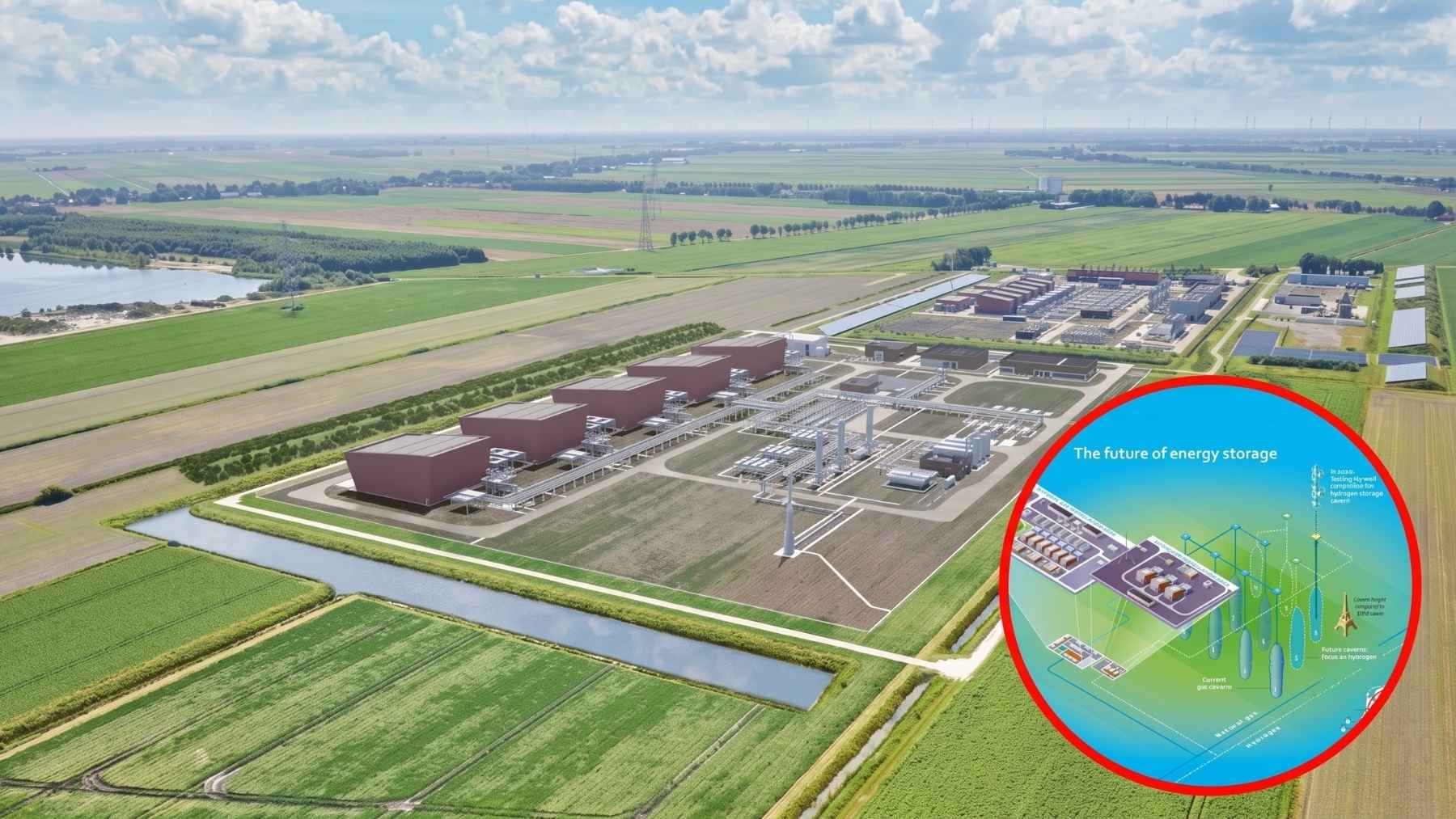
Per Argus Media, the Dutch government is providing €450 million ($514 million) in subsidies for the HyStock hydrogen storage project at Zuidwending, in the country’s north, developed by state-owned grid operator Gasunie. It’s a nine-figure bet on infrastructure that stores energy as gas, a kilometer underground, in salt.
Why the salt is the whole story
The Zuidwending site isn’t new. Gasunie’s subsidiary EnergyStock has stored natural gas in salt caverns there since 2011, and the geology of Groningen is exactly what energy planners dream about.
Underneath sits a salt formation thick enough to host caverns at grid scale, one of the few spots in northwest Europe that physically can. You drill down, pump in water, dissolve out a chunk of salt, pump the brine away, and you’re left with an airtight void the shape of a cigar, a kilometer down.
Salt is what makes it work. Hydrogen is a nightmare to contain: it embrittles steel, slips through gaskets, and generally makes engineers cry. Salt just seals itself. The formation creeps under pressure and closes any crack that tries to open, which is why the surrounding salt mass acts as a natural gas-tight barrier.
The idea isn’t experimental, either. The US and UK have stored gas in salt caverns like this for decades. What’s new is repurposing the technique from petrochemical reserve to grid-tied seasonal buffer, a very different job.
Two hundred gigawatt-hours in one hole
The specs are worth pausing on. Per HyStock’s own documentation, the caverns connect to the surface through pipes and valves starting around 1,200 meters down, with room for at least 6 kilotonnes of hydrogen apiece.
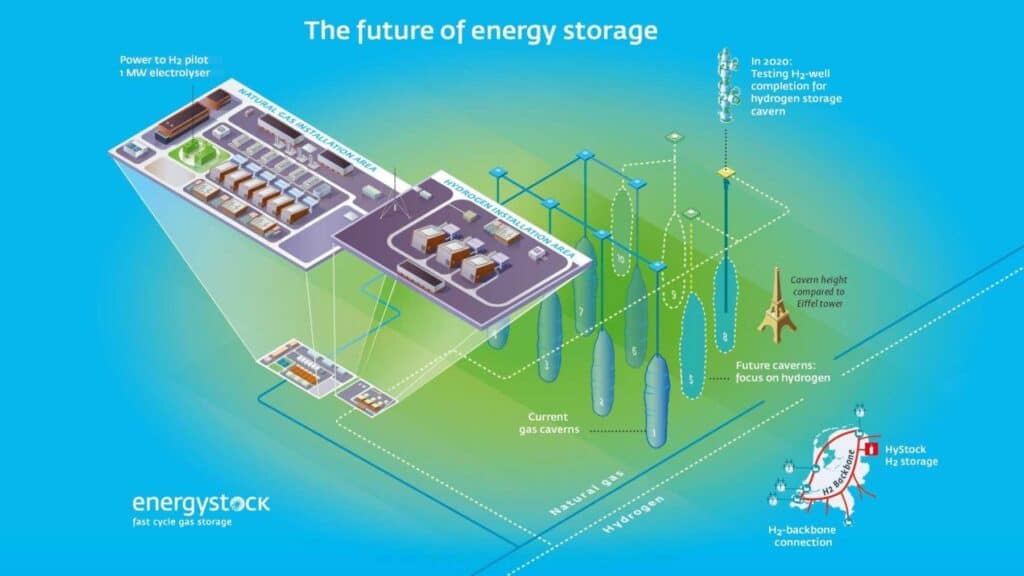
That first cavern is rated at 216 gigawatt-hours. For scale, that’s bigger than any grid-scale battery on Earth by roughly an order of magnitude, and the salt doesn’t wear out on a cycle count the way a lithium pack does.
Gasunie’s full plan is four caverns for a combined 20 kilotonnes of hydrogen. The timeline, though, has slipped. Early promises floated the first cavern years ago; Gasunie’s project page now says the first will be ready around 2031, with the next three following once salt company Nobian finishes developing them.
So the Netherlands isn’t buying capacity that switches on tomorrow. It’s funding capacity that becomes real toward the end of the decade, which, if you’re planning an offshore wind buildout, is exactly the horizon that matters.
The part nobody puts in a headline: cushion gas
Here’s the catch that explains why this needed government money instead of a private investor. Before you can cycle hydrogen in and out of a cavern, you have to permanently fill a big fraction of it with hydrogen that never comes back out. That’s the pressure floor that lets the top layer move, and it’s called cushion gas.
Argus reports the Dutch government said its support is meant to cover risks a typical investor couldn’t shoulder alone: the uncertain cost of that cushion gas, the likelihood of low utilization in the market’s early years, and the chance of permitting-related delays. In other words, a permanent underground buffer of expensive green hydrogen that never gets sold is baked into the price, and the state is absorbing that gamble.
The subsidy isn’t a blank check. The government was clear it doesn’t guarantee operations or cover cost overruns, and Gasunie owns the execution risk. It’s public money to get a first-of-its-kind facility off the ground, not a promise that the economics already close.
Why seasonal storage is the piece nobody built
A wind farm’s annual average is meaningless if you can’t shift the electricity from July to February. This is the function grid planners have been begging for, and Gasunie describes the caverns as a lung in the hydrogen network: something that can inhale huge volumes of hydrogen fast when there’s surplus and exhale them just as fast when there’s a shortfall.
Think of the hierarchy. Batteries handle second-to-second frequency response. Pumped hydro handles day-to-day. Nobody had a clean answer for month-to-month until salt caverns, which sit at the slow, enormous end of the scale.
The demand is already there. During HyStock’s Open Season auction, industrial buyers reserved capacity in that first cavern and the requests far outstripped the 216 GWh on offer. Companies wanted more hydrogen storage than a single cavern can physically hold, before the thing is even built.
Where Denmark and the rest of the map fit
The Netherlands isn’t doing this in isolation, and it isn’t the only country digging into salt. Denmark is working to convert caverns at Lille Torup to hydrogen, aiming for a first cavern around 2030, and salt company Nobian has signed a memorandum with Gas Storage Denmark to explore joint cavern development. Germany has its own salt-cavern project in the works, and a Danish-German hydrogen pipeline is targeted to link the two grids.
That’s the real shape of it: a Northern European hydrogen backbone slowly threading together, where whoever has the right geology hosts the storage and everyone else plugs in. The Netherlands happens to be sitting on some of the best salt in the region, so it’s building first.
The bigger point reaches past Europe. The same physics that makes hydrogen worth storing underground is why the molecule keeps turning up wherever batteries run out of room, from giant turbines cleared to burn pure hydrogen at sea to submarines that brew their own hydrogen from the alcohol in your gas tank. And the reason green hydrogen keeps stalling on cost is the same reason this cavern matters: you need somewhere cheap to put the stuff once you’ve made it.
Whether it scales enough to actually displace winter gas depends on how fast the other three caverns come online, whether cushion gas costs stay bearable, and whether cheap green hydrogen ever truly materializes. But the infrastructure layer, the piece that lets a summer of surplus wind sit underground for six months and still show up on a freezing February evening, just got its first serious money. The rest is chemistry.