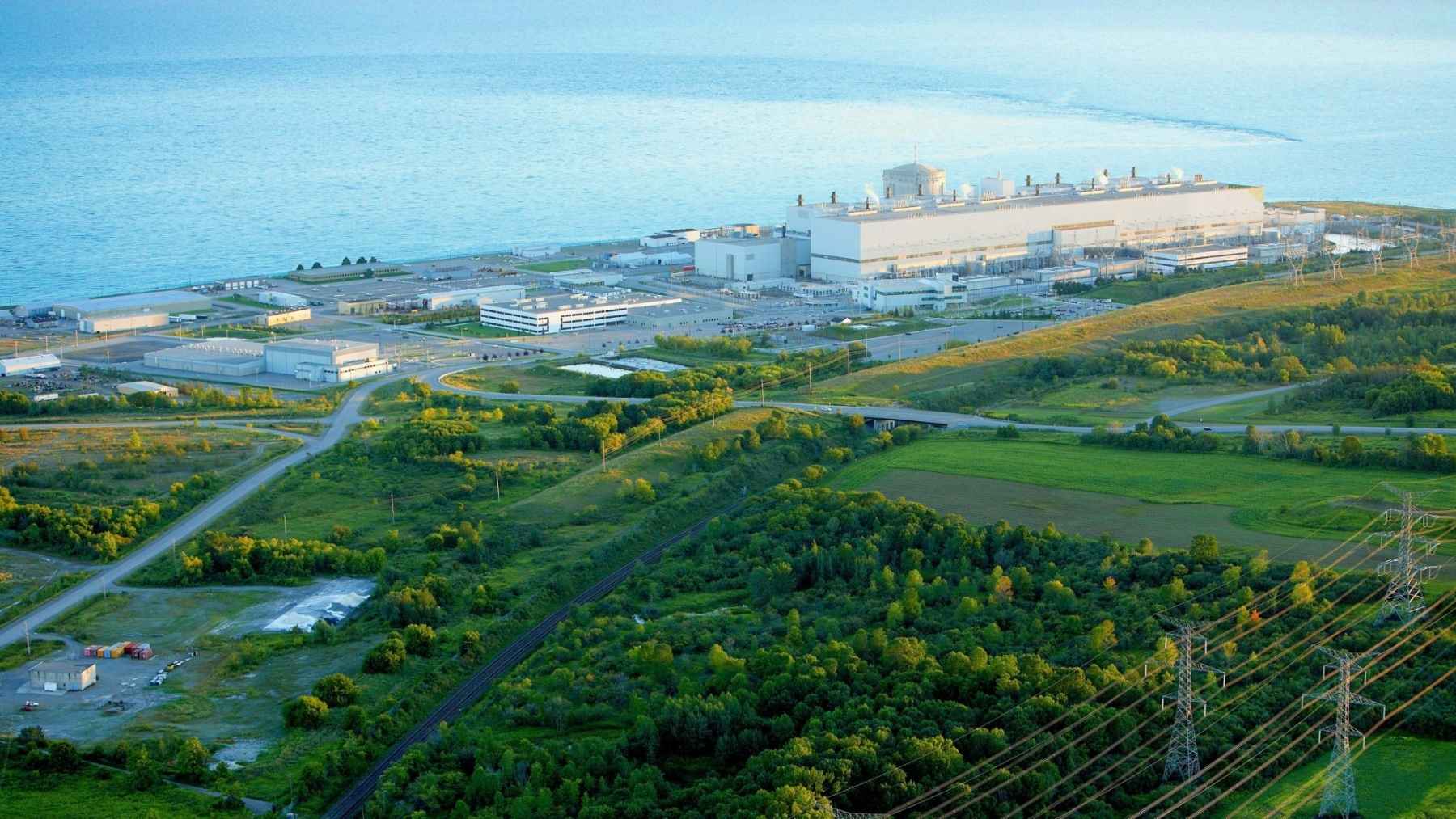

If you’ve followed Ontario’s nuclear program over the past year, you know the script by heart. On time. Under budget. Months ahead of schedule. Darlington’s four-reactor refurbishment wrapped up in March as the industry’s favorite proof that big nuclear projects don’t have to end in tears.
Then summer arrived, and half the station went quiet. According to an investigation by The Globe and Mail, two of Darlington’s four freshly refurbished reactors have spent long stretches of 2026 producing nothing, right after a decade-long, $12.8 billion (CAD) overhaul that provincial officials have held up as close to flawless.
Nobody is questioning the nuclear side of the work. The trouble, so far, is coming from everything wrapped around it. And that part of the story has a precedent Canada knows very well.
Unit 4 made it about a month before the first stumble
Unit 4 was the grand finale. The last of the four reactors finished its rebuild in 968 days, the fastest of the bunch, and reconnected to the grid at full power in March, after the Canadian Nuclear Safety Commission lifted the final regulatory hold point on March 7.
Ontario’s energy minister, Stephen Lecce, told the Globe in February that “We’re the only ones building on time, and we’re building on budget.” Fair enough on the construction side. The operating side got complicated fast.
Per grid operator data cited by the Globe, Unit 4 stopped generating on April 11, roughly a month after coming back. A report from the federal nuclear regulator tied the shutdown to “indications of a hydrogen leak” in the generator’s stator cooling water system, on the secondary, non-nuclear side of the plant.
The unit returned on May 26, ran near full output for about two weeks, then went dark again on June 10. OPG spokesperson Neal Kelly described the second stop as “electrical work that was unrelated to its recent refurbishment” and said the reactor would be back within days. The regulator confirmed it was notified on June 10 and that the electrical repairs are complete.
So the timeline reads: back in March, down in April, back in May, down in June. Not a safety story, and nobody has suggested otherwise. But for a machine that just received the most expensive spa treatment in Canadian history, it’s not the debut anyone scripted.
A 230-day repair job on boilers once rated fit for 30 more years
Unit 3 is the bigger deal. It came out of its own refurbishment in July 2023, and on March 30 of this year, twenty days after the project’s ribbon officially got cut, it went offline for a planned outage scheduled to last 230 days. The job: repairing its steam generators.
Run the math and Unit 3 isn’t due back until mid-November. That’s one of Ontario’s roughly 880-megawatt workhorses sitting idle through the exact months when the province’s air conditioners do their worst.
Each Darlington reactor has four steam generators, sixteen across the station. The Globe reports that early in the refurbishment, senior OPG officials judged them to be in excellent condition, good for another 30 years of service. The boilers had other plans.
OPG later found that internal components called primary moisture separators, which keep the steam feeding the turbines dry, had deteriorated and needed replacing. All of them were swapped in Units 1 and 4 during the refurbishment itself, plus two of Unit 3’s four steam generators in 2023. Last year, per the Globe, OPG’s board approved more than $250 million (CAD) to replace the remaining ones in Units 1 and 3.
A retube swaps the reactor’s guts, not the plant wrapped around it
In fairness to the machine, it helps to understand what a CANDU refurbishment actually buys. A CANDU runs its fuel through hundreds of horizontal pressure tubes instead of one big pressure vessel, a design quirk we got into when a 700 MW version of the reactor was pitched to US regulators earlier this year. Those tubes are the consumable. After roughly 30 years of neutron bombardment they’ve stretched and grown brittle, and the only fix is surgery.
At Darlington, that meant pulling 6,240 fuel bundles out of each reactor, draining the heavy water, then extracting and replacing 480 pressure tubes, 480 calandria tubes and 960 feeder pipes per unit. That’s the retube. It resets the nuclear clock for three more decades, and by every account the crews nailed it, finishing four months early and $150 million (CAD) under the $12.8 billion budget.
What a retube does not automatically renew is the conventional plant around the reactor: steam generators, turbines, electrical generators, the works. There, the operator inspects and makes judgment calls, component by component, on what stays. The Globe notes that getting those calls wrong is how a station ends up with outages and extra bills years later.
Compare that with what Bruce Power did a few hours up the road, where crews cut a hole in the roof and swapped out eight 100-ton steam generators entirely on its own Unit 3. Darlington’s steam generators stayed put and got rehabilitated instead. Two different answers to the same question, from two operators on the same grid.
Point Lepreau already ran this experiment
Canada has seen a version of this movie. Point Lepreau in New Brunswick was the first CANDU station ever refurbished, returning to service in 2012. It has performed worse than any of its refurbished peers since, and NB Power has acknowledged that one reason was doing too little work on the non-nuclear side of the plant, per the Globe.
That history is why this summer’s outages are getting read so closely. Nobody doubts the new pressure tubes. The open question is whether the components that stayed in place hold up the way the assessments said they would.
Darlington’s record so far isn’t Lepreau’s, either. Unit 2, the first reactor rebuilt, ran 529 consecutive days after its 2020 restart and posted an 85.3 percent capacity factor through the end of 2025, according to a Globe analysis of International Atomic Energy Agency data. For a CANDU coming out of major surgery, that’s a genuinely strong number.
The next invoice is $2 billion, and it lands in 2029
The outages are the visible part. The filings are where it gets expensive. In regulatory and rate documents reported by the Globe, OPG has laid out a queue of major work at the freshly refurbished station, starting with turbine rotor replacements in outages from 2029, estimated at $2 billion (CAD) for the first three units. The fourth unit’s rotors need replacing too.
Add rewinding the degraded generator stators on Units 1 and 2 for another $300 million, $253 million in component replacements at the station’s Tritium Removal Facility, and a $115 million upgrade to Unit 2’s turbine controls. None of it is scandalous on its own; power plants age. It just sits awkwardly next to a finished, celebrated rebuild.
OPG’s position is that none of this is out of the ordinary. A spokesperson for the energy minister told the Globe the utility routinely takes maintenance outages to meet regulatory commitments, and the federal regulator’s public record treats both Unit 4 events as repairs, not safety issues. OPG has also asked the Ontario Energy Board for higher payments for its nuclear output, which the Globe notes could feed into household power bills.
The grid itself is not in trouble this summer. In its June 18 seasonal update, Ontario’s system operator said the province has adequate supply even under extreme heat. The margin gets thinner from here, though: the four Pickering B units go offline for their own $26.8 billion (CAD) refurbishment starting this fall, and the IESO is already planning around a scheduled vacuum building outage at Darlington in April 2027.
Meanwhile, a few hundred yards from the units having a complicated summer, cranes are stacking the Western world’s first grid-scale small modular reactor on top of the 953-tonne basemat Canada lowered into place in May. Same site, same owner, opposite ends of a nuclear plant’s life.
The retube crews did their job, and the record shows it. What Darlington is testing now is the other half of the bargain: the thousands of judgment calls about 35-year-old hardware that didn’t get replaced. Sixteen steam generators have already cast their vote. The turbines get theirs in 2029.