
The clip is barely a few seconds long. A car comes flying up in busy freeway traffic, jumps into a lane that very much is not open, realizes it mid-move, and scrapes down the side of the car next to it while wobbling to recover. Then it takes off.
The car it scraped was a Tesla. Every angle of it was already sitting on a USB stick in the glovebox.
The Tesla belongs to Jeff Johnson (@echo5juliet), who posted the footage to X on July 2, where it promptly went viral. “Here is an idiot hitting me today on the freeway. He fled. Big mistake,” Johnson wrote.
Pro tip: Never hit a @Tesla on the freeway and speed away like you’re going to get away with it. 360 degree cameras record everything.
Here is an idiot hitting me today on the freeway. He fled. Big mistake. pic.twitter.com/1UTmgC7wOp
— Jeff Johnson 🇺🇸🦅 (@echo5juliet) July 2, 2026
Tesla is a permanent trending topic on X, usually because people are arguing about what Full Self-Driving can and can’t actually do. This time the discourse was simpler. Someone allegedly tried the world’s oldest freeway move — hit, flee, hope — against the one production car that treats every commute like a film shoot.
The Model Y is basically a rolling camera rig
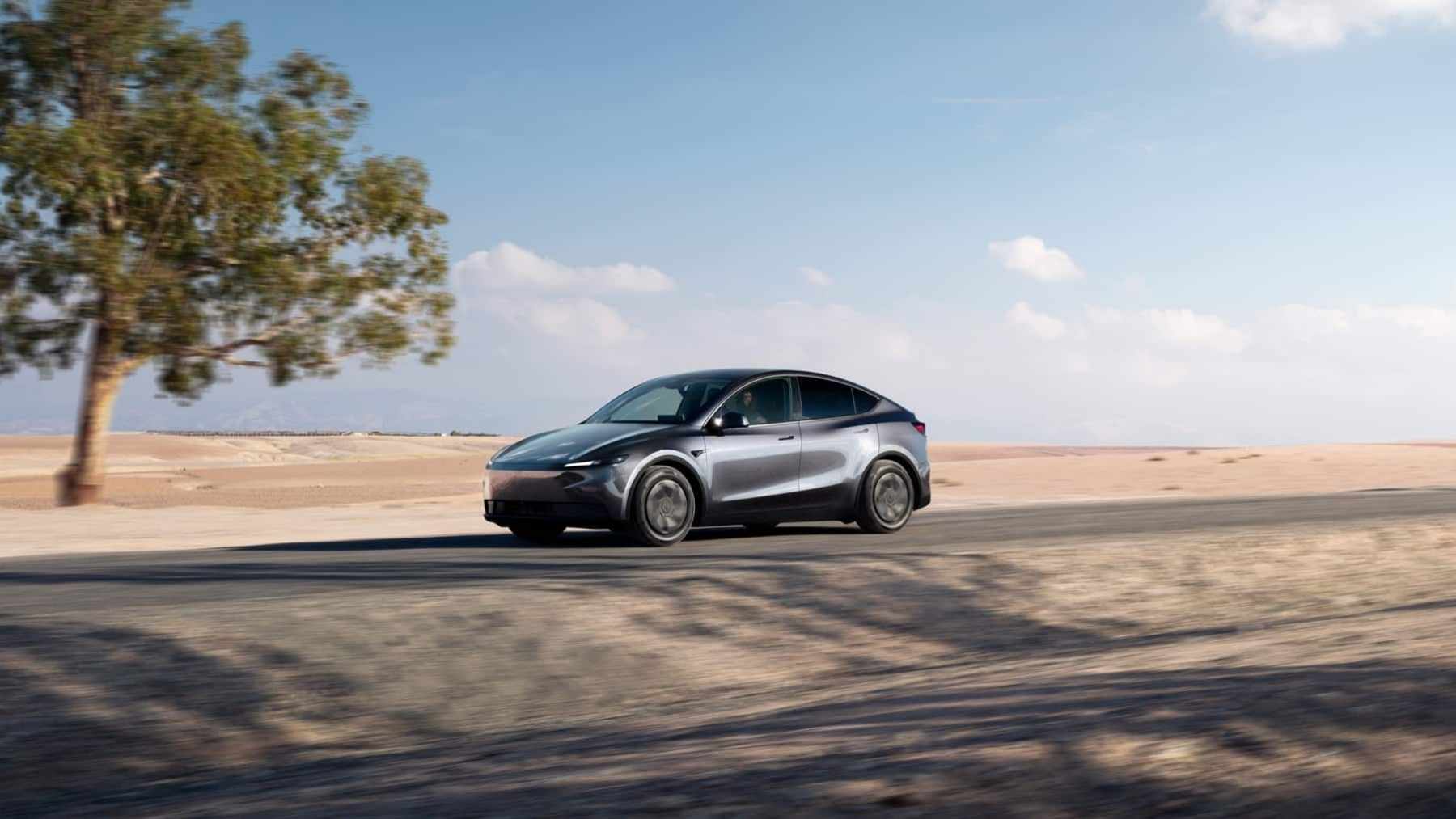
Johnson says in the replies that he’s driving a Model Y Performance. The current Model Y carries eight cameras, and the coverage is genuinely absurd when you list it out:
- One on the front bumper, above the grille — new to the 2025-and-later generation
- Two on the windshield, above the rearview mirror
- One on each door pillar
- One on each front fender, watching backward down the sides
- One above the rear license plate
Older Model Ys skip the bumper camera and mount three up top instead of two, but the punchline is the same either way: there is no angle around this car that isn’t being watched. That’s the “360” Johnson was bragging about.
Those same cameras are the entire sensor suite Elon Musk has long argued can deliver autonomous driving, on Tesla’s passenger cars and on the Cybercab robotaxi, skipping the spinning lidar rigs most rival robotaxi programs bolt to their roofs. Federal safety regulators have multiple open investigations into how the system behaves on real roads, the crashes keep making news, and at least one owner has already beaten Tesla in court over what FSD was sold as. Tesla’s own name for the feature these days is Full Self-Driving (Supervised). I believe the parentheses. My hands stay on the wheel.
But that’s a whole other article. Today the cameras are the hero.
How to make sure your Tesla actually saves the clip
Here’s the part a lot of owners get wrong: the dashcam records on a loop while you drive, and the loop gets overwritten. If a clip doesn’t get saved to the USB drive, it eventually disappears.
Per Tesla’s own Model Y manual, you set it up under Controls > Safety > Dashcam, with three modes: Auto, which saves footage when the car detects a safety-critical event like a collision; Manual, where you tap the dashcam icon to save the last ten minutes; and On Honk, which saves the last ten minutes every time you hit the horn.
One honest warning, straight from the manual: Tesla says not to rely on Auto to catch every event. A light scrape at freeway speed is exactly the kind of thing it might not flag. If something sketchy just happened, tap the icon or lean on the horn.
The storage part is already handled on most cars. Teslas built since roughly 2020 come with a pre-formatted USB drive sitting in the glovebox, and that’s the port you want — on many newer cars the center console USBs only charge devices. You can reformat a drive anytime under Controls > Safety > Format USB Drive, and review clips on the touchscreen or in the app when you’re parked.
Honestly, the safest assumption in 2026 is that every car on the road is recording something. But a Tesla is recording everything, in every direction, with a USB receipt. Merge accordingly — or don’t, and enjoy your fifteen minutes on X.