
Everyone’s been told the internal combustion engine is a dead man walking. Batteries won, hydrogen is a fuel-cell story if it’s a story at all, and diesel is on borrowed time. That’s roughly the consensus you’ll hear at any EV conference this year.
Then China’s biggest truck maker got a hydrogen-burning piston engine, an actual ICE with pistons and the whole 20th-century package, through the country’s national environmental certification. Backed up by six figures of real-road mileage under a 49-ton tractor.
Not a fuel cell. Not a concept. A diesel-shaped block that swallows hydrogen instead of gasoil and just cleared the same regulatory bar as any other heavy-duty engine sold in China.
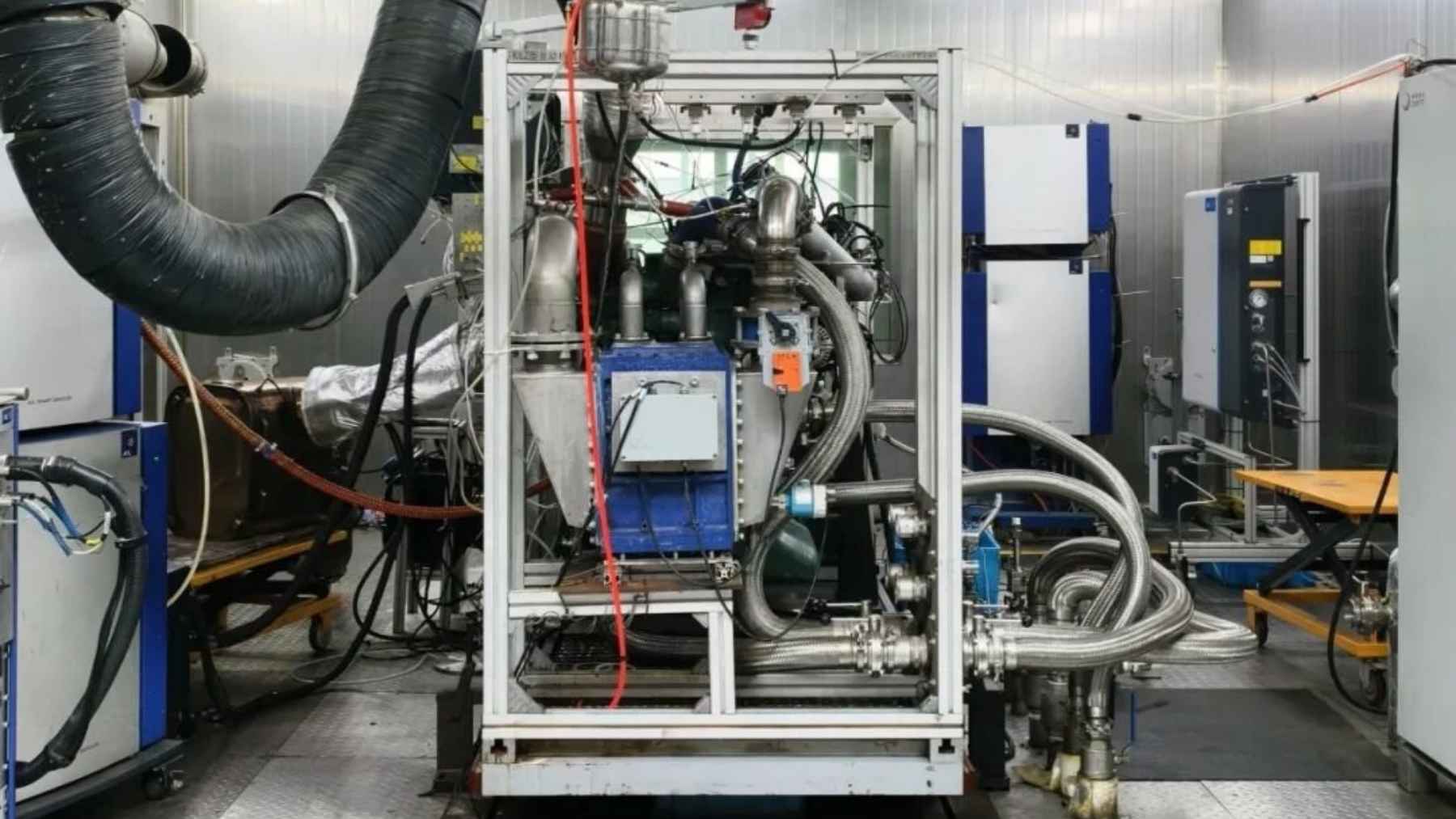
FAW Jiefang’s announcement, picked up over the weekend, covers the CA6HV3, a heavy-duty hydrogen internal combustion engine that just wrapped both certification and durability trials. If you’ve been writing off H2 ICE as a bench-test curiosity, this is the moment to look up.
What FAW Jiefang actually got approved
The CA6HV3 makes 460 horsepower and 2,100 Nm of torque, about 1,550 lb-ft, and it runs on hydrogen with a purity as low as 90%, per Power Progress. That last bit matters. Fuel cells are famously picky about hydrogen purity; a piston engine will happily burn dirtier, cheaper gas, including the gray stuff.
The durability side is where the story lives. A 49-ton FAW J6V tractor running this engine covered more than 100,000 kilometers (about 62,000 miles) in real-world road conditions. That’s a fleet-trial number, not a dyno-cell number.
The certification is China VI, the country’s current heavy-duty emissions standard. The interesting figure is how far under the limit the engine landed: per the announcement, NOx sits at roughly 5% of the China VI cap, and at about 14% of what the upcoming China VII rules will allow. Which is a way of saying they built it with headroom for the next decade of tightening, not just the current bar.
The timeline matters too, because this didn’t happen overnight. FAW first fired a prototype hydrogen direct-injection engine in June 2022, unveiled the production CA6HV3 in December 2024, and has now put certification and six-figure mileage behind it. Three milestones, four years, one engine family.
Why an ICE instead of a fuel cell
FAW Jiefang has been running two parallel hydrogen tracks. One is the fuel-cell J6P liquid hydrogen tractor, which FAW says has logged over 8,000 kilometers of public-road demonstration in Panzhihua since December 2025, with a single-fill range past 1,000 km from a 100-kilogram-class liquid tank filled at -253°C, at China’s first civilian liquid hydrogen station. Mainstream gaseous hydrogen trucks manage 400 to 500 km.
The other track is this: a hydrogen piston engine that looks, from the outside, a lot like the diesel it replaces.
The pitch for H2 ICE is boring in the best possible way. Same block architecture, same accessory drives, same cooling philosophy, same service network as a diesel. Fleets don’t retrain mechanics from scratch. Assembly lines don’t get gutted.
Fuel cells, for all their thermodynamic elegance, need platinum, ultra-pure hydrogen, delicate membrane stacks, and a service ecosystem that barely exists outside a few Chinese demonstration clusters. A hydrogen piston engine is closer to a natural-gas conversion than a moonshot. That’s the point.
The combustion itself is doing real work, though. The CA6HV3 is China’s first in-cylinder direct-injection hydrogen engine for heavy-duty trucks, and FAW quotes an indicated thermal efficiency above 55%. One asterisk before anyone frames that number: indicated efficiency excludes friction and pumping losses, so the brake figure a fleet actually pays for will land lower, the same trap we unpacked when a German lab claimed 60% on a test bench. Still, for a hydrogen ICE, it signals the lean-burn strategy works.
The 100,000 km number, in context
A truck engine is judged by how long it goes before something expensive breaks. For heavy-duty diesels, B10 life, the mileage at which 10% of engines need major service, is usually quoted in the seven figures. So 100,000 km isn’t the end of the durability story. It’s the entry ticket, roughly what a diesel would do in fleet trials before serial production.
Hydrogen ICE has two boogeymen in the reliability conversation. First is hydrogen embrittlement, the way H2 molecules crawl into metal lattices and turn tough steel brittle over time. Second is combustion chamber behavior, since hydrogen burns fast, hot and lean, and is famously good at frying valves and triggering pre-ignition.
FAW says the CA6HV3 uses hydrogen-resistant materials and special coatings against the first problem, per Power Progress. Getting a 49-ton tractor through 100,000 km without a headline failure is FAW saying: we solved both, well enough to sell. Whether it holds at 500,000 km, the number that actually matters for total cost of ownership, is the question they haven’t answered yet.
Who FAW Jiefang is, for the non-truck crowd
If the name doesn’t ring bells, that’s because FAW Jiefang doesn’t sell trucks in North America. In China, they’re the incumbent: founded in 1953, one of the country’s earliest automakers, and the outfit behind the Jiefang CA10, the first truck China ever mass-produced. Their J6 and J7 tractors are the workhorses of Chinese long-haul.
The reason that matters: this isn’t a startup demonstrating something in a lab. It’s the equivalent of Freightliner or Kenworth putting a hydrogen combustion engine into their production truck platform and taking it through the national regulator. When incumbents move, fleet buyers start writing purchase orders.
And FAW built the factory before the certification landed. The CA6HV3 line sits inside the 6DV plant in Dalian’s Jinpu district, backed by a roughly 614 million yuan (about $84.5 million) investment agreement, an 83% automation rate, and capacity for 50,000 engines a year, per Power Progress. FAW describes it as the world’s first hydrogen engine production line. That’s serial-production infrastructure, not pilot-plant tooling.
What this doesn’t mean
Nobody has said the CA6HV3 is about to land in a US-market truck. Nobody has said hydrogen ICE beats fuel cells on well-to-wheel efficiency; it doesn’t, a fuel cell converts H2 to motion more cleanly than any piston engine ever will. And nobody has said the hydrogen supply to fuel these things exists at scale.
The official numbers make that last point brutally. Per China’s industry ministry via Xinhua, the country closed 2025 with nearly 40,000 fuel cell vehicles sold cumulatively, of every type, and 574 hydrogen stations pumping over 360 tons a day. Beijing’s own 2030 target is just 100,000 vehicles. The China Society of Automotive Engineers estimates the current network can fuel maybe 4,000 to 5,000 heavy trucks per day. Nationwide.
Even FAW admits the economics aren’t there. Guo Ping, deputy director of FAW Jiefang’s development institute, told China Daily that hydrogen has to fall below 25 yuan per kilogram to compete with diesel and natural gas. In the pilot cities, it currently runs 35 to 76 yuan. And the real competition isn’t diesel anyway: battery-electric heavy trucks sold around 230,000 units in China in 2025 alone, hitting a 22% share of the heavy segment in the first half per ICCT figures. No fuel, no fleet, and the world’s largest hydrogen vehicle is already a monument to what happens when the fuel math doesn’t pencil out.
What the CA6HV3 certification does prove is that the regulatory and durability barriers to hydrogen ICE, the ones cited as the reason nobody would build one at scale, are surmountable. The chemistry works. The metallurgy holds. The emissions clear the national standard by an order of magnitude on NOx. A 13,000-hp Wärtsilä burning pure hydrogen onto Spain’s grid already proved the combustion case at industrial scale; FAW just proved it survives under a 49-ton tractor.
The Americans aren’t actually asleep on this, either. Cummins has its X15H hydrogen piston engine slated for 2027, with Werner already committed to 500 of them. The difference is that FAW’s version is certified, road-proven and has a production line with the lights on. The race stopped being theoretical this weekend.
Hydrogen combustion engines were supposed to be the loser’s bracket in the decarbonization tournament: worse than diesel on efficiency, worse than batteries on refueling, worse than fuel cells on emissions per mile. What FAW Jiefang just showed is that “worse on everything” turns into “good enough on the things a fleet buyer actually cares about” when the engine drops into an existing truck and gets serviced with existing tools.
Whether the hydrogen shows up to fuel it is somebody else’s problem.