
The nuclear comeback story usually comes with something shiny attached. A microreactor the size of a shipping container. A startup’s core that got driven to Idaho in the back of a pickup. A shuttered plant switched back on to feed Microsoft’s data centers. Everybody’s chasing the next machine.
In rural South Carolina, something a lot less glamorous just happened. Two reactors that got left for dead in 2017 quietly cleared their first real gate toward getting finished.
No ribbon, no press conference. On June 26, the board of state-owned utility Santee Cooper was told the first phase of a feasibility study was done, and the project could move to phase two.
If you followed energy news at all last decade, you know the address. This is V.C. Summer, the roughly $9 billion failure that collapsed a construction effort, produced federal fraud convictions of former utility executives, and stuck more than 700,000 South Carolina customers with charges that still land on their power bills. Locals call it Nukegate. It has been called the biggest business failure in the state’s history.
Here’s the part almost nobody covered: the parts never left.
The hardware never left the property
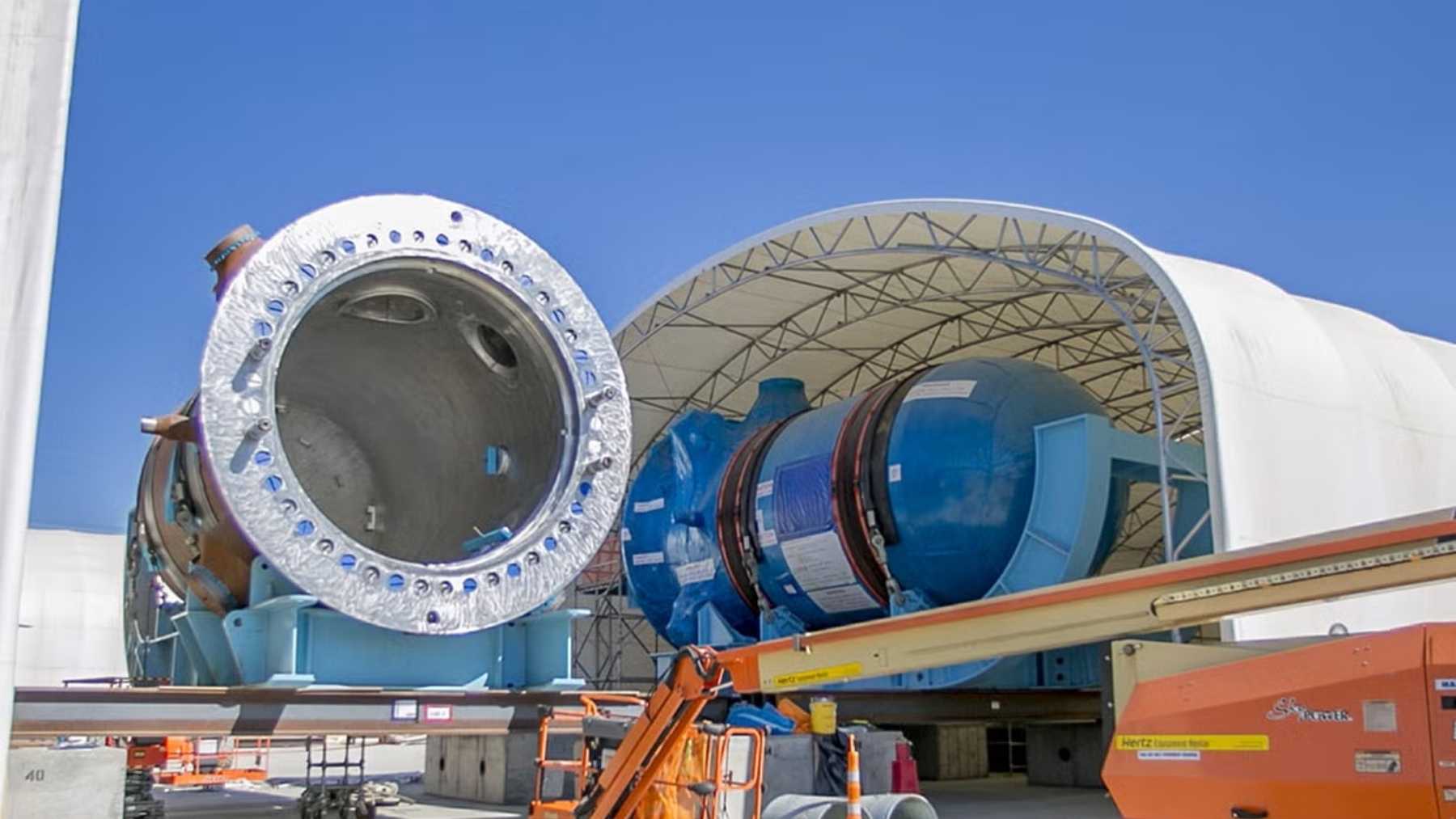
When crews walked off the V.C. Summer site in 2017, they left two half-built Westinghouse AP1000 reactors and most of the equipment meant to go inside them. Santee Cooper made a deliberate call to maintain all of it instead of scrapping it.
Nine years later, that decision is the entire pitch. Roughly 85 percent of the equipment needed to finish the job is still sitting on the property, according to Santee Cooper officials. When The State toured the site recently, reporters found two reactor vessel heads, each about 39 feet tall, parked inside a climate-controlled storage building. There is a warehouse full of supplies and computers.
The wildlife clocked the vacancy before Brookfield did. With the humans gone for the better part of a decade, ospreys moved in. The utility has counted 14 osprey nests around the site this year, some perched on utility poles, and the birds are territorial enough to go after people and drones, according to The Globe and Mail. Vultures and Canada geese took up residence too.
That is the strange thing about V.C. Summer. It is not a construction project starting from a hole in the ground. It is closer to a very expensive piece of furniture somebody left in storage, hoping the receipt would still be good someday.
What Santee Cooper’s board actually did
Strip away the site tour and the June 26 news was procedural, which is exactly why it matters.
Under a memorandum of understanding the board approved back in December, Brookfield Asset Management had until June 26 to complete an initial feasibility review, set a target date for a final investment decision, and put together an economic plan for the project. That date was the checkpoint. Deputy CEO Michael Finissi told the board that not all the paperwork was in by noon, but that the company expected to hand over the rest by end of day, and that phase two was all but here.
“We are moving forward,” CEO Jimmy Staton told the board. He called clearing the first phase a huge step.
The terms explain why this version looks different from the one that collapsed. If the project reaches a final investment decision and Brookfield commits to building, Brookfield pays Santee Cooper $2.7 billion in cash. The utility keeps a targeted 25 percent stake and the right to buy that slice of the power at cost once the reactors run. Santee Cooper says it will not put another dollar of its customers’ money into construction.
Phase two is where the real homework starts. Brookfield told the board it plans to apply for a federal loan from the Department of Energy, pick a company to operate the finished units, and complete a full cost analysis and schedule. Finissi said the utility expects Brookfield to decide whether it will actually commit that $2.7 billion by March 31, 2028.
Reviving dead reactors is suddenly a genre
V.C. Summer is not the only ghost getting coaxed back to life right now. On Lake Michigan, Holtec is trying to pull a retired 800-megawatt reactor out of decommissioning, which would be the first time a U.S. plant ever made that round trip.
Those are old reactors that once ran and got switched off. V.C. Summer is a different animal. Its two units were never finished in the first place, which is both the opportunity and the problem.
Brookfield is not a random buyer, either. The firm is the majority owner of Westinghouse, the company that designed the AP1000 reactors sitting unfinished on the site. Owning the technology was part of what made its bid attractive.
The AP1000 is the same design now running at Plant Vogtle in Georgia and at several plants in China, and it is the reactor Poland is putting up three of on the Baltic coast. V.C. Summer’s units are two more of them, roughly 1,150 megawatts each.
In May, Brookfield named the outfit that would actually manage the build: a joint venture it formed with The Nuclear Company, a firm launched in 2024 around a “design-once, build-many” idea and an AI-driven construction platform. What that pitch lacks on paper, it makes up for in résumé.
“Our team was built on the field of Vogtle,” said Joe Klecha, the company’s chief nuclear officer. Vogtle is the only place in the country where new AP1000s recently got finished and switched on, years late and well over budget, but finished. The people who lived through that are the ones being asked to do it again in South Carolina, this time with most of the parts already bought.
Nobody has decided to build anything yet
This is the part that disappears when a headline says a nuclear project is “back.” Nothing has been greenlit.
What happened on June 26 was a feasibility study passing its first phase. Brookfield still has to run the numbers, line up the financing, and eventually make a final investment decision it is under no obligation to make. That decision could land as late as March 2028. Between now and then, the whole thing can still fall apart, the way these projects have before.
There is also paperwork with the government that no longer exists. When the owners walked away, they asked the Nuclear Regulatory Commission to terminate the reactors’ combined construction and operating licenses, and the NRC did that in 2019. Brookfield and Santee Cooper will have to reapply before anyone finishes or runs the units, though the previously approved licenses should make that faster than starting cold.
Santee Cooper’s board chairman is Peter McCoy, who happens to be the former U.S. attorney who prosecuted the fraud that came out of the original failure. He is now selling the restart on the promise that it is built to avoid a repeat. “This is private business stepping up,” McCoy told the South Carolina Daily Gazette, with the federal government helping rather than ratepayers footing the bill.
An expensive do-over with the receipts still in the drawer
So V.C. Summer sits in a strange spot. It is not the shiny new nuclear the rest of the country is chasing, and it is not quite a fresh build either. It is the most expensive do-over in American power, propped up entirely by the fact that somebody kept the receipts and the reactor heads dry.
Everybody showed up for the $9 billion funeral in 2017. Almost nobody came back for the part where the thing kept its parts on ice and, on June 26, quietly passed its first physical.
Whether it ever produces a single watt now comes down to a decision Brookfield does not have to make until 2028, on a project that has already taught South Carolina exactly how these things go wrong.