
Every so often a semi truck wedges itself under a low bridge, and somebody on the scene remembers the old trick: let some air out of the tires and drive it out the bottom. You lower the vehicle, because you sure can’t lift the bridge. Baltimore just spent roughly half a billion dollars proving that same logic works at railroad scale.
The problem was the Howard Street Tunnel, a 1.7-mile (8,700-foot) brick-and-stone tube finished in 1895 that runs directly beneath downtown Baltimore. For 130 years it was the choke point that kept double-stacked container trains off the busiest freight corridor on the East Coast.
The obvious fix, raising the ceiling, was never seriously on the table. So CSX dug the floor out from under it instead. In two weeks of June alone, the railroad cut a ribbon at the Port of Baltimore, declared full double-stack clearance from the port to the Midwest, and closed the book on a project people had been arguing about since before Maryland’s current governor was born.
A 19-foot tunnel in a 21-foot world
The Howard Street Tunnel was built for the Baltimore & Ohio, the railroad on your Monopoly board, and it was a marvel in 1895. Then shipping containers happened.
Stacking one container on top of another roughly doubles what a single train can haul, which is why double-stack became the default across most of the American rail network decades ago. It needs 21 feet of vertical clearance. The Howard Street Tunnel offered about 19.
Those missing two feet did an impressive amount of damage. Every container train running the I-95 corridor either went single-stacked through Baltimore or detoured around it, and the tunnel wasn’t even alone. It was the worst of 22 clearance obstructions spread across Maryland, Delaware and Pennsylvania on the roughly 100-mile stretch between Baltimore and Philadelphia.
Fixing it took decades of false starts. Maryland Senate President Bill Ferguson says the late congresswoman Helen Delich Bentley, the port advocate the Port of Baltimore is now named after, was pressing him to get Howard Street done back in 2010. A funding deal collapsed in 2016. The one that stuck came together in 2019, and Gov. Wes Moore, who is 47, noted at the June ceremony that the conversation predates his own birth.
The ceiling was never really an option
On paper, notching the tunnel roof sounds simpler than excavating the floor. In practice, the roof is a 130-year-old brick arch holding up a city.
Hatch, the project’s lead designer, has said the track alignment was engineered specifically to avoid roof notching, because cutting into the arch could compromise the structural integrity of the whole tube. Directly above sit downtown blocks, building foundations and Baltimore’s light rail running along the surface of Howard Street. Old tunnels are unforgiving things to modify, and the margins hidden inside aging designs have a habit of being thinner than the blueprints claim.
So the floor lost. The official program target was an extra 18 inches of clearance at the tunnel and the other 21 spots on the corridor. Skanska, half of the joint venture that built it, says the finished job actually bought two full feet inside the tube, taking it from 19 feet of clearance to 21 without touching the original 1895 archway.
233 days, 1,188 slabs and a crane bolted to a flatcar
The tunnel closed to trains in early February 2025, and CSX says crews then worked 233 consecutive days, 24/7, from February 5 through September 25. What they did in there is the part worth slowing down for.
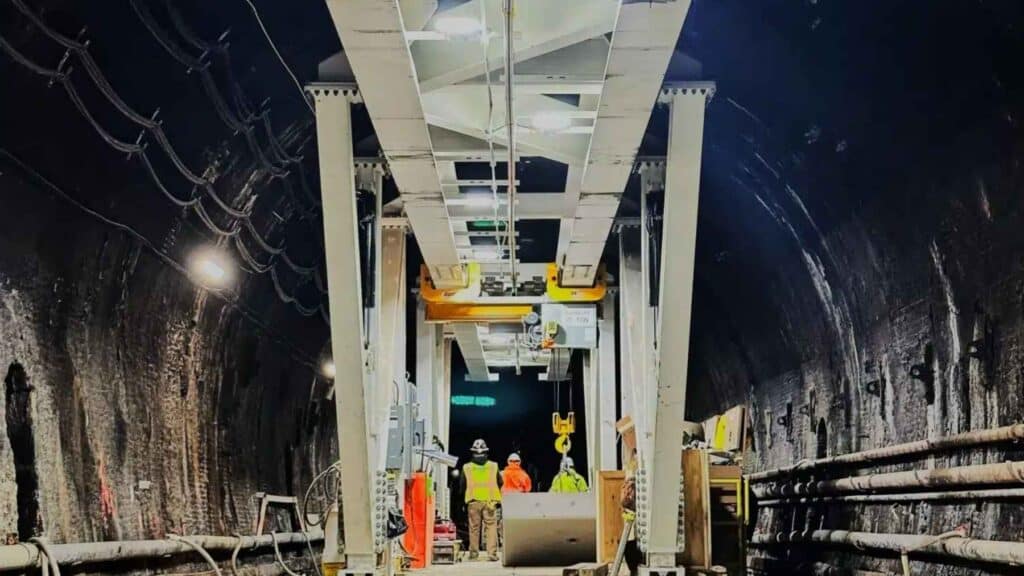
Step one was demolishing the original floor, including the 19th-century brick sitting beneath the old track. More than 25,000 cubic yards of excavated material came out of the tunnel, hauled through the same two portals everything else had to squeeze through. Crews drove 1,128 dewatering wellpoints to keep groundwater out of the freshly dug trench.
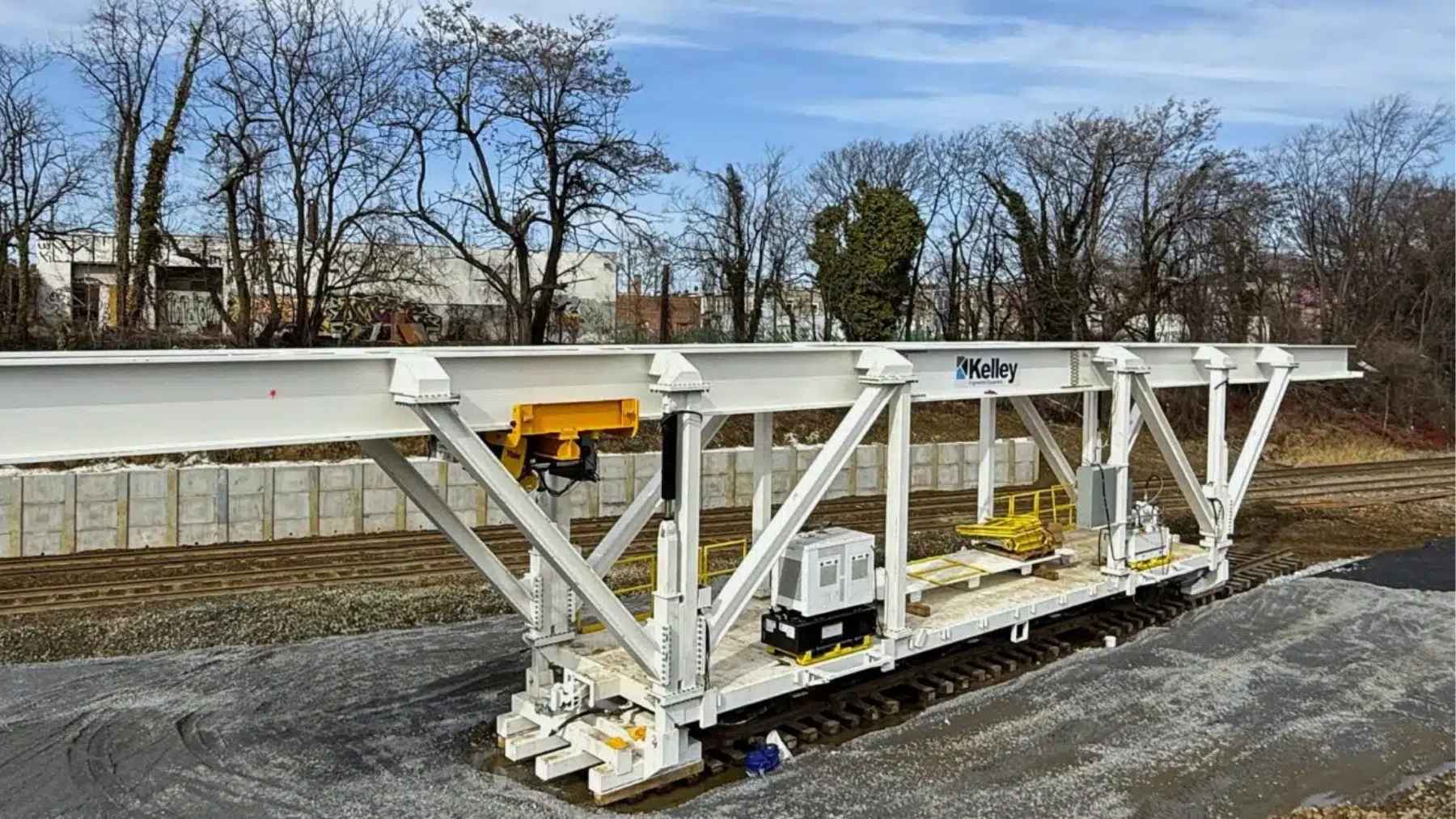
Step two was the machine. There’s no room in a tunnel this tight for conventional cranes, so the Skanska-Fay team had a self-powered gantry crane custom built and mounted on a railcar, engineered with Kelley Engineered Equipment and Wolf Hills Fabricators. It rolled into the dark carrying precast concrete invert slabs, each 18 to 19 feet across and weighing around 10 tons, and set them down as the new, lower floor. There are 1,188 of those slabs under the rails now.
Add over 4,000 cubic yards of concrete, more than 14,000 linear feet of wall drain, and over 24,000 cubic feet of grout that CSX says was mixed by hand, because a batch plant does not fit in a Victorian railroad tunnel. The whole time, buses, light rail and office workers went about their business a few yards overhead.
Here’s the number that should embarrass a few megaprojects: per Skanska, the work was originally expected to run until August 2027. The tunnel reopened to trains on September 26, 2025, nearly two years early.
That reopening came with a plot twist. CSX CEO Joe Hinrichs hosted the ribbon-cutting at the tunnel on a Friday. By Monday, the board had replaced him with former Linde boss Steve Angel under pressure from an activist investor. Railroading is a tough business.
Three locomotives for 14 containers, at 12:15 in the morning
The first revenue double-stack train rolled through the fully cleared tunnel at 12:15 a.m. on Monday, May 4, 2026, once the last clearance work on the corridor caught up with the tunnel itself. According to Trains, it was a short intermodal run with three locomotives pulling two well cars and exactly 14 containers, which is a magnificently unglamorous way to end a 130-year wait.
“The first train was a relatively small train,” CSX spokesman Austin Staton told the magazine, noting the new service links Baltimore and Chicago on an expedited route. Small train, big precedent.
The formal party came on June 22, when Moore and Angel cut a ribbon at the port in front of a banner reading “Double Stack Is Here!” With the final bridge work done, Angel said the railroad now has “full double-stack clearance between the Port of Baltimore, key Midwestern markets” and the wider East Coast network, per Maryland Matters. Sen. Chris Van Hollen broke down the bill at the same event: $217 million from Maryland, $130 million from CSX, $125 million from a federal grant and $23 million from Pennsylvania. That’s $495 million, plus another $16 million to get the port itself ready for taller trains.
160,000 more boxes a year, if the math holds
Now the honest part. The concrete is real and the projections are projections, and the two deserve different levels of trust.
CSX and Maryland officials estimate the cleared corridor will bring about 160,000 additional containers a year into the Port of Baltimore and support more than 13,000 jobs across the region. The Federal Railroad Administration’s environmental review projects around 1.2 billion truck miles avoided over 30 years, saving an estimated 137 million gallons of fuel, as freight shifts from I-95 to rail. CSX has separately told Trains it expects to convert 75,000 to 125,000 truckloads a year to intermodal.
Every one of those numbers depends on shippers actually choosing the train. The early signs at least point the right way. The port moved 50 million tons of cargo in 2025, its second-best year ever, while still recovering from the Francis Scott Key Bridge collapse of March 2024. The same port recently unloaded a 1,200-ton German tunnel boring machine headed for Washington, and a new deep-berth container terminal is starting construction at Sparrows Point.
Freight rail elsewhere is chasing driverless ore trains that haul 28,000 tons through the Australian desert with nobody in the cab. Baltimore’s revolution is humbler: the same trains, stacked twice as tall, through a tube older than the Model T. But humble is what you can build under an occupied downtown, and it shipped early.
The forecasts will take years to check. The two extra feet of air under Howard Street are already there, paid for, and not going anywhere. Concrete doesn’t care about spreadsheets. It just sits there, 18 inches lower than it used to.