
Digging a tunnel under a city usually starts with a very big hole. Crews excavate a launch pit, lower the boring machine down in sections, and bolt it together in the dark before it ever touches rock. The 1,200-ton machine that just started grinding under the Potomac in Washington went in exactly that way, assembled piece by piece roughly 100 feet below the surface.
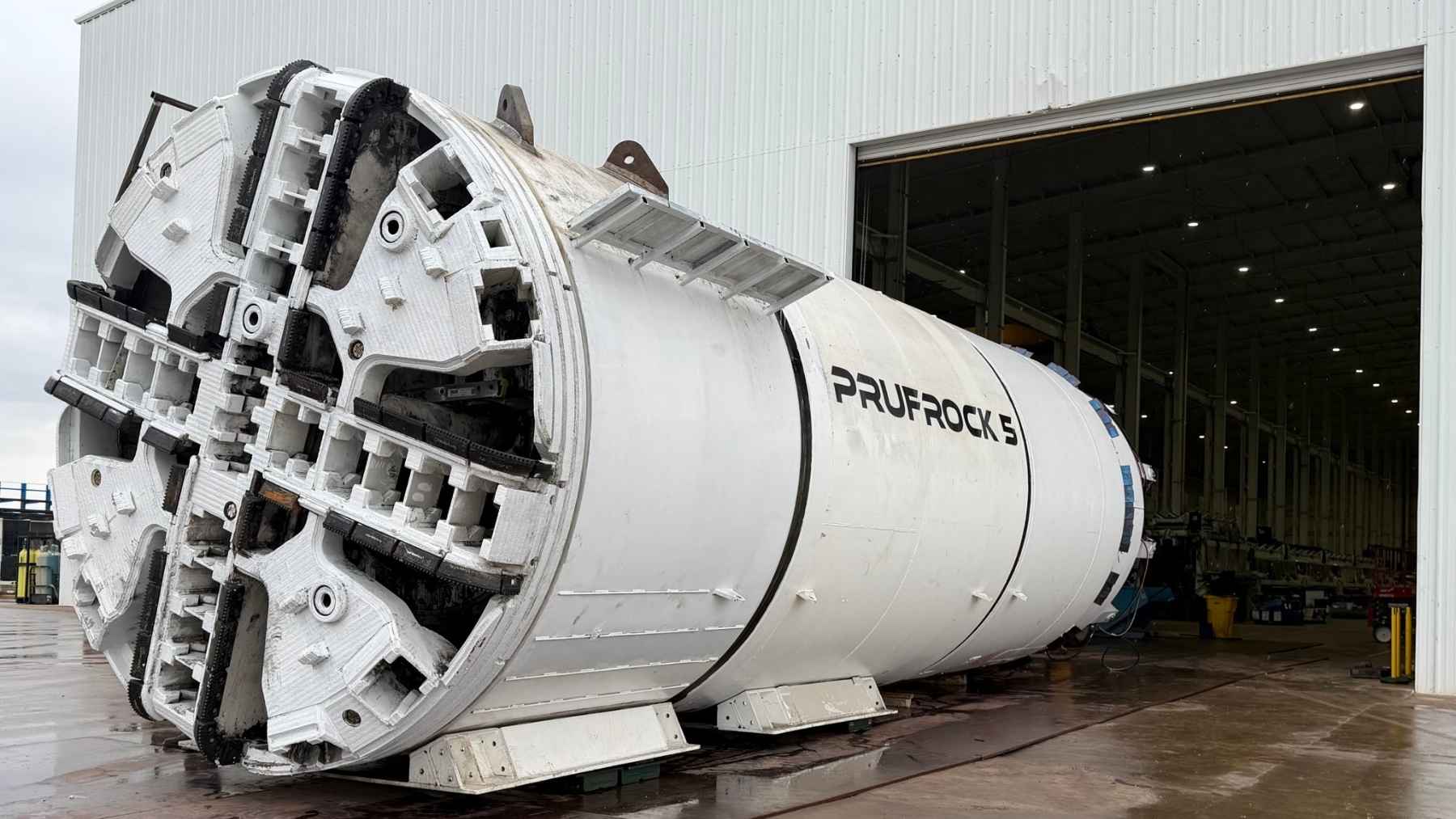
The Boring Company skips the hole. Its Prufrock machines show up on a truck, tilt nose-down, and dig their own way in from the surface. And Nashville now has two of them.
On June 17, the company confirmed on X that Prufrock MB2, the second all-electric borer assigned to its Music City Loop project, had completed commissioning and was cleared to mine. The company’s own June update had already scheduled the launch within the month, and a third machine ships in August.
The second machine is bigger where it counts
MB2 arrived at the Nashville site in late April, according to the company’s June project update, and spent the following weeks in the last stretch of shakedown work before a borer is allowed to eat rock for a living. The sign-off included a short cutterhead spin test at 11 rpm.
The upgrades over the first machine are real, if unglamorous. MB2 carries about 15% more power and 17-inch disc cutters on its head, up from 15.5 inches on MB1, which buys it more bite at the rock face. The Boring Company assembles these machines at its own Bastrop, Texas headquarters and folds whatever the previous unit taught it straight into the next one.
Both borers work out of the same pad at 637 Rosa L. Parks Blvd., a lot near the Tennessee State Capitol designed from day one to hold two machines. MB1 has been chewing since late February, which explains the line the company attached to MB2’s clearance: “Will MB2 catch up to MB1, who had quite the head start?” That is a tunneling contractor publicly setting up a race between its own equipment.
No pit, no crane, nobody underground
A conventional tunnel borer works in a loop that hasn’t changed much in decades. It grinds forward about five feet, stops, rings the fresh bore with precast concrete segments, then gets going again. Every stop costs money, and the launch pit at the start is a construction project all by itself.
Prufrock’s pitch is deleting both. The machine lines the tunnel while it mines instead of pausing for segment work, and it launches straight off its transporter into the dirt, within 24 hours of arriving on site per the company. When a bore is finished, it angles back up, surfaces, and leaves on a trailer for the next job. The maneuver has a name: porpoising.
The other design choice is who’s underground while it works. Nobody. Prufrock is fully electric and runs with no people in the tunnel during normal digging, steered from a control room up top.
It’s also a bet on small. China’s Jianghai weighs about 5,000 metric tons and swings a cutter head 54 feet across, and the same industry that built it also produced a 500-ton rig that drills straight down. Prufrock goes the other way: a compact machine you can truck between launch sites and build again in Texas, which is how a third copy ends up shipping in August while the second one is still box-fresh.
Nashville’s rock is half the reason this is happening here
MB1 broke ground on February 25, within hours of the state and federal sign-off. Tennessee Gov. Bill Lee announced the lease and permit approval that day, and by evening the machine was in the ground, with the company posting that it was 2.5 feet in. Most contractors wait for a slightly rounder number before celebrating.
The geology is cooperating. The latest coring puts the local rock at approximately 14,000 psi compressive strength, and strong rock conditions were part of why the company picked Nashville in the first place, as Teslarati notes. A machine that lines the tunnel while it cuts wants ground that behaves.
The paperwork kept pace. The project needs 45 separate permits and approvals, 37 of them before tunneling, and all 37 are in hand. The big one is the TDOT tunnel permit, which took over seven months of technical review and authorizes up to 25 miles of tunnel inside the state’s right-of-way. The remaining eight cover extra launch sites for later phases.
Not everyone in town is sold, either. State lawmakers and residents have raised concerns about flooding risk and the unknown environmental impact of tunneling under the city. The company will be answering those questions in public for as long as its machines keep eating.
The tunnels end at the airport, and the cars inside are Teslas
The Music City Loop itself is an almost 13-mile system connecting downtown Nashville and Lower Broadway to West End Avenue and Nashville International Airport, per the company’s project page. The headline promise is the airport run: roughly 10 minutes from BNA to Lower Broadway, under streets where the same trip regularly takes far longer.
The airport alignment follows Rosa L. Parks Boulevard, Lafayette Street and Murfreesboro Pike before ending within 100 feet of the terminal. The tunnels sit about 30 feet down with a 12-foot internal diameter, and the vehicles inside are Teslas, initially Model Ys and Model Xs with human Loop drivers behind the wheel.
Stations are firming up too. The airport authority approved a BNA station 8-0, the convention center authority unanimously signed off on an easement under Music City Center, and the first residential agreement will serve the Prime, Alcove and Paramount towers downtown.
The company has claimed it can build the whole thing for $240 million to $300 million, a figure that would embarrass most American transit budgets if it holds. The first operational segment is targeted for late 2026, with the full route aimed at 2029. The only system actually operating today is the Vegas Loop, which shuttles convention crowds between Las Vegas venues in the same Teslas.
So the summer schedule under Nashville looks like this: MB1 keeps grinding, MB2 joins it, and MB3 rolls out of Texas in August. Three copies of the same machine, iterating against each other in live rock, with the manufacturer keeping score in public.
Whether the cost and speed claims survive 13 miles of Tennessee limestone is the part nobody can fact-check yet. But the racing format is already set, and The Boring Company picked the one event where it can’t lose to anyone but itself.
 @asherlev ROOKIE3 months ago