
Your kitchen freezer runs at about 0°F and mostly gets opened for ice cream. The freezers holding the oldest continuous slice of Earth’s climate record run at minus 58°F (minus 50°C), they sit in labs across Europe, and nobody opens them casually. Inside is Antarctic ice that finished forming long before our species existed.
You probably heard about the drilling. In January 2025, the European Beyond EPICA – Oldest Ice project hit bedrock at Little Dome C in East Antarctica, 2,800 meters down, and completed a continuous ice core holding at least 1.2 million years of climate history. That part made headlines everywhere.
What happened next didn’t, and it’s arguably the better machine story. Drilling a 1.7-mile column of ancient ice turns out to be the easy half. The hard half is moving it across two hemispheres without ever letting it warm up, then reading it one milliliter of ancient air at a time.
The hole was the famous part
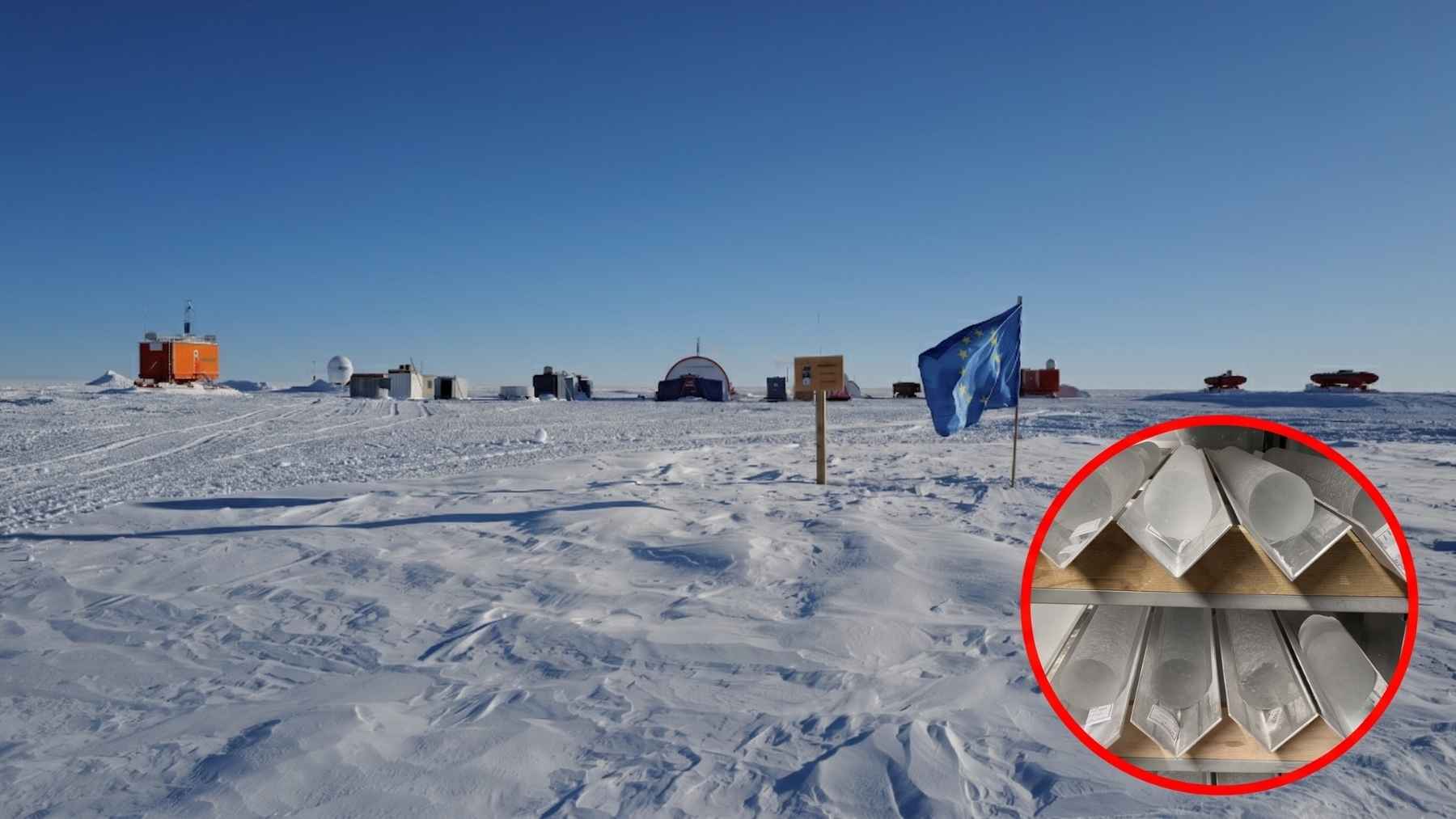
Getting to bedrock took four drilling seasons and more than 200 days of drilling and core processing on the Antarctic plateau. Little Dome C sits 22 miles (35 km) from the French-Italian Concordia Station, at 10,500 feet of altitude, where a summer day averages minus 31°F. The tool that did it is an electromechanical drill supplied by Germany’s Alfred Wegener Institute and the University of Copenhagen, a direct descendant of the Danish Hans Tausen design that built the original EPICA cores. The borehole stays filled with Estisol-140, an ester-based drilling fluid, to keep the hole from squeezing itself shut under two kilometers of ice pressure.
Antarctica has a habit of demanding machines like this. It’s the same continent where a robot submarine spent 27 days mapping the underside of a glacier because nothing else could get there.
The payoff is stacked vertically. The upper 2,480 meters of the core hold a high-resolution climate record, and the section between 2,426 and 2,490 meters covers the stretch from 800,000 to 1.2 million years ago, exactly where ice-flow models said it would be. Down there, the project reports up to 13,000 years of climate compressed into a single meter of ice. Below that sit roughly 210 meters of basal ice so deformed that its age and origin are still an open question.
The age claim isn’t a press-release flourish, either. After the core was split at the Alfred Wegener Institute in Bremerhaven, a team at the British Antarctic Survey in Cambridge ran the chemical analysis of 190 meters from the deepest usable section and confirmed a complete record of climate and atmospheric composition going back at least 1.2 million years, the oldest continuous ice core ever retrieved. Project coordinator Carlo Barbante called it plainly: “we have achieved a historic result,” he said in the project’s closing release. The 1.5-million-year figure you may see floating around remains the aspirational target, not the confirmed number.
Minus 58 degrees, across two hemispheres
Here’s the part nobody wrote about. Ice cores travel from Antarctica to Europe inside specialized cold containers held at minus 58°F (minus 50°C), aboard the Italian icebreaker Laura Bassi. That temperature isn’t paranoia. The whole scientific value of this core lives in air bubbles trapped inside the ice, and any warming risks compromising the gas record before a single instrument touches it.
So the cold chain runs unbroken from a storage cave dug into the Antarctic plateau, onto a ship crossing the equator, into a truck, and finally into European cold rooms. The first big consignment reached Italy in April 2025 and moved on to Bremerhaven by road. According to the British Antarctic Survey, the final samples from the last field season arrived in Europe in April 2026. Every meter of a 2,800-meter core, delivered at a temperature colder than an Antarctic summer.
From Bremerhaven, where the core gets cut into sections, the pieces fan out to 14 laboratories in 10 countries. Each lab owns a slice of the science: dust in Milan, halogens in Venice, basal ice in Brussels and Copenhagen, isotopes almost everywhere.
Five spectrometers, one milliliter per minute
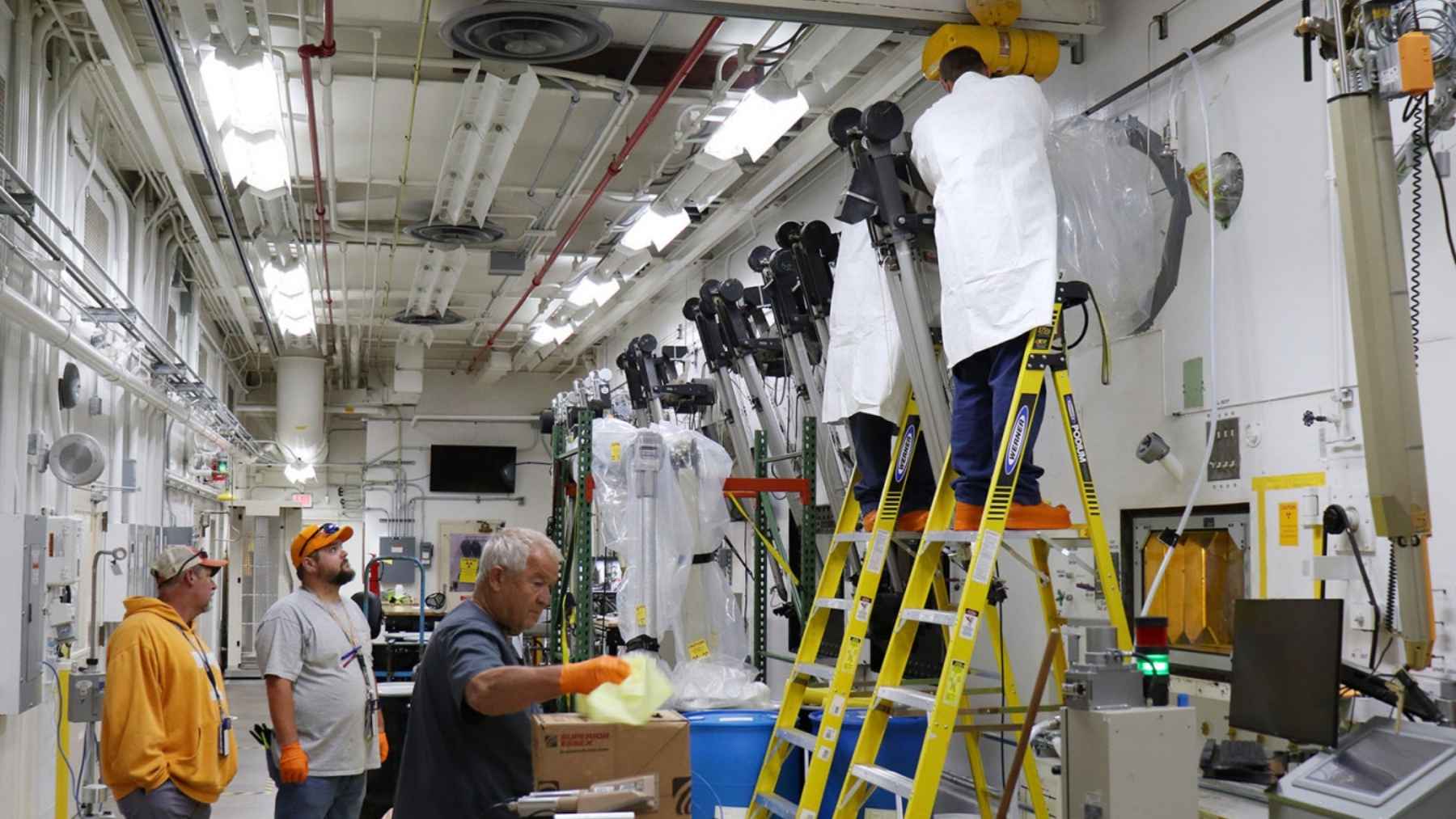
Actually reading the ice is its own engineering discipline. The first big analysis campaign ran at the British Antarctic Survey between late August and October 2025, targeting impurities in the deepest section, from 2,400 to 2,592 meters. The method is continuous flow analysis: stand a one-meter bar of ice vertically on a heated melt head and let it sink at 1.5 centimeters per minute, feeding the meltwater to a wall of instruments. At cruising speed that’s 8 meters of million-year-old ice per day, with around 30 scientists rotating through Cambridge over seven weeks.
Then came the gases, which is where this gets properly absurd. In February and March 2026, European teams converged on Copenhagen with their equipment for a joint gas campaign. The setup melts a 3.5 by 3.5 centimeter stick of ice, sends the clean inner meltwater through a membrane that strips out the ancient air, and pipes that air to the analyzers.
The instrument chain, described by the University of Cambridge’s Department of Earth Sciences, ran three laser spectrometers and two mass spectrometers wired in series for the first time, all working off a gas flow of one milliliter per minute. That’s methane, nitrous oxide, carbon monoxide, carbon dioxide, plus oxygen and nitrogen isotopes, measured simultaneously from a stream of air you could fit in a thimble. The meltwater gets bottled for later work, including cosmogenic isotopes used to date the core. Even the ancient air gets collected after analysis. As the Cambridge team put it: “Nothing is wasted.”
There’s a good reason for the hoarding. Every meter of this ice is the only meter of its kind on Earth. Waste a sample and there’s no drilling back for more, at least not without another four Antarctic seasons.
The question a million years of ice should answer
All of this exists because of a scheduling problem in Earth’s ice ages. Until roughly a million years ago, glacial cycles ran on a 41,000-year rhythm. Then, during what’s called the Mid-Pleistocene Transition, they shifted to a 100,000-year beat, with deeper freezes and sharper thaws. Nobody knows why. The orbital mechanics driving the cycles didn’t change, so something inside the climate system itself did.
The previous EPICA core reached back 800,000 years, close but short of the transition. This one crosses it entirely, with the greenhouse gases from that era sealed in the bubbles. Dr. Liz Thomas, who heads the ice cores team at BAS, framed the stakes for the British Antarctic Survey: “There is no other place on Earth that retains such a long record.”
The first results are already leaking into daylight. A first coarse-resolution CO2 record covering the Mid-Pleistocene Transition was presented at the EGU General Assembly in Vienna this May, and the modelling groups have published their homework too. A 2.5D ice-flow study in The Cryosphere puts the practical limit for usable climate ice at 20,000 annual layers per meter, which is the resolution wall the deepest sections brush against. The full peer-reviewed gas papers are the next domino, and when they land, a million years of atmospheric history goes public.
The borehole is still down there, full of fluid
The final field campaign wrapped this past Antarctic summer with two last tricks. The team pulled fragments of the rocky bed from under the ice sheet, which will be dated to reveal when that ground last saw sunlight, effectively putting a birthdate on the East Antarctic ice sheet itself. And they pulled off a borehole deviation at a depth of over two kilometers, steering a new branch off the main hole so future teams can re-drill duplicate cores from the exact section covering the transition. Extreme drilling is having a moment generally, and unlike the crew planning to drill back into a magma chamber in Iceland, this hole gets to stay comfortably frozen.
So the drill is out of the ice and the camp is packed up. The work has simply moved into rooms where everyone wears expedition gear indoors. The Copenhagen gas data is being processed now, another analysis campaign is planned in Grenoble for early 2027 to keep working through the air bubbles, and a deviated borehole waits under the plateau for whoever comes next.
The coldest freezers in Europe are holding 1.2 million years of weather. Somebody still has to read the whole thing.