
Most of what you know about launching a jet off an aircraft carrier probably comes from the movies, and frankly the movies have it about right. A fighter gets hooked to a shuttle in the deck, somebody crouches and points at the bow, and a cloud of steam chases the plane off the end of the ship. That’s how the Navy has done it since the 1950s, and it’s how the Nimitz-class carriers still do it today.
The Navy’s newest carriers don’t do any of that. The Ford class throws airplanes with an electric linear motor and catches them with a system built around spinning water and a big electric motor instead of a hydraulic piston. And until a couple of weeks ago, the Navy’s newest fighter had never been through either one.
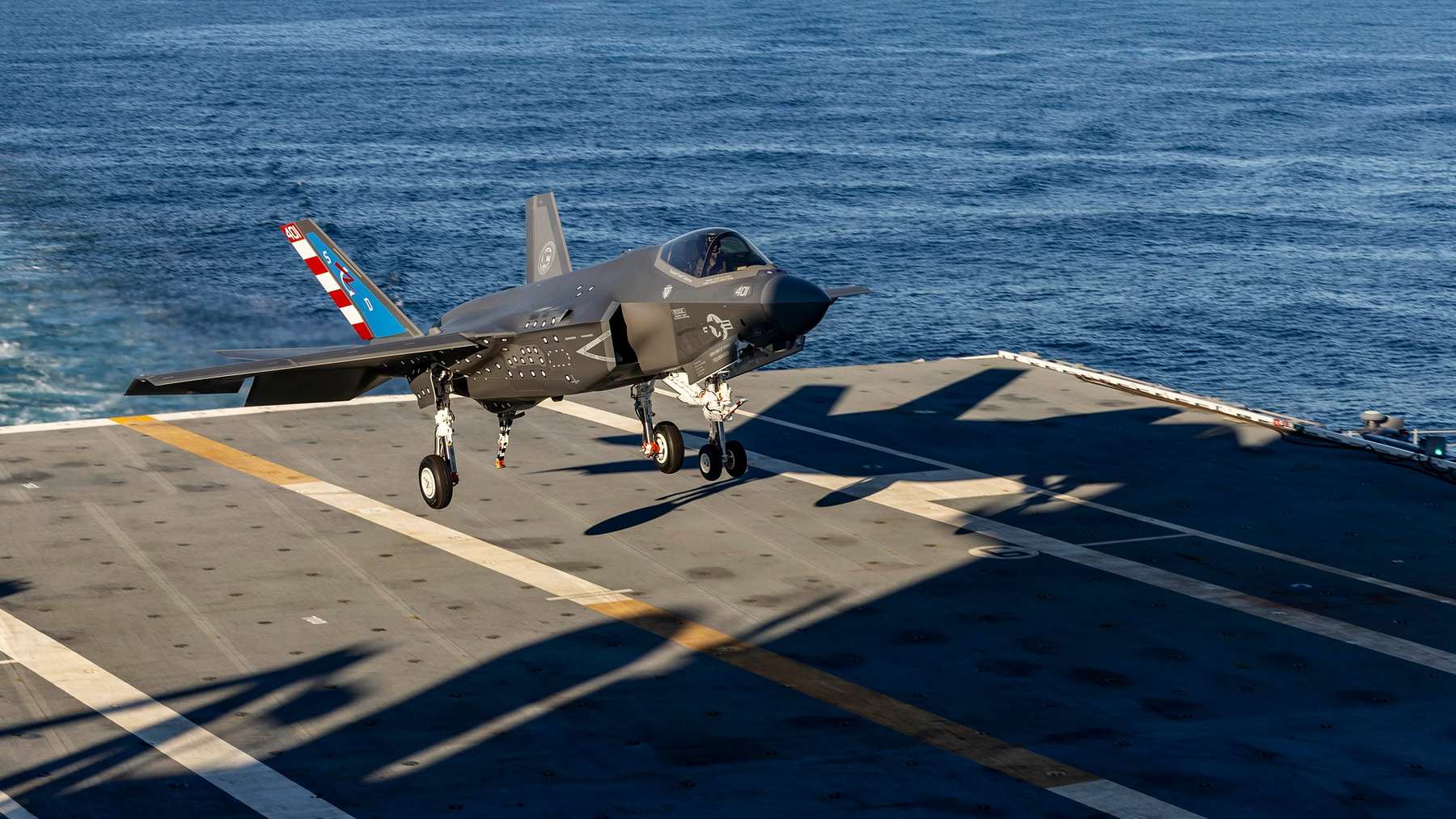
That changed on Tuesday, October 13. An F-35C from the “Salty Dogs” of Air Test and Evaluation Squadron 23, flying out of Naval Air Station Patuxent River in Maryland, caught a wire on the deck of the future USS John F. Kennedy somewhere in the Western Atlantic.
The next day, one of the jets got shot off the bow. The Navy’s own photo captions call it the first time an F-35C has landed on, and launched from, a Ford-class aircraft carrier, and the pictures show two aircraft aboard, tails 401 and 403.
So a 100,000-ton ship that isn’t even commissioned yet just did something the lead ship of her class hasn’t managed in nine years of service.
How does that happen?
So why hasn’t the Ford ever flown one?
The F-35C is the Navy’s version of the F-35, the one with the bigger wings and the beefed-up landing gear so it’ll survive being slammed onto a deck and yanked to a stop by a cable. It’s been doing exactly that since November 2014, when it first flew out to USS Nimitz for compatibility testing, according to Naval News.
The older Nimitz-class carriers have been deploying with F-35C squadrons for years now. USS Carl Vinson took the first one out.
The ship is what’s late. USS Gerald R. Ford, the first of the class, was commissioned on July 22, 2017, and she’d just come home to Norfolk on May 16 after a 326-day deployment. Her air wing on that cruise was F/A-18E/F Super Hornets and EA-18G Growlers.
No F-35Cs. Naval News reports Ford still doesn’t embark the stealth fighter at all, and the Navy plans to retrofit her for it in a future maintenance period.
You may be wondering how a brand-new carrier design ends up unable to take the brand-new fighter that was being built at the same time. The short answer is a cost cap.
Congress put a ceiling on what the Navy could spend on each Ford-class hull, and the Navy stayed under it partly by pushing a bunch of F-35-specific work, reportedly things like jet blast deflectors that can take the F-35’s exhaust heat and the maintenance network the jet needs to stay flyable, into a later yard period instead of building it in. Ford got delivered on time, more or less. She just got delivered without the pieces that let her fly the plane.
Which, if you squint, is a pretty neat trick. Stay under budget by not finishing the ship.
Congress ran out of patience with the Kennedy
By the time the Kennedy was coming together at Newport News, lawmakers had seen enough. In June 2019, the House Armed Services seapower subcommittee wrote language into its version of the Fiscal Year 2020 defense bill that would’ve barred the Navy from accepting the ship at all unless she could deploy with F-35Cs. A committee staffer told USNI News at the time that the Kennedy wouldn’t be able to deploy with F-35s on delivery “as a direct result of that cost cap,” and put that cap at $11 billion.
The final law softened it a bit. Section 124 of the FY2020 National Defense Authorization Act (Public Law 116-92) requires the Navy to make sure the Kennedy can operate and deploy the F-35C before she finishes her post-shakedown availability. If you’re not up on Navy acquisition jargon, and there’s no reason you should be, here’s the two-sentence version.
After the shipbuilder hands over a new ship, the crew takes her to sea for a few months to find out what breaks, then she goes back into the yard to fix all of it and bolt on whatever wasn’t ready at delivery. That yard visit is the post-shakedown availability, and Congress made it the deadline.
The Navy’s answer, in November 2020, was to stop pretending it would do the F-35 work later and fold it into construction instead. The ship went from a two-phase delivery to a single-phase one, with the F-35C modifications and a new air surveillance radar included. The Pentagon’s contract announcement said the change was made to meet “a congressional mandate,” and USNI News reported it that way too.
So the Kennedy is, as far as I can tell, the first Ford-class carrier that will arrive able to fly the Navy’s best fighter without going back to the shop first. Enterprise and Doris Miller, the two hulls behind her, are being built that way from the keel up.
So what caught the plane?
I find this half more interesting than the catapult, if I’m being picky, because the catapult gets all the press. On a Nimitz, the arresting wire runs to a big hydraulic cylinder below deck, and the jet’s energy goes into shoving fluid through a valve that a sailor sets by hand for whatever’s about to land.
It works. It’s worked for decades. The Navy’s own pitch for the new gear is that it’s finer with the forces it puts into the airplane and a lot less work for the people running it.
The Ford class replaced it with something called the Advanced Arresting Gear, and you’ll see it described all over the internet as “electromagnetic,” which isn’t quite right. According to NAVAIR, the energy from the landing goes into water turbines, which the engineers call water twisters, with a large induction motor on the same shaft doing the fine control.
A computer decides, run by run, how hard to lean on the cable. So it’s an electric motor and a bucket of spinning water, not a magnet.
And it’s been a headache. USNI News was reporting the system two years behind its test schedule back in 2015, and the Kennedy’s own budget documents listed arresting gear testing as one of the two things that held up her delivery last year. From the looks of things, that’s one box that got checked on October 13.
The launch end, the Electromagnetic Aircraft Launch System, is the half that’s actually electromagnetic. The shuttle rides a linear motor down the track, there’s no steam at all, and the sailors below deck get a quieter, cooler workplace out of the deal, which NAVAIR lists as a selling point. I’ll admit I’d take that trade too.
Four elevators to go
So is the ship done? Not quite, and the holdup is the piece of Ford-class hardware that gave the lead ship the most grief: the weapons elevators.
Each Ford-class carrier’s got 11 of them, and they move bombs and missiles from the magazines deep in the hull up to the flight deck. They run on electromagnetic motors instead of the cables the Nimitz class uses, and on Ford they took years to get working. On the Kennedy, the count’s better, but it isn’t finished.
When she left Newport News on August 12 for acceptance trials, seven of the 11 had been delivered to the Navy, according to USNI News, which is enough for the crew to reach every magazine and train. The Navy’s own August 17 press release said the shipbuilder was still working on the remaining four.
Those trials went fine. The Kennedy spent four days off the Atlantic coast and wrapped up on August 15, and on September 29 the Navy took what it calls preliminary acceptance of the ship, which is basically the Navy agreeing to sail her while the yard finishes up.
Capt. Mark Johnson, the program manager for the class, said the milestone would let the crew “get more water under the keel” in the Navy’s own announcement, carried by Seapower. The ship’s about 99 percent complete, by the Navy’s count, and the last four elevators are in final testing.
What the Navy hasn’t said is how many traps and launches the two jets actually did, or how long VX-23 stays aboard. The photo sets show one landing and one launch, and that’s it. Compatibility testing on Ford ran through a whole air wing’s worth of aircraft types over weeks, so I’d expect the same here, but the Navy hasn’t published a schedule and I’m not going to invent one.
The ship herself, for the record, is 1,092 feet long with a 256-foot-wide flight deck, displaces about 100,000 tons fully loaded, and will carry around 4,500 people with an air wing aboard. Her keel was laid at Newport News on August 22, 2015, and the Navy still calls her PCU John F. Kennedy, for pre-commissioning unit, because she doesn’t get the USS until somebody’s broken a bottle and read the orders. We’ve covered what a Dutch diesel submarine once did to a carrier group built around a Nimitz-class ship, and the Navy’s growing habit of handing the dull jobs to crewless boats, so a new carrier that can finally fly the jet it was built alongside is arguably the more conventional story of the three.
The Navy took preliminary acceptance of the Kennedy from HII’s Newport News Shipbuilding on September 29, 2026, and says formal delivery comes in spring 2027. USNI News puts that at March, with the ship slated to enter service later that year.