
If you’ve ever backed a boat trailer down a public ramp, you know the basic problem. The water has to be where the tide chart says it’ll be, the ramp has to hold, and if you get the timing wrong you’re sitting there with your hazards on while the people behind you honk. Now imagine doing that in reverse, with a 369-ton gas turbine instead of a bass boat, on a beach with no ramp at all, and with the schedule of a 300-megawatt power plant riding on the tide table.
That’s pretty much what happened on the west coast of Ireland on Thursday, August 20, and the company that pulled it off has now explained how. The details are, frankly, better than the press release.
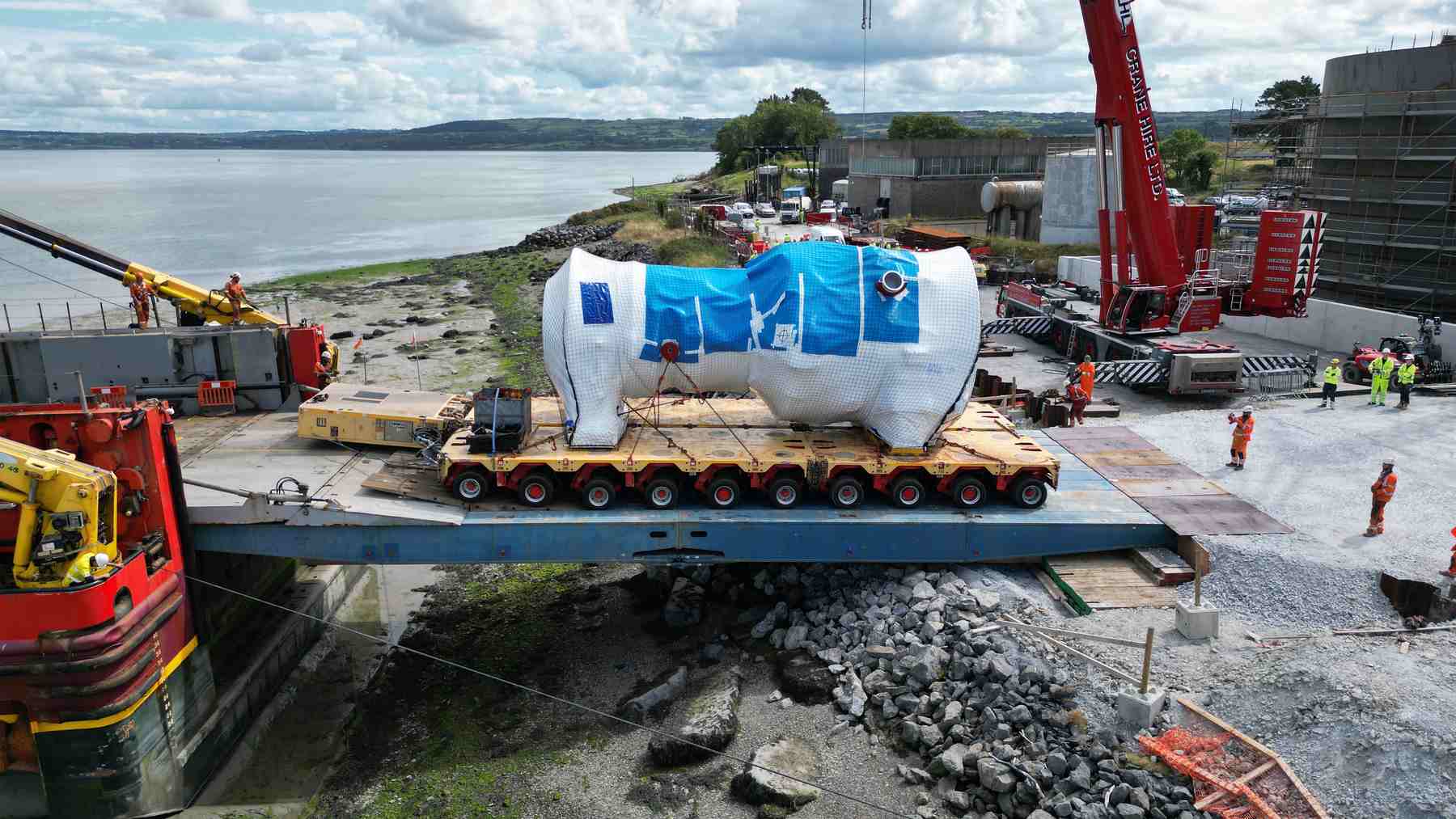
The turbine in question is an Ansaldo Energia AE94.3A, built in Genoa, Italy, and headed for SSE’s new Tarbert Next Generation Power Station in County Kerry. SSE says it weighs 335 metric tons, which works out to about 369 US tons, and measures roughly 36 feet long, 17 feet wide and 16 feet tall. So basically a two-story house that happens to spin. It went by ship from Genoa to Foynes, a port on the Shannon Estuary, was rolled onto a heavy-lift barge called the Terra Marique, and came ashore on a beach right next to Tarbert Lighthouse.
SSE calls it the biggest single item to reach the site so far, and the first marine landing of heavy generating equipment at this scale the company has done in Ireland. The project’s director of construction, Charlie Cryans, called the delivery “an important construction milestone” in that announcement, which is the kind of thing you say when the thing didn’t end up in the Shannon.
So why not drive it in on a truck?
Because there isn’t a road that’ll take it. Foynes is a real port with real cranes, and it’s only a short hop down the estuary from Tarbert. But the shipping company that did the job, Robert Wynn and Sons, said in a note published by Heavy Lift News on October 14 that the size and weight of the parts made the road route from Foynes impractical. Tarbert Island, where the plant sits, is reached by a national secondary road. You can move a lot down a road like that. You can’t move a 369-ton turbine down it without rebuilding half the route, and I’d guess that’s roughly the math SSE did.
SSE also says the whole operation was designed to keep disruption to the local community to a minimum, which is the polite way of saying nobody wanted a 369-ton turbine crawling through a Kerry village at walking pace.
So Wynn and the freight forwarder running the job, NX Group, went looking for a beach. They found one that leads straight onto the construction site, and the catch was that it only works at specific low-tide conditions. The planning took more than 12 months, according to the company, which included surveying the approach from the water, measuring how much weight the shoreline could actually bear, and running ground-penetrating radar over the sand to find any buried rock that could punch a hole in the barge when it sat down on the bottom.
That last bit is the key to the whole thing, so here’s how a beach landing actually works. The barge comes in at high water and parks itself as close to shore as the surveys allow. Then the tide goes out, and the barge, which is flat-bottomed and built for this, settles onto the seabed like a very expensive whale. Once it’s sitting still on the sand, you connect it to the beach with ramps, drive the cargo off, and float the barge back off on the next high tide.
At Tarbert, the surveys said the Terra Marique had to stay more than 75 feet offshore. So NX Group sourced a set of custom 82-foot ramps to bridge the gap and carry the loaded transporter from the barge deck to the sand.
The transporter is an SPMT, which stands for self-propelled modular transporter. If you haven’t seen one, picture a flat steel deck on dozens of wheels, each one able to steer and lift on its own, controlled by a guy walking alongside with a joystick. They’re how you move a 712-ton wooden ship over a dike or a 279-foot turbine blade up a mountain road, and they’re apparently how you drive a gas turbine up a beach in County Kerry.
Parking a 262-foot barge within three feet
The Terra Marique is 262 feet long, 54 feet wide, flat-bottomed, and rated to carry a single load of up to about 1,300 tons, so a 369-ton turbine isn’t close to maxing it out. What made Tarbert hard wasn’t the weight. It was the parking.
A beach doesn’t come with bollards or a quay, so there’s nothing to tie up to. Wynn says the barge had to hold its position within one meter, call it three feet, both lengthwise and sideways, in an exposed tidal spot, so that when it settled onto the sand it would line up with those 82-foot ramps. It did that with its own built-in spud poles (big steel legs that drop down into the seabed to pin the vessel in place) plus two ballasted tractor units from Aylward Heavy Haulage, an Irish heavy-haul outfit, holding it from the beach side while the water was still up. Then the tide dropped, the barge took the ground and the crew lined it up with the ramps.
I’d have paid money to watch that part.
Wynn has beached this same barge before. The company landed a 171-ton transformer across a beach in north Wales for a National Grid substation, and that job took under 12 hours from arrival to floating back off. The Tarbert turbine weighs more than double that, and the company hasn’t said how long the discharge took or whether the barge left on the very next tide. That’s a slightly odd thing to leave out of a write-up about a tidal operation, but there you go.
The turbine wasn’t the only thing that came up that beach
It turns out the August landing was one of three. Wynn says it made two runs from Foynes to Tarbert with the Terra Marique, the first carrying the turbine and the second a 351-ton generator stator, and then a third delivery with a transformer that was loaded in Antwerp, Belgium. The company puts the three loads at between 337 and 369 tons, which by my math makes the transformer the lightest of the bunch at 337. Each one went across the same beach on the same ramps, and the company’s only public dates are for the turbine, so I can’t tell you when the other two came in.
A stator, if you’re wondering, is the stationary part of the generator: a big ring of copper windings that the spinning part turns inside of to make electricity. On a machine this size it’s essentially a steel drum that weighs about as much as five Abrams tanks, and you can’t ship it in pieces any more than you can ship the turbine in pieces.
What’s actually being built at Tarbert
The AE94.3A is an F-class gas turbine, which in power-plant terms means a big, mature design rather than a cutting-edge one. Ansaldo rates it at roughly 294 megawatts at the generator terminals in its catalog, and the company says more than 110 of them are running around the world. Tarbert will have one.
Now seems like a good time to point out that there are two kinds of gas turbine plant. A combined-cycle plant takes the hot exhaust from the gas turbine and uses it to boil water for a second, steam turbine, which gets you well north of 55 percent efficiency. An open-cycle plant skips all that: the gas turbine spins the generator, the exhaust goes up the stack, and you get around 40 percent efficiency in exchange for a machine that can go from cold to full power in minutes. Tarbert is the second kind. It’s a peaker, built to run when Ireland’s wind drops and demand doesn’t.
The fuel is where it gets a little unusual. SSE says the plant will run on sustainable biofuels rather than natural gas, and the project’s planning paperwork describes that as hydrotreated vegetable oil, or HVO, a diesel-like fuel refined from waste fats and plant oils. A biofuel-fired peaker at this scale is a fairly new idea, and SSE hasn’t said much publicly about where 300 megawatts’ worth of HVO comes from or how much the plant will burn. I’m a bit curious about that one, but it’s a question for 2027.
The plant is budgeted at up to 300 million euros and construction started in December 2025. It replaces an oil-fired station on the same site that was shut down in 2023 after nearly six decades of generating. SSE says about 200 people are working on the build and that the finished station will employ 14. Fourteen. That’s what a 300-megawatt gas turbine looks like as an employer, which is arguably the best argument for building them and the worst argument for expecting them to revive a town.
Tarbert is one of two flexible-generation plants SSE has going in Ireland. The other, Platin Power Station in County Meath, broke ground in June 2026, and the company puts the two together at up to 600 million euros. SSE says Tarbert is still on track to finish in late 2027, and with Wynn’s October 14 note confirming all three heavy loads are on site, the hard part of the delivery is, from the looks of things, done.