
The Boring Company has spent five years running Teslas through tunnels under Las Vegas, and the polite knock on the whole operation is that it never grew much past a convention center shuttle. Clark County has approved 68 miles of tunnel and 104 stations, but what’s actually open is still a small slice of that.
So the biggest news out of the company right now isn’t in Nevada at all. It’s in Dubai, where crews just started casting the 25,000 concrete rings that will line the first phase of the Dubai Loop, a four-station car tunnel network under the city’s financial district. The company put numbers on it in a July 3 post: about 4,000 pounds per segment, 100 million pounds of concrete in total.
That’s the tunnel, getting manufactured above ground before any machine starts digging. And the promise at the other end is blunt. Take a 20-minute drive between DIFC and Dubai Mall and turn it into three minutes.
The tunnel is being built before it’s dug
Phase one needs those 25,000 precast segments, each weighing around 4,000 pounds, roughly what a base Ford F-150 weighs. Stack them all together and you get about 45,000 metric tons of concrete lining. Production is running at The Boring Company’s own precast facility in Dubai, according to The National, which reported the construction start on July 4.
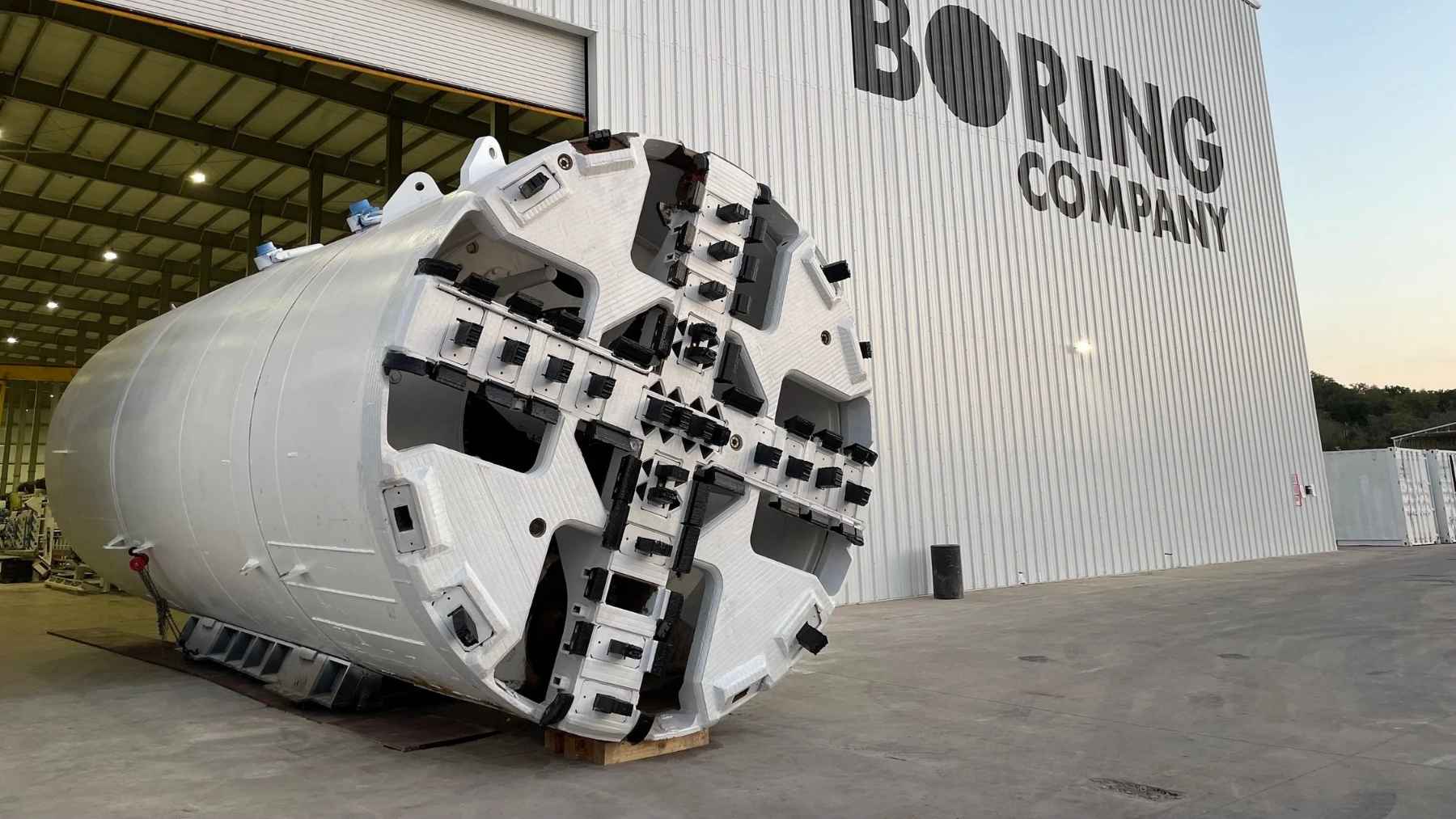
Precast lining is how most modern tunnels get built. The reason it matters more than usual here is the machine doing the installing. The company’s Prufrock borers place the rings as they excavate instead of stopping every few feet to build a section of wall, so by the time the cutterhead reaches the far end, the tunnel behind it is already finished.
Manufacturing your tunnel before you dig it sounds backwards until you look at where the industry is heading. Denmark is currently assembling an 11-mile Baltic crossing out of factory-cast concrete boxes, sunk onto the seabed one at a time. Concrete poured in a controlled plant beats concrete poured in a hole, and everyone building big underground stuff seems to have gotten the memo.
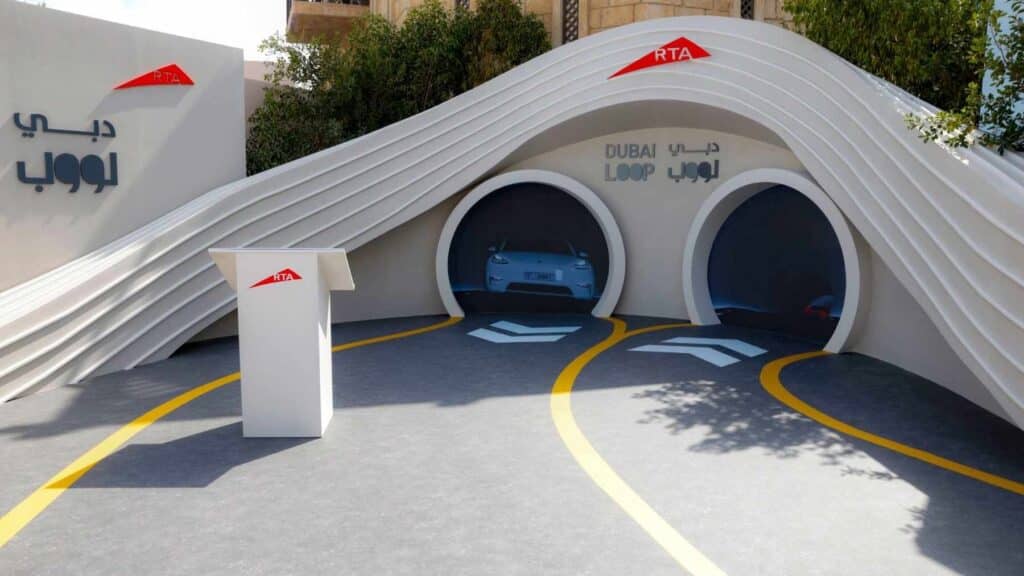
Four miles, four stations, three minutes
The pilot route runs 4 miles (6.4 km) with four stations: DIFC, ICD Brookfield Place, Za’abeel Dubai Mall Parking, and Burj Khalifa/Dubai Mall. The tunnels measure 12 feet (3.6 meters) across, sized for cars rather than trains, and Dubai’s Roads and Transport Authority has said the fleet will be autonomous Teslas. In Las Vegas, the same concept still runs on chauffeured Model Ys.
Run the math on the headline promise and it holds up. Four miles in three minutes is an 80 mph average, underground, with no lights and no cross traffic. The surface version of that trip takes around 20 minutes on a good day, which in Dubai traffic is not every day.
The RTA expects about 13,000 passengers a day on the pilot. The full network is designed to stretch up to 14 miles (22.5 km) with 19 stations, linking the World Trade Centre and the financial district with Business Bay, at a projected capacity of some 30,000 passengers a day.
One thing Loop is not is a subway with extra steps. There’s no shared train and no intermediate stops. You board at your station and the car drives straight to your destination, which is where the three-minute figure comes from.
The money is small by megaproject standards. Phase one is estimated at $154 million and the full route at $545 million, per the agreement The Boring Company and the RTA signed at the World Governments Summit on February 3. Dubai is spending $9.25 billion on the Gold Line extension of its metro, due in 2032. The entire Loop network pencils out to about 6% of that one project.
The same machines are already eating Nashville rock
The borers headed for this job are Prufrocks, the same all-electric machines The Boring Company has chewing under Nashville right now. They launch off a truck straight into the dirt, no launch pit, and run with nobody inside the tunnel during normal digging.
They’re also small on purpose. A Prufrock bore is 12 feet across, about the width of a single American highway lane, because a one-car tunnel doesn’t need a cathedral. For scale, the Chinese machine grinding under the Yangtze swings a 54-foot cutterhead and weighs close to 5,000 metric tons. A Prufrock is compact enough to build in Texas and ship abroad.
The Texas connection runs deeper than manufacturing. The Boring Company says its tunneling operations in both Las Vegas and Dubai are monitored and controlled remotely from its Operations Center in Bastrop, which the company says lets it “deliver more tunnel miles each year in the battle against soul-destroying traffic.” A machine in the Gulf, steered from a control room outside Austin.
Nothing is being excavated yet
What started this month is concrete production and groundwork, not digging. Back in February, the company said it needed approvals on roughly 48 permits and No Objection Certificates from about 10 different entities before boring can begin, with tunneling targeted for the second half of 2026. That deadline is now less than six months out.
The paper trail behind the project is real, though. The RTA and The Boring Company signed a study agreement at the World Governments Summit in 2025, then came back a year later with a definitive deal, signed by RTA Director General Mattar Al Tayer and the company’s global VP of business development, James Fitzgerald. Once design work wraps, the company estimates phase one takes about a year to deliver, and the full route about three.
Dubai is also the second city to get this system, as Khaleej Times notes, and the first outside the United States. Las Vegas was the proof of concept. Dubai is the export version, with a government construction contract attached instead of a convention authority.
Whether Loop counts as mass transit or a very fast valet service is a debate Las Vegas hasn’t settled in five years of operation. Dubai is about to run that experiment at city scale, with a client that doesn’t do decade-long reviews and a downtown that badly wants the traffic gone. The rings are stacking up in the yard, the machines are booked, and the permit pile is the only thing standing between 100 million pounds of concrete and the ground it was cast for.