
Digging a subway under a city means moving dirt, and moving dirt normally means trucks. Thousands of them, grinding through streets that never asked for a construction site, hauling spoil to a landfill somewhere past the edge of town.
Vienna ran its U2 extension the other way around. Everything the boring machine excavated came out through one central shaft at Matzleinsdorfer Platz rather than at points along the route, which the contractors reckon kept around 20,000 truck journeys off city streets and avoided about 75 metric tons of CO2.
A good chunk of that clay is now sitting in Austrian builders’ yards as bricks.
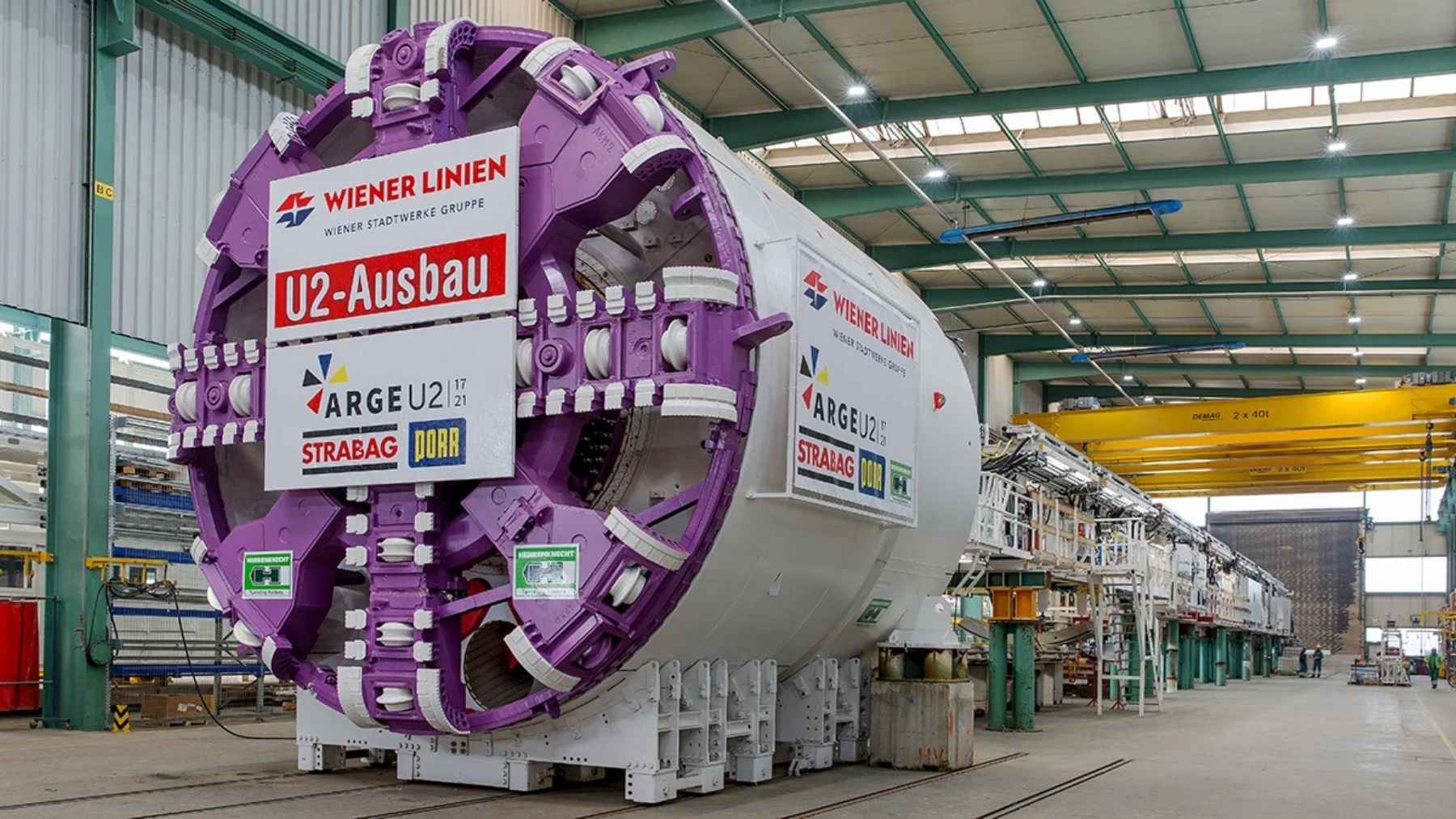
The machine that dug it is named Debohra. She weighs roughly 1,300 metric tons, about 1,430 US tons, and on July 10 she punched into the emergency shaft at Augustinplatz in Vienna’s seventh district for the second time in twelve months. The first time was July 2025, on the other track. This one closed out the second running tunnel, and with it the machine-bored portion of the entire first stage of the U2xU5 expansion, according to the STRABAG and PORR consortium building it.
Getting her back to the start was the awkward part
Boring machines do not reverse. When Debohra reached Augustinplatz in July 2025 with the first tube behind her, there was no backing her out and lining her up for the second one.
So the crews took her apart instead. Individual components were lifted out at Augustinplatz and driven across the city by road to the launch shaft at Matzleinsdorfer Platz, while the long trailing gantries behind the cutting shield were dragged back through the tunnel she had just finished.
Heavy-haulage contractor Felbermayr handled the road leg at the end of September 2025, using a tandem lift, a four-axle tractor unit and a ten-axle semi low loader over a route of roughly seven miles (11 km). The machine went back together at the launch shaft and restarted the second drive in the fall of 2025.
Nine months later she came out at Augustinplatz again, almost exactly a year after the first breakthrough.
Twenty-seven thousand parts and a purple cutting wheel
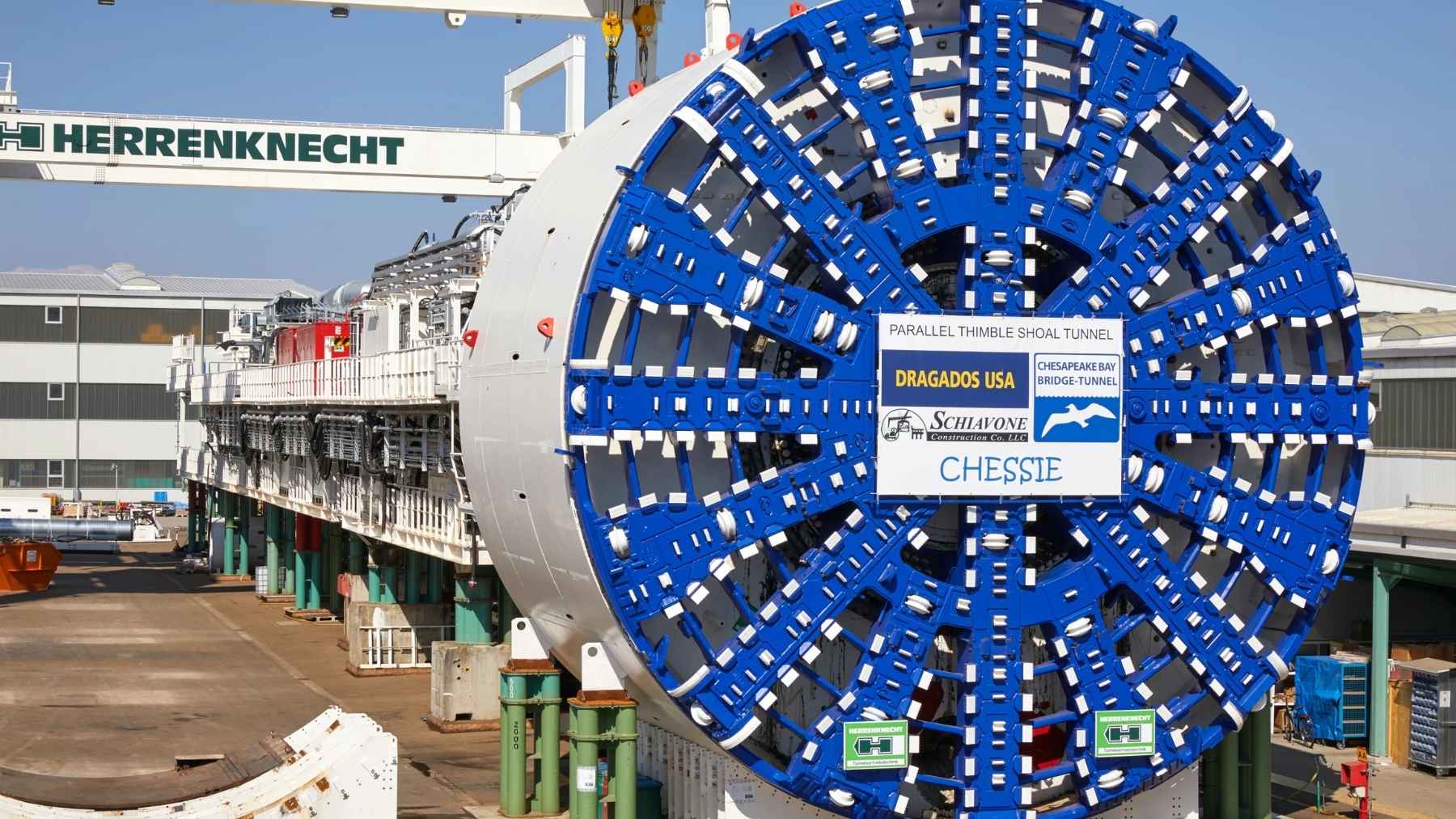
Debohra was built at Herrenknecht’s plant in Schwanau, Germany, and designed specifically for the ground under Vienna. She runs 417 feet long (127 m) and is assembled from roughly 27,000 individual parts. She arrived in early 2024 in pieces and was rebuilt inside the shaft at Matzleinsdorfer Platz.
She is an EPB shield, short for earth pressure balance, the type you reach for when the ground is soft and sticky rather than hard rock. Ralph Lickert, project manager at Herrenknecht, called it “the optimal machine type for the predominantly clayey geology” the site investigations had predicted.
That geology is the Wiener Tegel, the stiff, clay-rich layer sitting under much of the city. Debohra worked through it almost entirely underground.
Excavation diameter is 22.4 feet (6.84 m). The cutting wheel is a touch wider at 22.6 feet (6.88 m), weighs about 86 US tons (78 metric tons) and carries roughly 40 disc cutters and 100 scraper knives, per figures published by Austrian construction title SOLID alongside the project’s own photographs. It is painted purple, which is the color the U2 wears on Vienna’s network map.
Cutterhead drive power is 1,920 kilowatts, around 2,575 horsepower, and Wiener Linien says the machine managed up to 33 feet (10 m) of progress a day.
Behind the cutting wheel she builds the tunnel as she goes, bolting precast concrete segments into rings against the ground she has just cleared. Across six separate drive sections the consortium installed 2,850 of those rings, made up of around 17,000 individual segments. The first tube alone accounted for 1,495 rings and 8,970 segments, six to a ring, over 1.3 miles (2.1 km). Both tubes together come to 2.6 miles (4.2 km).
The clay she dug is already on sale as bricks
Wiener Linien and brickmaker Wienerberger set up an arrangement to keep the spoil out of a landfill. About 45,800 cubic yards (35,000 m3) of Viennese clay excavated by Debohra has been handed over to Wienerberger so far.
It travels to two plants, Hennersdorf outside Vienna and Göllersdorf in Lower Austria, hauled by Koller Transporte-Kies-Erdbau, a PORR subsidiary. There it gets processed the way clay from a conventional pit would be.
The result is roughly 2.8 million bricks, which the city and the company put at enough material for around 1,000 single-family houses. Production started in March 2026 and the bricks have been available through normal builders’ merchants since May.
Two things to keep straight before anyone calls this a closed loop. Wienerberger’s own description says the tunnel material is blended into the clay mix from its existing pits rather than used on its own. And the 35,000 cubic meters is the quality-checked material handed over to date, not the total excavated from both tubes.
For scale on that, Austrian outlet Vienna.at reported 83,000 cubic meters of ground removed during the first tube alone, around 108,600 cubic yards. The brick clay is a slice of the spoil, not all of it, and more is due as it clears testing.
Johann Marchner, country managing director of Wienerberger Austria, has told Austrian trade press that the bricks meet the company’s normal standards for structural performance, insulation and acoustics, and that he would rather not describe them as a pilot product at all.
Herrenknecht builds a lot of what digs under America
By the standards of what that same factory ships to the United States, Debohra is a mid-sized machine. The German borer being bolted together in a New Jersey trench for the Hudson Tunnel Project carries a cutterhead over 28 feet across, and the rock waiting for it is abrasive enough to wear out cutters every couple of days. The 54-foot machine Herrenknecht finished for San Jose is larger still, wide enough to carry both tracks and two station platforms inside a single tube.
The four machines assigned to New York’s new Hudson River rail tunnel come from the same manufacturer, arranged in two pairs with different cutterheads for very different ground.
American water tunnels have their own naming habit too. Nora, the Robbins machine that bored the Delaware Aqueduct bypass under the Hudson, was rated at upwards of 2.7 million pounds, or about 1,350 US tons. Line the units up and Debohra, at roughly 1,430 US tons, is the heavier of the two.
Herrenknecht says its machines have bored more than 3,000 kilometers of metro tunnel across over 1,300 projects, including 22 machines on the Grand Paris Express and 15 on Sydney Metro.
The hole is finished. The subway is not.
A breakthrough photo makes a project look done. What Debohra leaves behind is the bored shell of two tubes.
Track, power, ventilation, smoke extraction, safety systems, cross passages and the interior fit-out of four new stations all come next, followed by testing and commissioning. Those stations are Matzleinsdorfer Platz, Reinprechtsdorfer Straße, Pilgramgasse and Neubaugasse.
The machine-bored stretch also stops at Augustinplatz. The section onward toward Rathaus was built by conventional mined tunnelling rather than by Debohra, and that work is already complete, as is the U5 tunnel between Rathaus and Frankhplatz. Across the whole first stage it adds up to a bit over three miles (5 km) of new U2 and U5 route.
Passenger service on the extended U2 to Matzleinsdorfer Platz is scheduled for 2030. When the STRABAG and PORR consortium won the contract in late 2020, the announced completion date was 2028; SOLID reported in 2025 that geological conditions pushed the first stage out by two years. That 2030 date was fixed before July’s breakthrough, and the breakthrough did not move it.
Debohra is being dismantled at Augustinplatz now, and the parts go back to Schwanau to be overhauled for the next job. Vienna got two tunnels out of her, kept 20,000 truck trips off its streets and put a few million bricks on the market from the hole she left. Not a bad haul for a machine that has to be taken to pieces every time it wants to turn around.