
There’s a pretty simple rule for fixing anything that sits at the bottom of a lake: get rid of the lake first. You drain it, let the mud firm up a bit, and send people down there with wrenches and a crane. Engineers call it working in the dry, and as you’d expect, it’s how almost everyone would rather do it.
Hydro Tasmania didn’t get that option at Lake Trevallyn. The lake sits on the edge of Launceston, in northern Tasmania, and it isn’t only there to spin turbines. TasWater draws Launceston’s drinking water from it, local farmers irrigate with it, and plenty of people use it for recreation. Draining it would have hit all of them, cost the utility extra money, and, as Hydro Tasmania put it a little more politely, made life muddy for the people living nearby.
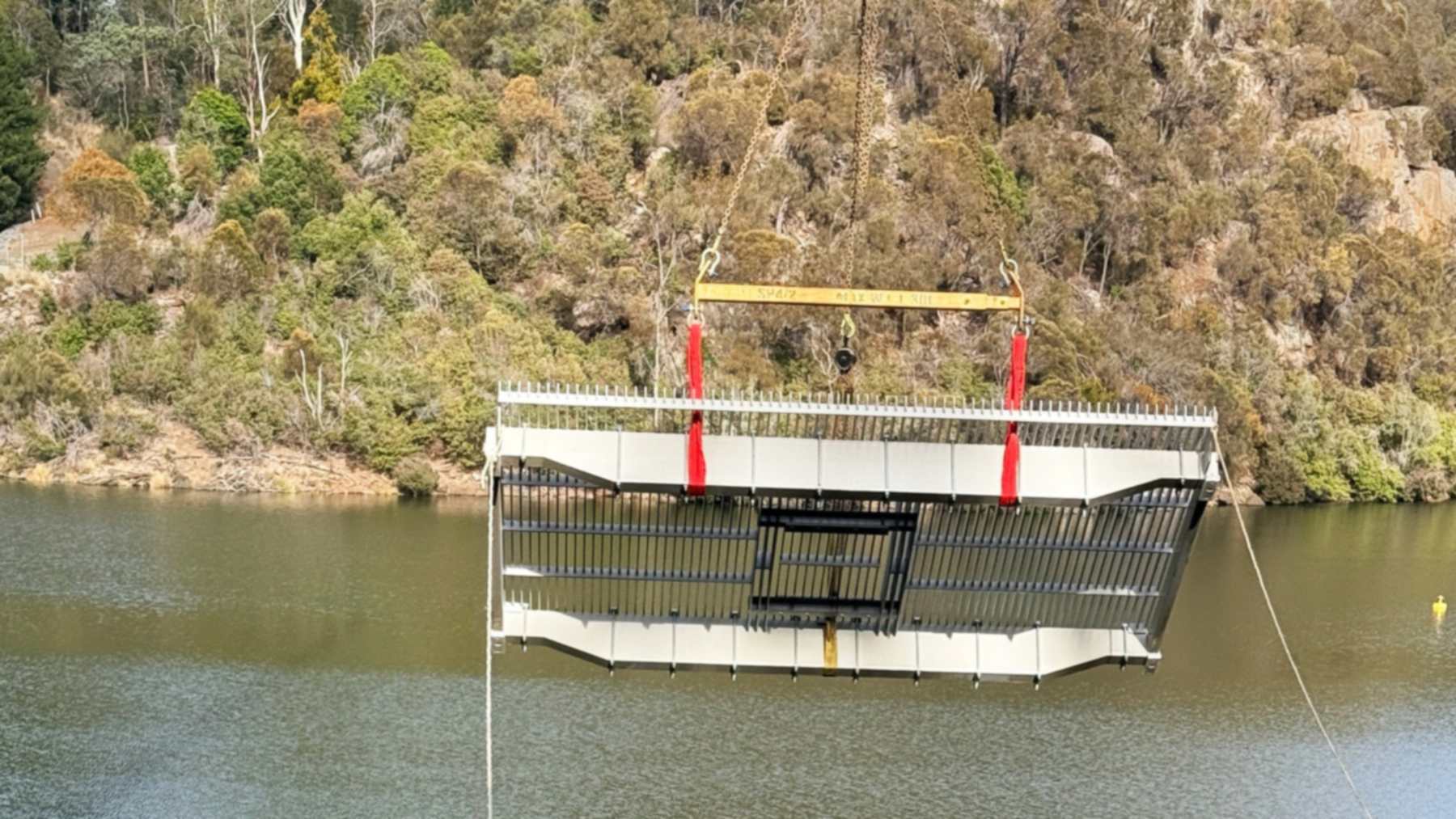
So when the steel screen guarding the intake of the Trevallyn Power Station needed replacing, the whole job happened underwater, with the lake held in its normal operating range. The new screen is about 46 feet tall and 39 feet wide. Divers fitted it roughly 59 feet down, with a crane on the surface lowering the steel to them and visibility that, by Hydro Tasmania’s account, didn’t stretch much past 20 inches.
The work wrapped up in April. Then in September, the project made the shortlist for Project of the Year at Engineers Australia’s Tasmanian excellence awards, which is a decent excuse to look at how they pulled it off.
So what does a trash rack actually do?
Every hydro plant has a spot where water leaves the lake and heads for the turbines. A trash rack is basically a big steel grate over that opening, so logs, rocks and branches get stopped at the door instead of being sucked into machinery that really doesn’t want to eat a tree.
At Trevallyn, there’s a lot of water pulling that debris along. Jesse Clark, Hydro Tasmania’s executive general manager for assets and infrastructure, told Pulse Tasmania the station passes roughly 26,000 gallons of water a second. He compared it to filling an Olympic-size pool in under 30 seconds.
Trevallyn is a run-of-river plant, which basically means it doesn’t stockpile much water behind its dam. It works with whatever the river sends down each day, and Hydro Tasmania rates its four turbines at 102.8 megawatts combined.
The station’s been running for more than 70 years. Parts of its old trash rack weren’t far behind it.
The old beams were cast into the concrete
Swapping a trash rack without draining the lake has been done before. What made Trevallyn awkward was the way the original was built. The steel beams that held the old screen weren’t bolted to the intake. They were cast straight into its concrete.
“They can’t be unbolted,” Eli Pharaoh, a mechanical design engineer at Entura, Hydro Tasmania’s in-house engineering consultancy, said in Hydro Tasmania’s write-up of the project. The alternative was having divers hack them out with cutting gear and then work out how to anchor new supports into whatever concrete was left, all at the bottom of a lake.
So the team went with what Entura’s engineers call the “big frame” idea. Instead of replacing beams and panels one at a time, they built a prefabricated steel frame, also about 46 by 39 feet, that fits around the intake opening. That frame carries its own mounting points for the new beams and all eight screen panels, so it doesn’t matter how rough or uneven the old concrete behind it is.
“As long as the frame goes in square, everything else lines up,” Pharaoh said in an Entura article published in May.
Anyone who’s hung a door in an old house will get this right away. The walls are never square. So you buy a pre-hung door that comes with its own frame, shim that frame until it’s level, and the door swings fine. Trevallyn’s version is a lot heavier and lives 59 feet underwater, but it’s pretty much the same trick.
The station kept running for the first half
The job ran in two stages, and the first one happened while the plant was still generating at reduced capacity. Divers installed the new frame upstream of the old rack, so the old screen kept doing its job while they worked in front of it. According to Entura’s project page, that stage covered most of the slow stuff: underwater drilling, around 50 anchors, lining the frame up and patching the concrete.
Leaving one turbine running helped in a less obvious way, too. It kept sediment moving, so the divers could actually see what they were doing, and Hydro Tasmania says the station could go back to full output overnight.
It’s a similar approach to the one at Barkley Dam in Kentucky, where the Army Corps is rebuilding one generator at a time so the other three can keep selling power.
So why not shut the whole station down and get it over with?
Because a hydro plant that’s switched off isn’t making any money, and a plant that runs on daily river flow can’t bank the water for later. Hydro Tasmania even warned locals back in February that the dam could spill into the river below during the works if the station went into a full outage while inflows were high.
With the frame already in place, the full shutdown came down to about 10 days. The old rack came out, the new panels went in, and Entura says that full outage had originally been estimated at about five weeks. For a station that only earns when water’s going through it, I’d call that the number that matters most here.
The divers had to do every job on the list
Everything underwater takes longer, and the drawings stayed up on the boat with the dive supervisor rather than going down with the divers. Pulse Tasmania reported that the divers wore helmet cameras, so the people up top could watch and talk them through each step.
Clark’s description of the divers’ workload in Hydro Tasmania’s announcement was that “they’re riggers, fitters, welders and surveyors.” On land, that’s four different crews. Riggers handle the slings and lifting gear, fitters line parts up and bolt them together, and surveyors check that everything ended up where the drawings say it should be.
So the design pushed as much work as possible out of the water. Big sections of the frame were put together in a workshop before they went in, which cut the number of bolts divers had to tighten underwater to roughly 30. Every bolt counts down there. Where that count started depends on which write-up you read. Hydro Tasmania and an Entura news post put it at something like 150, while Entura’s project page says around 250.
Lachlan Osborne, the dive supervisor from Tasmanian Divers Group, told Entura he’d spent 20 years as a saturation diver in oil and gas (those are the divers who live under pressure for weeks at a time to work deep offshore) and had never seen a job this complicated go in as cleanly. Coming from someone with that background, I’d take that pretty seriously.
Then the paint got in the way
The new steel didn’t get a traditional galvanized finish. Galvanizing is basically a zinc coating that corrodes first so the steel underneath doesn’t, and it’s what you’ll find on most outdoor hardware at your local home improvement store. Hydro Tasmania went with a thick protective paint reinforced with glass fiber instead, because it’s meant to hold up better underwater.
The catch is that thick paint doesn’t go on perfectly evenly. Tiny differences in coating thickness along beams more than 46 feet long added up, and by the far end the structure had a bow of about an inch. Pharaoh compared the result to a banana.
An inch doesn’t sound like much. But this is a frame whose entire purpose is to go in square, so the divers loosened some of the bolts and used underwater winches to pull the structure back into line.
Frankly, I’d argue that’s the most relatable moment of the whole project. You know the feeling if you’ve ever built a shelf that measured fine on paper and still wobbled on the wall. The divers had to sort theirs out 59 feet down, by feel, in murky water.
There are a few gaps in the record
I’d love to tell you what all that steel weighs, but neither Hydro Tasmania nor Entura has published a figure, and I’m not going to guess from the size of the crane. Hydro Tasmania did put the cost of the upgrade at 2.5 million Australian dollars.
The age of the old rack is a little fuzzy, too. Hydro Tasmania’s announcement calls it 30 years old, while the utility’s own engineering write-up and Entura both say parts of it dated back close to 60. My best guess is that the screen panels had been replaced once before and the beams cast into the concrete were the originals, but I can’t find anything that spells that out.
Pharaoh has also been upfront that the big frame won’t suit every dam. It made sense at Trevallyn because of a very particular mix of problems: a lake shared with a city’s water supply, farmers and recreation, supports cast into the concrete and a tight window for shutting the station down.
The bit I find arguably smartest is what happens next time. The frame and its anchor points stay put, and Entura says the next replacement should be much more straightforward because of them. It’s a bit like the Holyoke Dam on the Connecticut River, where new rubber crest sections are being bolted onto a foundation poured 25 years ago.
Entura announced on September 18 that the Trevallyn trash rack replacement was a finalist for Project of the Year at the Engineers Australia Excellence Awards in Tasmania. If the new coating lasts as long as Hydro Tasmania expects, the screen should stay in service for about 40 years.